
Why Part Numbers Matter More Than You Think
When you first start building circuits, you might search for a basic electronic components parts number list 2024 to stock your lab. But as we navigate the semiconductor landscape in 2026, component lifecycles, package variations, and suffix codes mean that a static list isn't enough. A part number is not just a random string of characters; it is a precise DNA sequence that tells you the manufacturer, the silicon revision, the packaging type, and the operating temperature range.
Ordering the wrong variant of a microcontroller or logic chip can result in a board that physically won't fit your breadboard, or worse, a circuit that fails catastrophically when exposed to summer heat. This tutorial will teach you how to decode part numbers like a senior engineer, ensuring your 2026 beginner projects are built on a foundation of correct, authentic, and optimally specified components.
The Anatomy of a Component Part Number
Most integrated circuits (ICs) follow a standardized naming convention consisting of three main segments: the Prefix, the Base Number, and the Suffix. Let's break down a classic component you will find on almost every beginner's list: the SN74HC595N.
- Prefix (SN): Indicates the manufacturer and the specific product family. In this case, 'SN' denotes Texas Instruments' standard commercial logic line.
- Base Number (74HC595): The core identifier. '74' signifies commercial-grade logic (as opposed to '54' for military-grade). 'HC' stands for High-speed CMOS, and '595' identifies the specific function (an 8-bit shift register).
- Suffix (N): The package and temperature code. 'N' specifically means a Plastic Dual In-Line Package (PDIP), which is the through-hole chip you can plug directly into a solderless breadboard.
Pro-Tip for Beginners: If you accidentally order the
SN74HC595Dinstead of theSN74HC595N, you will receive a Surface Mount Device (SMD) SOIC-16 package. It has the exact same silicon inside, but the pins are spaced at 1.27mm and require a custom PCB or messy dead-bug soldering, making it useless for breadboard prototyping.
The Beginner’s Core Inventory: 2026 Standard Parts List
Below is an updated, highly specific inventory for a modern electronics workbench. Prices reflect early 2026 distributor averages (e.g., Mouser, Digi-Key) for single-unit, hobbyist quantities.
| Part Number | Manufacturer | Function | Package | Avg 2026 Price |
|---|---|---|---|---|
NE555P |
Texas Instruments | Precision Timer | PDIP-8 | $0.15 - $0.22 |
LM358P |
Texas Instruments | Dual Op-Amp | PDIP-8 | $0.25 - $0.35 |
ATMEGA328P-PU |
Microchip | 8-bit AVR MCU | PDIP-28 | $2.85 - $3.20 |
ESP32-S3-WROOM-1 |
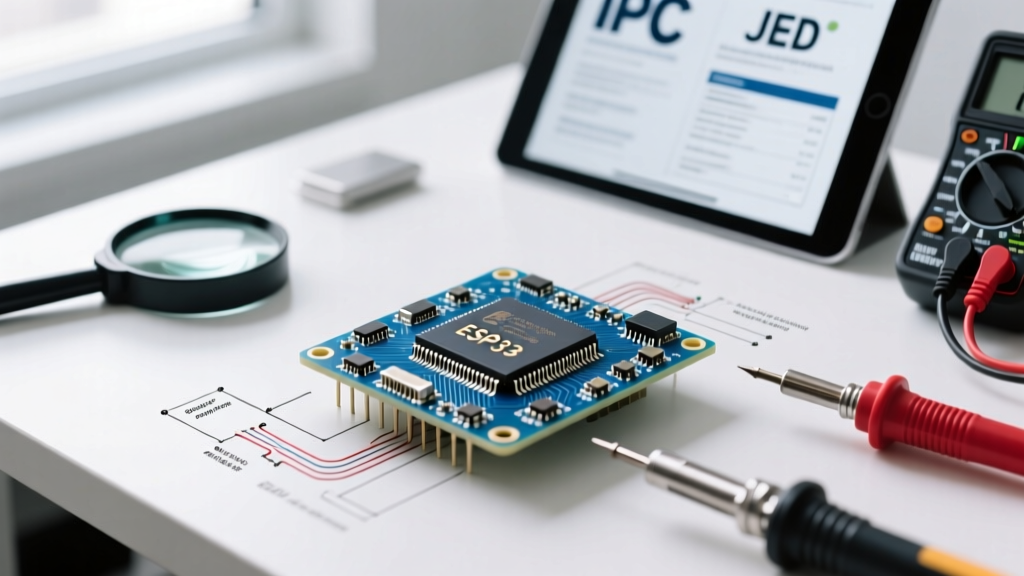
Espressif | Wi-Fi/BLE 5.0 MCU | SMD Module | $3.10 - $3.60 |
SN74HC595N |
Texas Instruments | 8-Bit Shift Register | PDIP-16 | $0.45 - $0.60 |
L7805CV |
STMicroelectronics | 5V Linear Regulator | TO-220 | $0.30 - $0.45 |
Deep Dive: The ATMEGA328P-PU vs. ATMEGA328P-AU
Notice the suffix difference on the Microchip MCU. The -PU suffix designates a 28-pin PDIP (through-hole) package, perfect for inserting into a ZIF socket on an Arduino Uno clone. The -AU suffix designates a 32-pin TQFP surface-mount package. While the TQFP version has slightly more I/O pins exposed, it requires a stencil, solder paste, and a hot air rework station to mount. Always verify the suffix against your assembly method.
Temperature Grades: The Hidden Spec Killer
A common mistake when referencing older component lists is ignoring the temperature grade, which is often buried in the prefix or suffix. According to Texas Instruments naming conventions, logic families are split into distinct thermal buckets:
- Commercial (0°C to 70°C): Usually denoted by standard prefixes (e.g.,
LM,SN74). Fine for indoor DIY projects and desktop gadgets. - Industrial (-40°C to 85°C): Often denoted by an 'I' in the suffix or specific prefixes. Required for outdoor weather stations, automotive dashboards, or garage-based deployments.
- Automotive (-40°C to 125°C): Denoted by a 'Q' (e.g.,
SN74HC595Q). Overkill for most beginners but necessary if your project lives under a car hood.
If you are building an automated greenhouse watering system using an LM358 op-amp, and the greenhouse drops to -5°C in the winter, the commercial-grade silicon will drift out of spec or fail entirely. You must specifically order the industrial-rated variant (e.g., LM358I or equivalent industrial spec from the manufacturer).
Sourcing Parts Without Getting Counterfeits
As supply chains fluctuate, the secondary market is flooded with counterfeit silicon. The Electronic Resellers Association International (ERAI) consistently reports that counterfeit ICs—where the top of a cheap chip is sanded down and reprinted with a premium part number—pose a massive risk to hobbyists and professionals alike.
The Safe Sourcing Hierarchy
- Franchised Distributors (Tier 1): Mouser, Digi-Key, Farnell, and Arrow. They source directly from the manufacturer. You pay a slight premium for single units, but the silicon is guaranteed authentic. For project BOMs and verified tutorials, Digi-Key's educational resources highly recommend sticking to authorized channels for microcontrollers and power management ICs.
- Direct from Manufacturer Storefronts: Espressif, Adafruit, and SparkFun sell direct or through verified partners.
- Marketplaces (Tier 3 - High Risk): AliExpress, eBay, and Amazon third-party sellers. Never buy power regulators (like the
L7805CV) or safety-critical optocouplers from these sources. Counterfeit voltage regulators frequently lack internal thermal shutdown circuitry, leading to literal fires when they short out.
Frequently Asked Questions (FAQ)
What does the 'P' mean at the end of a TI part number like NE555P?
The 'P' (or 'N' in newer nomenclature) stands for Plastic DIP (Dual In-Line Package). It means the chip has two parallel rows of through-hole pins spaced at 0.1 inches (2.54mm), making it perfectly compatible with standard solderless breadboards and perfboards.
Can I use an automotive-grade chip instead of a commercial one?
Electrically, yes. An automotive-grade SN74HC595Q will function identically to a commercial SN74HC595N on a breadboard. However, automotive parts are more expensive and sometimes only available in surface-mount packages (like SOIC or TSSOP) rather than beginner-friendly through-hole DIP packages.
Why do some part numbers have a 'G' or 'Z' at the very end?
Suffixes like 'G' (e.g., SN74HC595NG) typically denote 'Green' or RoHS-compliant packaging, meaning the component is manufactured without lead (Pb) in the solder finishes. In 2026, virtually all newly manufactured components are RoHS compliant, but older stock or specific military-spec parts may still use leaded finishes, which require different soldering iron temperature profiles.