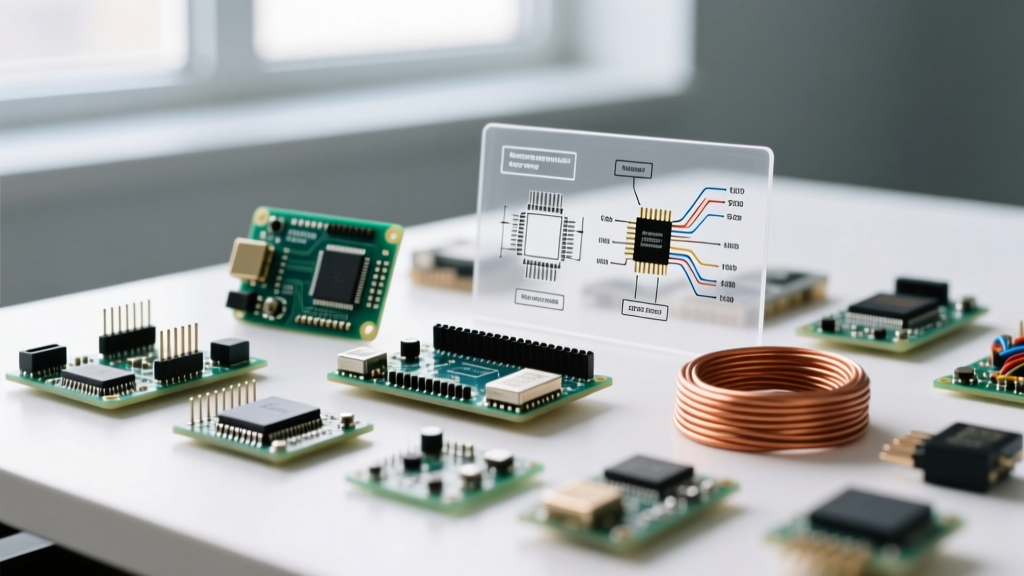

The Hidden Costs of End-of-Life (EOL) Sourcing in 2026
When a critical legacy IC on your bill of materials (BOM) receives a Product Discontinuance Notice (PDN), engineering teams face a high-stakes dilemma. Do you spend $25,000 and six months redesigning the PCB, or do you hunt down the remaining global inventory? Navigating the landscape of obsolete electronic component suppliers requires a deep understanding of supply chain mechanics, authentication protocols, and financial trade-offs. Unlike standard distribution channels like Digi-Key or Mouser, the obsolete market is heavily fragmented, ranging from fully franchised post-silicon manufacturers to unvetted gray-market brokers.
In this guide, we compare the leading alternatives for sourcing end-of-life (EOL) semiconductors, evaluating their authentication rigor, pricing models, and ideal use cases for hardware engineers and procurement specialists.
Franchised vs. Independent Obsolete Electronic Component Suppliers
The most critical distinction in the EOL market is the difference between franchised/authorized suppliers and independent distributors. This distinction directly impacts your risk exposure to counterfeit components—a market that costs the global electronics industry billions annually, according to data tracked by ERAI.
The Franchised Heavyweights: Rochester Electronics and Flip Electronics
Franchised suppliers operate with the explicit intellectual property (IP) licensing and authorization of the original component manufacturer (OCM).
- Rochester Electronics: Rochester operates on a unique 'post-silicon' manufacturing model. When an OCM like Texas Instruments or Analog Devices sunsets a product line, Rochester frequently purchases the original wafers, die, masks, and test programs. They package and test the silicon to the exact original specifications. Because they manufacture from original IP, their parts are 100% authentic and carry the original OCM's warranty. However, lead times for custom post-silicon runs can stretch from 8 to 16 weeks, and minimum order quantities (MOQs) can be steep.
- Flip Electronics: Flip focuses on supply chain buyouts. They purchase remaining authorized inventory directly from OEMs, EMS providers, and original manufacturers. If a company over-ordered a legacy Xilinx FPGA in 2023 and discontinues their product line in 2025, Flip buys the sealed, traceable reels. They are the best alternative for finding large quantities of factory-sealed EOL parts, though their inventory is finite and non-replenishable.
The Independent and Hybrid Brokers: Win Source and Smith & Associates
Independent suppliers do not hold direct IP licenses from the OCMs. Instead, they rely on vast global networks to locate new-old-stock (NOS), pulled, or refurbished components.
- Win Source: Operating with a massive footprint in Asian markets, Win Source excels at rapid fulfillment. If you need 5,000 units of an obsolete Intel 80C196KC microcontroller by Friday, Win Source can often source them. However, the risk of 'remarked' or 'pulled' (desoldered from scrap PCBs) components is significantly higher. They rely on internal testing labs rather than OCM traceability.
- Smith & Associates: A prominent independent distributor that offers robust quality control and counterfeit avoidance programs. They act as a high-tier broker, often bridging the gap between the speed of the gray market and the safety of franchised distributors, though at a premium brokerage fee.
Head-to-Head Supplier Comparison Matrix
| Supplier | Sourcing Model | Typical Lead Time | Price Premium | Auth. Guarantee | Best Use Case |
|---|---|---|---|---|---|
| Rochester Electronics | Post-Silicon Mfg / IP Licensed | 8 - 16 Weeks | High (2x - 5x) | 100% (OCM Backed) | Aerospace, Medical, Long-term lifecycle support |
| Flip Electronics | Authorized Supply Chain Buyouts | 1 - 4 Weeks | Medium (1.5x - 3x) | 100% (Traceable) | Automotive, Industrial, High-volume production runs |
| Win Source | Independent / Global Network | 24 - 72 Hours | Low to Variable | Internal Lab Tested | Prototyping, Consumer electronics, Emergency line-down |
| Smith & Associates | Independent / Vetted Broker | 3 - 10 Days | Medium | AS5553 Compliant | Enterprise IT, Telecom, Mid-volume manufacturing |
Authentication and Counterfeit Mitigation
When sourcing from independent obsolete electronic component suppliers, counterfeit mitigation is non-negotiable. The SAE AS5553 standard outlines rigorous testing protocols for suspect parts. If you are procuring legacy components like the Analog Devices AD534 multiplier or older Xilinx Spartan-3 FPGAs from non-franchised sources, demand the following testing documentation:
Expert Insight: Never rely solely on visual inspection. Modern counterfeiters use high-precision CNC milling and laser etching to replicate OCM logos and date codes on sanded-down, cheaper alternative ICs. Always require X-ray and decapsulation reports for high-value obsolete silicon.
Advanced Testing Methodologies
- X-Ray Fluorescence (XRF) and Radiography: X-ray inspection verifies the internal wire bonding structure and die size. A remarked counterfeit might have the external markings of a 14-bit ADC, but the X-ray will reveal the smaller, cheaper die of an 8-bit ADC inside the package.
- Decapsulation (Decap): Using fuming nitric acid or sulfuric acid, the top epoxy layer of the IC is dissolved to expose the silicon die. Inspecting the die under a high-powered microscope reveals the OCM's proprietary copyright logos and exact die revision numbers, which are nearly impossible for counterfeiters to replicate at the nanometer scale.
- Electrical Parametric Testing: Testing the component across the full military or industrial temperature range (-55°C to +125°C) to ensure it meets the original datasheet specifications, rather than just room-temperature functionality.
Real-World Sourcing Scenarios and Pricing Realities
To understand the financial impact, let us examine two common 2026 sourcing scenarios for obsolete components:
Scenario A: The Legacy Microcontroller (Intel 80C196KC)
Your industrial control board relies on the 80C196KC, a part that has been EOL for over a decade.
Rochester Electronics may not hold the IP for this specific Intel architecture, leaving you to rely on the secondary market. Win Source might quote $18 per unit, but these are often 'pulled' from recycled e-waste boards, cleaned, and re-tinned. The failure rate in high-vibration environments can exceed 4%.
Smith & Associates might source factory-sealed NOS from a defunct European HVAC manufacturer for $65 per unit, fully tested and backed by an AS5553 guarantee.
Scenario B: The Precision Analog IC (Analog Devices AD534)
The AD534 is a classic precision multiplier. Rochester Electronics holds the IP and can manufacture it fresh from original wafers. The cost will be roughly $110 per unit with a 12-week lead time, but it comes with a full Analog Devices traceability certificate. For a medical device requiring FDA compliance, this premium is mandatory.
Strategic Alternatives to Buying Obsolete Silicon
Before committing to a long-term contract with obsolete electronic component suppliers, engineering managers should run a 'Redesign vs. Source' financial analysis. Market intelligence platforms like SiliconExpert provide vital lifecycle forecasting to help make this decision.
When to Redesign the PCB
If the obsolete part is a standard logic gate, a linear regulator (like the legacy LM317 variants), or a basic microcontroller, redesigning is usually the superior choice. A $20,000 NRE (Non-Recurring Engineering) cost for a PCB respin is easily amortized if it eliminates a $40 per-unit premium on an obsolete IC over a 5,000-unit production run.
When to Stick with Obsolete Suppliers
Redesign is rarely viable if the obsolete component is a highly specialized ASIC, a complex FPGA with thousands of hours of proprietary HDL code tied to its specific architecture, or if the end-product is a legacy military/aerospace system where recertification costs exceed $250,000. In these cases, establishing a lifetime buy (LTB) through a franchised supplier like Flip or Rochester is the only logical path.
Final Verdict: Aligning Suppliers with Your BOM
Choosing the right partner among obsolete electronic component suppliers depends entirely on your industry's risk tolerance and regulatory environment. For medical, aerospace, and automotive applications where a single counterfeit IC could result in catastrophic failure or severe regulatory penalties, Rochester Electronics and Flip Electronics are the undisputed leaders. Their franchised models eliminate the gray market risk entirely.
Conversely, for consumer electronics, rapid prototyping, or legacy IT maintenance where speed and cost outweigh absolute traceability, vetted independent brokers like Smith & Associates or Win Source provide the agility required to keep production lines moving. Always mandate SAE AS5553 testing protocols when venturing outside the franchised ecosystem, and never compromise on decapsulation and X-ray verification for high-value legacy silicon.


