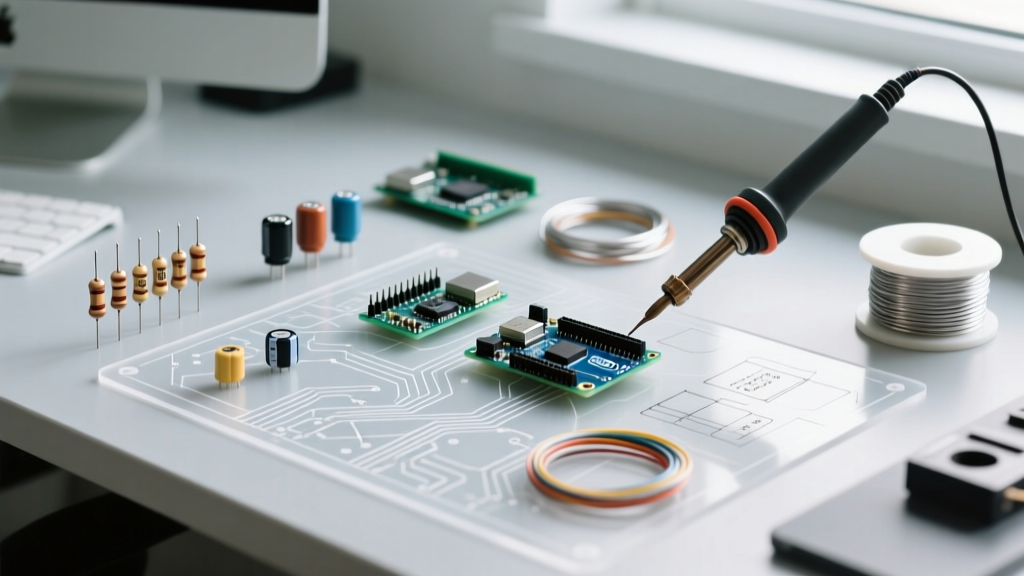

The Strategic Approach to Your First Electronic Component List
Every successful hardware prototype begins long before the soldering iron heats up; it starts with a meticulously curated electronic component list. Many beginners fall into the trap of purchasing massive, unorganized Amazon assortment kits filled with 5% tolerance carbon film resistors and unbranded, out-of-spec capacitors. While these kits seem cost-effective, they often lead to erratic circuit behavior, excessive noise in analog signals, and frustrating debugging sessions.
As we navigate the prototyping landscape in 2026, the shift toward low-voltage logic (3.3V and 1.8V) and high-speed RF designs (like Wi-Fi 6 and BLE 5.3) demands higher precision from your passive and active components. This guide will help you build a professional-grade electronic component list that balances cost, reliability, and modern design requirements.
Core Passives: Beyond the Generic Assortment
Passive components form the backbone of signal conditioning and power decoupling. When building your inventory, prioritize tolerance, temperature coefficient, and dielectric material over sheer quantity.
Resistors: Metal Film and Precision
For general-purpose through-hole prototyping, 1/4W (0.25W) Metal Film resistors with 1% tolerance are the undisputed standard. Unlike carbon composition resistors, metal film offers low noise and excellent temperature stability (typically ±50 ppm/°C).
- The E12 vs. E24 Series: For a starter lab, the E12 series (12 values per decade: 10, 12, 15, 18, 22, 27, 33, 39, 47, 56, 68, 82) is sufficient. You can combine them in series/parallel for intermediate values.
- Recommended Brand: Yageo or Panasonic (e.g., Panasonic ERA-3AEB series for SMD, or their metal film through-hole equivalents).
- Cost Expectation: $12 to $18 for a comprehensive 1,000+ piece E12 laboratory book from authorized distributors.
Capacitors: The Hidden Trap of MLCC DC Bias
According to Electronics Tutorials on Capacitor Types, selecting the right dielectric is critical. Multi-Layer Ceramic Capacitors (MLCCs) are ubiquitous, but their dielectric class dictates their behavior. As noted in SparkFun's Electronics Tutorials, understanding how components react under stress is key to robust design.
- C0G/NP0 (Class I): Use these for timing circuits, oscillators, and RF filters. They exhibit zero capacitance shift with voltage or temperature.
- X7R/X5R (Class II): Ideal for power supply decoupling. However, beware of DC Bias. A 10µF X5R 0805 capacitor rated for 16V might only provide 2µF of actual capacitance when 10V is applied. Always oversize the voltage rating by at least 3x for power rails.
- Electrolytic: Stock low-ESR aluminum electrolytics (e.g., Nichicon PW series or Rubycon ZL series) for bulk power filtering. Avoid generic unbranded caps, which suffer from high Equivalent Series Resistance (ESR) and premature drying.
Active Components: Modernizing Your IC Inventory
The era of relying solely on the 5V ATmega328P or the classic LM317 linear regulator is fading. Your electronic component list must reflect modern 3.3V logic and high-efficiency power management.
Voltage Regulators
While the LM317T is a legendary adjustable linear regulator, it has a high dropout voltage (up to 2.5V) and requires a minimum load current to regulate properly. For modern 3.3V and 5V prototyping, stock Low Dropout Regulators (LDOs).
Expert Insight: The Microchip MCP1700-3302E/TO (3.3V, 250mA) and the Texas Instruments LM1117-3.3 (800mA) are vastly superior for low-power microcontroller projects, offering dropout voltages under 0.6V and requiring minimal external quiescent current.
Transistors and MOSFETs
When switching loads with modern 3.3V microcontrollers (like the ESP32-C6 or Raspberry Pi RP2350), standard MOSFETs like the IRF520 will fail to turn on fully, leading to thermal runaway. You must select Logic-Level MOSFETs.
- N-Channel Logic Level: IRLZ44N or STP55NF06L. Look for a Gate-Source Threshold Voltage (Vgs(th)) that guarantees full Rds(on) at Vgs = 2.5V or 4.5V.
- BJTs: The 2N3904 (NPN) and 2N3906 (PNP) remain essential for low-current switching and basic amplification. Stock them in TO-92 packages.
Electromechanical and Interconnects
A prototype is only as reliable as its connections. Breadboard jumper wires are notorious for intermittent contact issues. Elevate your prototyping by standardizing your connectors.
| Connector Type | Use Case | Recommended Part / Brand | Why It Matters |
|---|---|---|---|
| JST-PH (2.0mm) | Battery connections, sensor modules | JST S2B-PH-K-S | Secure locking mechanism; prevents accidental reverse polarity if keyed correctly. |
| JST-XH (2.54mm) | PCB-to-PCB, stepper motors | JST XH series | Matches standard 0.1" header pitch but offers a positive latch. |
| Tactile Switches | User inputs, reset buttons | Omron B3F series | Superior tactile feedback and 100,000+ cycle lifespan compared to generic clones. |
Sourcing Strategy: Authorized Distributors vs. Marketplaces
When finalizing your electronic component list, where you buy is just as important as what you buy. The secondary market is flooded with counterfeit components. Fake FTDI USB-to-Serial chips can brick when drivers update, and counterfeit LM2596 buck converters often lack proper overcurrent protection, posing fire hazards.
For critical ICs, microcontrollers, and precision analog components, always order from authorized distributors like Digi-Key, Mouser, or Farnell. Utilizing Digi-Key Electronics Resources and their parametric search tools allows you to filter by exact specifications, ensuring you don't accidentally order a 5% tolerance part when you need 1%. For bulk passives (resistors, standard LEDs, generic connectors), reputable marketplace vendors (like Adafruit or SparkFun) or verified LCSC sellers are acceptable for keeping costs down.
Inventory Management for the DIY Lab
Do not leave components in their cut tape or anti-static bags piled in a drawer. Invest in a modular storage system. The Stalwart 48-Drawer Parts Cabinet or the Plano 1374-00 StowAway are excellent starting points. Label every drawer with the component value, tolerance, and voltage rating. For moisture-sensitive SMD components (MSL 3 or higher), store them in resealable ESD bags with fresh silica gel desiccant to prevent the 'popcorn effect' during reflow soldering.
Summary: Your Actionable Next Steps
Building a reliable electronic component list is an iterative process. Start with the core E12 resistor book, a curated selection of X7R and C0G MLCCs, logic-level MOSFETs, and modern LDOs. Avoid the temptation of the $15 '10,000-piece' mystery kits. By investing $50 to $80 upfront in high-quality, authorized components, you will save countless hours of troubleshooting ghost-in-the-machine errors on your breadboard. Prototype smart, source responsibly, and build circuits that work the first time.


