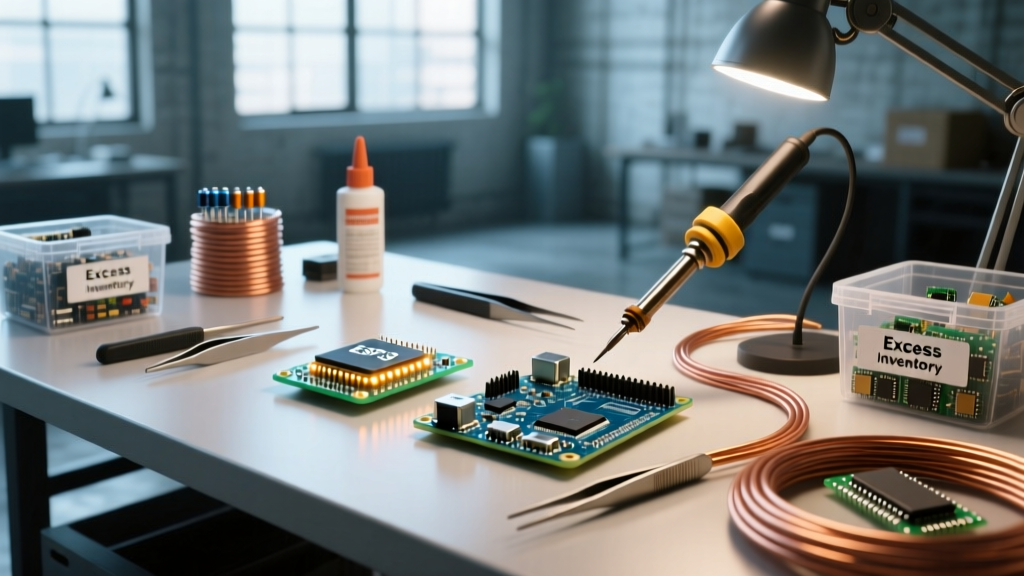

The Anatomy of Excess Electronic Component Inventory
In the volatile world of electronics manufacturing, the phrase excess electronic component inventory (EECI) refers to the surplus of semiconductors, passives, and electromechanical parts that OEMs (Original Equipment Manufacturers) and EMS (Electronic Manufacturing Services) providers hold beyond their immediate production needs. Following the severe allocation periods of the early 2020s, the industry entered a massive inventory correction cycle peaking in 2025 and extending into 2026. Today, billions of dollars in surplus microcontrollers, power management ICs, and memory modules sit in climate-controlled warehouses waiting to be absorbed by the secondary market.
For hobbyists, prototypers, and mid-volume design firms, this surplus represents a goldmine of discounted components. However, navigating the secondary market requires a deep understanding of how this excess inventory is generated, verified, and ultimately sold.
Why Do OEMs and EMS Providers Overstock?
The creation of EECI is usually a symptom of the "bullwhip effect" in the global supply chain. During periods of constrained supply, contract manufacturers like Foxconn or Jabil are forced to place massive, overlapping orders for critical components—such as the STM32G4 series or NXP Kinetis microcontrollers—just to secure allocation. When end-market demand softens or a product design pivots, these companies are left holding millions of units. Additionally, End-of-Life (EOL) transitions often prompt manufacturers to execute "last-time buy" orders, resulting in excess stock if the projected demand for the legacy product was overestimated.
How the Secondary Market Digests Surplus Parts
When an OEM decides to liquidate its excess electronic component inventory, the parts do not simply go to a landfill. They enter a highly structured secondary market ecosystem designed to recoup capital and prevent e-waste.
The Brokerage Funnel
The journey of a surplus component typically follows a distinct path:
- Franchised Distributor Buybacks: Companies like Arrow or Avnet may accept returns of excess stock from their OEM clients, restocking the parts with a 15% to 25% penalty fee, provided the original packaging is intact.
- Independent Brokers: If franchised distributors refuse the stock, it is sold in bulk to independent distributors. These brokers purchase excess inventory at 10% to 40% of the original wholesale cost, assuming the financial risk of holding and reselling the parts.
- Online Marketplaces and Aggregators: Brokers list the verified surplus on platforms like BrokerForum, Octopart, and Findchips, making the parts visible to global buyers, including small-batch prototypers.
"The secondary market acts as the pressure release valve for the semiconductor industry. Without independent brokers digesting excess electronic component inventory, the capital lockup would stifle innovation and R&D budgets across the entire tech sector."
The Verification Gauntlet: Sorting Genuine from Suspect
The greatest risk when purchasing surplus components is the introduction of counterfeit or degraded parts into the supply chain. Reputable independent distributors adhere to strict testing protocols, primarily governed by the SAE International AS5553 standard for counterfeit electronic parts avoidance, and the guidelines set forth by the Independent Distributors of Electronics Association (IDEA).
| Testing Protocol | Equipment Used | Defects / Anomalies Detected |
|---|---|---|
| High-Mag Visual Inspection | 40x - 120x Stereo Microscope | Resurfacing (sandpaper marks), mismatched laser etching, bent leads, incorrect country of origin markings. |
| X-Ray Fluorescence (XRF) | Nikon XT V 160 or similar | Internal die size discrepancies, missing wire bonds, incorrect lead frame geometry, RoHS compliance (lead detection). |
| Decapsulation (Decap) | Fuming Nitric Acid / Sulfuric Acid | Exposes the silicon die to verify the manufacturer's internal lot codes, copyright dates, and die revision numbers against the datasheet. |
| Electrical Testing | Automated Test Equipment (ATE) | Parametric failures, dead-on-arrival (DOA) ICs, and out-of-spec leakage currents. |
According to data tracked by the Electronic Resellers Association International (ERAI), the most common counterfeit vulnerability in surplus inventory involves "blacktopping"—where a cheap, lower-spec component (e.g., an 8MHz MCU) is sanded down and re-marked as a premium, higher-spec variant (e.g., a 16MHz MCU). X-ray and decapsulation are the only definitive ways to catch these sophisticated fakes.
Prototyper's Guide: Safely Sourcing Surplus Components
For engineers building PCB prototypes or running small-batch Kickstarter campaigns, buying excess electronic component inventory can reduce BOM (Bill of Materials) costs by 30% to 60%. For example, a specialized Texas Instruments buck converter that lists for $4.50 on a franchised distributor's site might be available for $2.10 on the secondary market due to an OEM's over-ordering. However, buyers must manage specific physical risks associated with surplus stock.
Managing Moisture Sensitivity Levels (MSL)
Surface-mount ICs are highly susceptible to moisture ingress. Components are rated from MSL 1 (unlimited floor life) to MSL 6 (must be baked and soldered within minutes of opening). When surplus inventory sits in a warehouse for three years, the original moisture barrier bags (MBBs) and humidity indicator cards (HICs) often degrade or are compromised.
If you purchase surplus BGA or QFN packages, you must assume the MSL has been breached. If you attempt to run these parts through a reflow oven without baking them first, the trapped moisture will rapidly expand, causing the "popcorn effect"—micro-fractures inside the IC package that destroy the component.
Step-by-Step MSL Recovery for Surplus Parts
Follow the IPC/JEDEC J-STD-033B.1 standard to safely prepare surplus components for assembly:
- Inspect the Packaging: Check the MSL rating printed on the original bag. If the bag is punctured or the HIC shows >10% color change, baking is mandatory.
- Low-Temperature Bake (Safe for Tape & Reel): If your parts are on plastic tape and reel, you cannot use high heat. Bake the components at 40°C (104°F) with <5% relative humidity for 96 to 192 hours, depending on package thickness.
- High-Temperature Bake (Trays Only): If the parts are in high-temperature JEDEC trays, you can bake them at 125°C (257°F) for 24 hours to rapidly drive out moisture.
- Re-seal or Solder Immediately: Once baked, the parts must be soldered within their allotted floor life (e.g., 168 hours for MSL 3) or immediately re-sealed in a new MBB with fresh desiccant.
Watch the Date Code and Lead Oxidation
Always request the "Date Code" (DC) from the broker before purchasing surplus. A date code older than 24 months indicates a high risk of lead oxidation, particularly on fine-pitch QFP or BGA packages. Oxidized leads will fail to form a proper metallurgical bond with your solder paste, resulting in cold solder joints or open circuits. If you must use parts older than two years, consider sending them to a specialized re-tinning service before assembly.
The Environmental Imperative
Beyond the economic benefits, the secondary market for excess electronic component inventory plays a critical role in sustainability. The semiconductor manufacturing process is incredibly resource-intensive, requiring massive amounts of ultrapure water, rare earth gases, and energy. By recirculating surplus chips back into the prototyping and production ecosystem, the industry diverts thousands of tons of complex e-waste from landfills annually, ensuring that the silicon already mined and processed fulfills its intended purpose.


