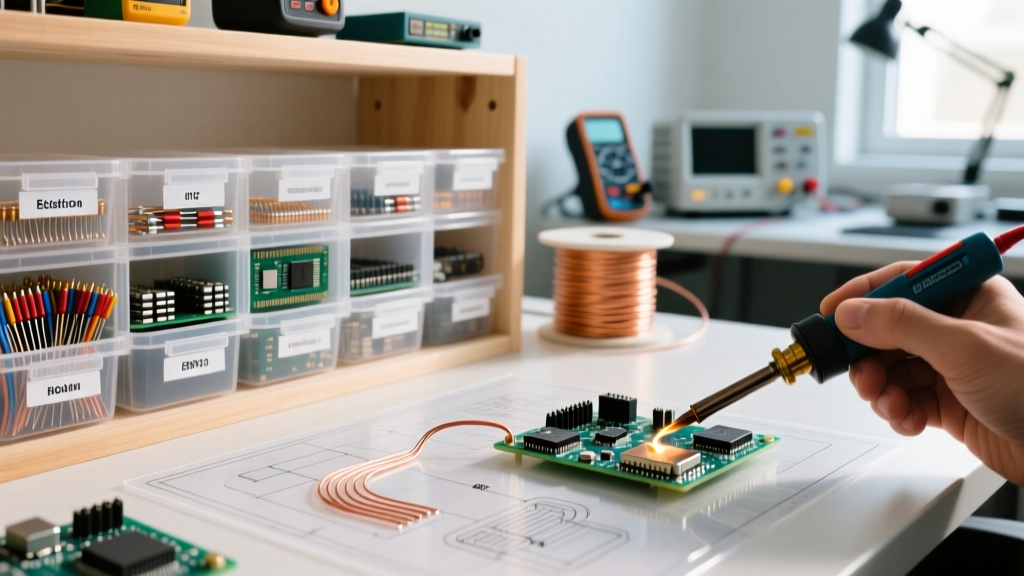

The Hidden Cost of Poor Component Organization
For hardware engineers and DIY makers, the excitement of circuit design often hits a wall during the assembly phase. You have the schematic finalized and the PCB printed, but you are missing a single 0603 10kΩ pull-up resistor or a specific logic-level MOSFET. In 2026, while the severe global semiconductor shortages of the early 2020s have largely stabilized, localized supply chain hiccups still plague specialized microcontrollers and power management ICs. This reality makes robust electronic component management not just a luxury, but a critical necessity for any serious prototyping lab.
Effective management bridges the gap between physical storage, digital tracking, and strategic sourcing. Below is a comprehensive, expert-level guide to building a resilient inventory system that saves time, prevents counterfeit integration, and optimizes your prototyping budget.
Physical Architecture: Designing Your Storage Ecosystem
The foundation of electronic component management begins with physical storage. Tossing components into mixed plastic bags guarantees frustration and increases the risk of electrostatic discharge (ESD) damage. Your physical architecture must prioritize ESD safety, moisture control, and rapid retrieval.
Bin Selection: Akro-Mils vs. Stanley Pro
When outfitting a lab, the debate usually narrows down to two industry standards: drawer cabinets and multi-compartment organizers. Here is how they compare for component-specific storage:
| Feature | Akro-Mils 10164 (44-Drawer) | Stanley 25-Compartment Pro |
|---|---|---|
| Average Cost | $35 - $45 per unit | $15 - $20 per unit |
| Best Use Case | Through-hole resistors, small capacitors, discrete diodes | Connectors, switches, larger ICs, modules (ESP32, Arduino) |
| ESD Safety | Poor (Standard plastic generates static) | Poor (Standard plastic) |
| Labeling | Excellent (Built-in label slots) | Good (Flat top lid for custom tape labels) |
Expert Tip: To mitigate the ESD risks of standard plastic bins, line your drawers with anti-static foam or store sensitive ICs in their original ESD shielding bags inside the drawers. Never store bare CMOS chips in unlined plastic bins.
Digital Tracking: Moving Beyond Spreadsheets
Physical bins are useless if you do not know what is inside them. While many makers start with Microsoft Excel, spreadsheets fail to handle multi-location tracking, barcode scanning, and bill-of-materials (BOM) importing. In 2026, the standard for open-source electronic component management is InvenTree.
Setting Up InvenTree for the DIY Lab
InvenTree is a Python/Django-based open-source inventory management system. Unlike older, deprecated platforms like PartKeepr, InvenTree is actively maintained and supports modern API integrations. To deploy it effectively:
- Host Locally or via Docker: Run InvenTree on a local Raspberry Pi 5 or a basic home server using Docker Compose. This keeps your proprietary BOMs off cloud servers.
- Implement Barcode Scanning: Use a standard USB barcode scanner (like the Datalogic QuickScan, ~$60) to scan DigiKey or Mouser barcodes directly into InvenTree's receiving module.
- Map Supplier Data: Link your internal part numbers to manufacturer part numbers (MPNs) and distributor SKUs to automate reorder alerts.
Strategic Sourcing in the Post-Shortage Era
Sourcing components requires a defensive strategy. The gray market is flooded with counterfeit ICs, particularly voltage regulators, operational amplifiers, and high-demand microcontrollers. Integrating a fake chip into your prototype can lead to catastrophic failure, thermal runaway, or erratic debugging sessions that waste weeks of engineering time.
Navigating Authorized vs. Gray Market Distributors
Always default to authorized distributors like Mouser, DigiKey, Arrow, or Farnell. While their shipping costs ($8-$15 minimum) can be painful for small orders, the guarantee of authenticity is worth the premium. When you must use third-party marketplaces like AliExpress or Amazon for passive components or basic connectors, apply strict verification protocols.
For high-risk sourcing, consult the Electronic Resellers Association International (ERAI). ERAI maintains a database of known counterfeit parts and problematic brokers. Cross-referencing a suspicious broker on ERAI before purchasing a batch of STM32 microcontrollers can save your project from hidden malware or sanded-down remarketed chips.
Leveraging Aggregators for Supply Chain Visibility
Before committing to a design, check component availability using aggregators like Octopart. Designing a custom PCB around a specialized power management IC that only has one global supplier with a 52-week lead time is a critical engineering failure. Always verify that your active components have at least two authorized distributors with robust stock levels before finalizing your schematic.
Moisture Sensitivity and FIFO Protocols
Surface-mount components are highly susceptible to moisture ingress. If moisture trapped inside an IC package is exposed to reflow soldering temperatures (240°C+), it rapidly expands, causing the 'popcorn effect'—micro-fractures inside the silicon that destroy the chip.
⚠️ MSL Callout: Managing Floor Life
Components are rated by Moisture Sensitivity Level (MSL) per IPC/JEDEC J-STD-020 standards. MSL 3 components (common for QFN and BGA packages) have a strict 168-hour floor life once removed from their dry-sealed bags. If you exceed this time, you must bake the components in a specialized SMD oven (typically 40°C for 192 hours or 125°C for 24 hours, depending on the package thickness) before reflow soldering. Track bag opening dates on your physical storage bins using dry-erase markers.
To enforce a First-In, First-Out (FIFO) protocol, physically arrange your SMD tape-and-reel storage so that older reels are pushed to the front. For advanced labs, investing in an electronic dry cabinet (e.g., Dr. Storage models starting around $350) set to 5% relative humidity eliminates the need for baking altogether.
Step-by-Step: Building Your Reorder Point (ROP) Matrix
Running out of common passives halts prototyping momentum. Establish a Reorder Point (ROP) matrix for your most consumed components. The formula is straightforward:
ROP = (Lead Time in Days × Average Daily Usage) + Safety Stock
Real-World Calculation Example
Let us calculate the ROP for a 0603 10kΩ resistor (Yageo RC0603FR-0710KL) and an ATmega328P-PU microcontroller.
- 0603 10kΩ Resistor: You use about 5 per day. Lead time from Mouser is 2 days. You want a safety stock of 50. ROP = (2 × 5) + 50 = 60 units. When your bin drops to 60, order a fresh reel of 5,000.
- ATmega328P-PU: You use 1 per week (0.14 per day). Lead time is 4 days. Safety stock is 3. ROP = (4 × 0.14) + 3 = 3.56. Round up to 4. When you have 4 DIP chips left, order 10 more.
Conclusion
Mastering electronic component management transforms your lab from a chaotic storage space into a high-efficiency manufacturing hub. By investing in proper ESD-safe physical bins, deploying open-source digital trackers like InvenTree, rigorously vetting your supply chain against counterfeits, and respecting MSL floor lives, you eliminate the friction between design and reality. Treat your inventory with the same engineering rigor you apply to your schematics, and your prototyping workflow will become seamless.


