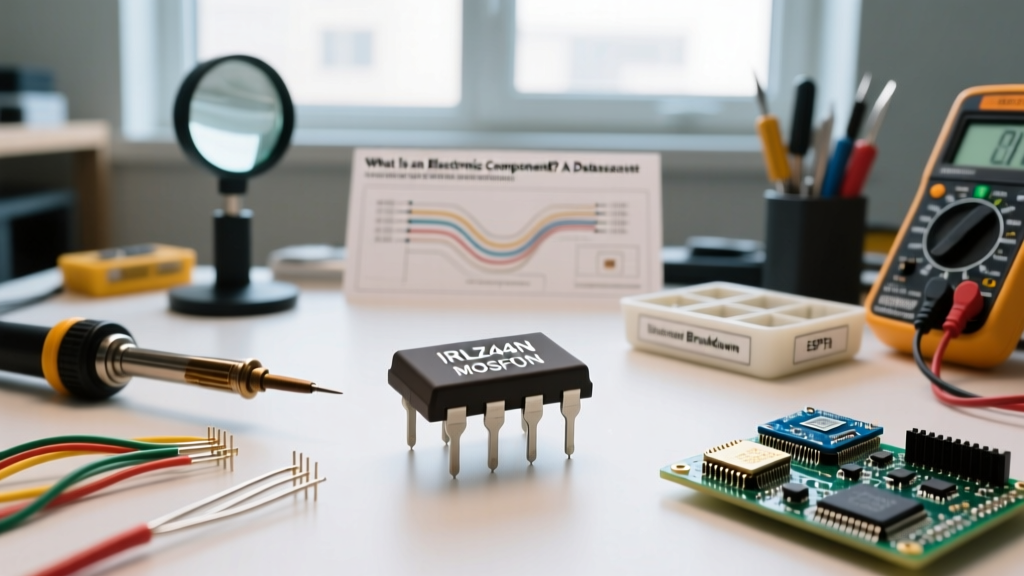

Defining the Building Blocks of Modern Electronics
At the most fundamental level, an electronic component is any basic discrete device or physical entity in an electronic system used to affect electrons or their associated fields. But if you ask a seasoned PCB designer or a hardware engineer what a component actually is, they won't give you a textbook definition. They will hand you a datasheet. To truly understand what an electronic component is, you must understand its physical limits, its thermal boundaries, and its electrical quirks as defined by its manufacturer.
The Engineering Definition: An electronic component is a physical device with defined electrical terminals, packaged to integrate into a circuit, whose behavior is strictly governed by its semiconductor physics, parasitic elements, and thermal mass.
In this guide, we are going to answer the question 'what is an electronic component' not by listing types of resistors and capacitors, but by performing a deep-dive datasheet breakdown of one of the most popular discrete components in the DIY and prototyping space: the IRLZ44N N-Channel Logic-Level MOSFET. By dissecting its datasheet, we will uncover the hidden realities of component selection in 2026.
Anatomy of a Datasheet: The IRLZ44N Case Study
When you open a semiconductor datasheet, you are looking at a legal and technical contract between the manufacturer (in this case, Infineon Technologies) and the engineer. Let's break down the critical sections to understand what this specific component actually is.
1. The Feature Summary (The Marketing Pitch)
The first page of any datasheet is the sales pitch. For the IRLZ44N, it boasts 'Advanced Process Technology,' 'Ultra Low On-Resistance,' and 'Dynamic dV/dt Capability.' It is packaged in a standard TO-220AB through-hole format. While useful for a quick overview, veteran engineers know to skip this section. The feature summary tells you what the component wants to be, not what it actually does under stress. To find the truth, we must look at the absolute maximum ratings.
2. Absolute Maximum Ratings (The Death Boundaries)
This section defines the exact thresholds that will cause catastrophic, irreversible silicon failure. For the IRLZ44N, the critical limits are:
- Drain-to-Source Voltage (VDSS): 55V. Exceed this, and the internal oxide layer experiences avalanche breakdown, shorting the drain to the source permanently.
- Continuous Drain Current (ID): 47A (at TC = 25°C). Warning: This is a theoretical trap for beginners.
- Pulsed Drain Current (IDM): 160A. This is the component's ability to handle brief inrush currents, like starting a DC motor.
- Maximum Power Dissipation (PD): 63W. This assumes the component case is bolted to an infinite, perfectly cooled heatsink held at exactly 25°C.
Real-World Edge Case: If you are using this MOSFET to switch an inductive load (like a solenoid or relay) without a flyback diode, the inductive kickback can easily generate voltage spikes exceeding 100V. The 55V VDSS limit will be breached in nanoseconds, resulting in a literal explosion of the silicon die inside the TO-220 package.
3. Thermal Characteristics (The Heat Reality Check)
This is where the true nature of the electronic component is revealed. The IRLZ44N datasheet lists the Junction-to-Ambient Thermal Resistance (RθJA) as 62 °C/W. This number is the most critical piece of data on the entire document. Let's do the real-world math that separates hobbyists from professionals.
Imagine you want to run a 12V LED strip drawing 15 Amps continuously. You drive the IRLZ44N gate with a 5V Arduino pin. Looking at the electrical characteristics table, the Static Drain-to-Source On-Resistance (RDS(on)) at VGS = 5V is roughly 25mΩ (0.025Ω).
The Thermal Math:
- Power Dissipated as Heat (P): I² × R = 15² × 0.025 = 5.625 Watts.
- Temperature Rise: Power × RθJA = 5.625W × 62 °C/W = 348.75 °C rise above room temperature.
- Max Junction Temperature (TJ): 175 °C.
The Verdict: Even though the front page claims the component can handle '47 Amps,' running just 15 Amps without a heatsink will cause the internal silicon junction to reach nearly 370 °C. The component will desolder itself from your breadboard and catch fire. An electronic component is not just its electrical schematic symbol; it is a physical object bound by thermodynamics. To fix this, you must attach a heatsink to lower the effective thermal resistance, or choose a MOSFET with a lower RDS(on).
Component Comparison: Why the IRLZ44N Isn't Always the Answer
Understanding what an electronic component is requires knowing its alternatives. As of early 2026, the market is saturated with various N-Channel MOSFETs. Here is how the IRLZ44N stacks up against common alternatives for 5V logic-level microcontroller prototyping:
| Component Model | Type | Max VDS | RDS(on) @ 5V | Approx. 2026 Price (Single) | Best Use Case |
|---|---|---|---|---|---|
| IRLZ44N | Logic-Level | 55V | 25.0 mΩ | $1.45 | General purpose 12V/24V loads up to 10A |
| IRF520 | Standard | 100V | N/A (Needs 10V) | $0.85 | High voltage, requires dedicated gate driver |
| IRLB8721 | Logic-Level | 30V | 4.5 mΩ | $1.90 | High current (20A+) 12V LED strips, 3D printers |
| AO3400 | SMD Logic | 30V | 35.0 mΩ | $0.15 | Compact PCBs, low current (<4A) space-constrained designs |
If you are designing a heated bed circuit for a 3D printer drawing 12A at 12V, the IRLZ44N will run warm. Swapping to the IRLB8721 drops the RDS(on) to 4.5mΩ, reducing heat dissipation from 3.6W down to 0.64W, eliminating the need for a bulky heatsink. This is the essence of component selection.
4. The 2026 Counterfeit Problem: When a Component Isn't What It Claims
A critical aspect of modern hardware engineering is verifying that the physical component in your hand matches the datasheet. The IRLZ44N is one of the most counterfeited components on the market. In 2026, you can buy 10 'IRLZ44N' transistors on third-party marketplaces for $3.00. However, teardowns and curve-tracer tests routinely reveal these are actually remarketed, lower-spec MOSFETs (like the IRF510) with the laser etching scrubbed and reprinted.
How to spot a fake:
- The Scratch Test: Genuine Infineon parts use deep laser etching. Fakes often use cheap ink that can be scratched off with a fingernail or wiped with isopropyl alcohol.
- The Gate Threshold Test: A true logic-level IRLZ44N has a Gate Threshold Voltage (VGS(th)) between 1.0V and 2.0V. If your multimeter diode test or curve tracer shows it barely turning on at 3.3V, you have a counterfeit standard-level MOSFET.
- Source Pricing: Always cross-reference distributor pricing. If Mouser and DigiKey sell the genuine article for $1.45 each, a $0.30 listing is mathematically guaranteed to be counterfeit or recycled e-waste.
Frequently Asked Questions (FAQ)
Is a microcontroller considered a single electronic component?
Yes. While an Arduino or ESP32 contains billions of microscopic transistors internally, it is packaged and behaves as a single discrete Integrated Circuit (IC) component from the perspective of the PCB designer. It has defined pins, a specific footprint, and a single governing datasheet.
What is the difference between active and passive electronic components?
Passive components (resistors, capacitors, inductors) cannot introduce net energy into a circuit or amplify a signal; they can only store, dissipate, or filter energy. Active components (transistors, op-amps, microcontrollers) require an external power source and can amplify signals, act as switches, or compute logic.
Why do datasheets list so many different graphs?
Graphs like the 'Safe Operating Area' (SOA) and 'Typical Output Characteristics' map the non-linear reality of semiconductor physics. A component's resistance, capacitance, and gain change dynamically based on temperature and voltage. Graphs provide the behavioral map that static tables cannot capture.
Final Thoughts
So, what is an electronic component? It is not merely a symbol on a schematic. It is a physical manifestation of semiconductor physics, constrained by thermal limits, parasitic inductances, and manufacturing tolerances. By learning to read between the lines of a datasheet—calculating thermal runaway thresholds, understanding logic-level gate drives, and verifying supply chain authenticity—you transition from simply connecting wires to engineering reliable, robust electronic systems. For further reading on interpreting semiconductor specifications, refer to this excellent guide on how to read a datasheet from All About Circuits, or explore the broader MOSFET product architectures detailed by Infineon Technologies.


