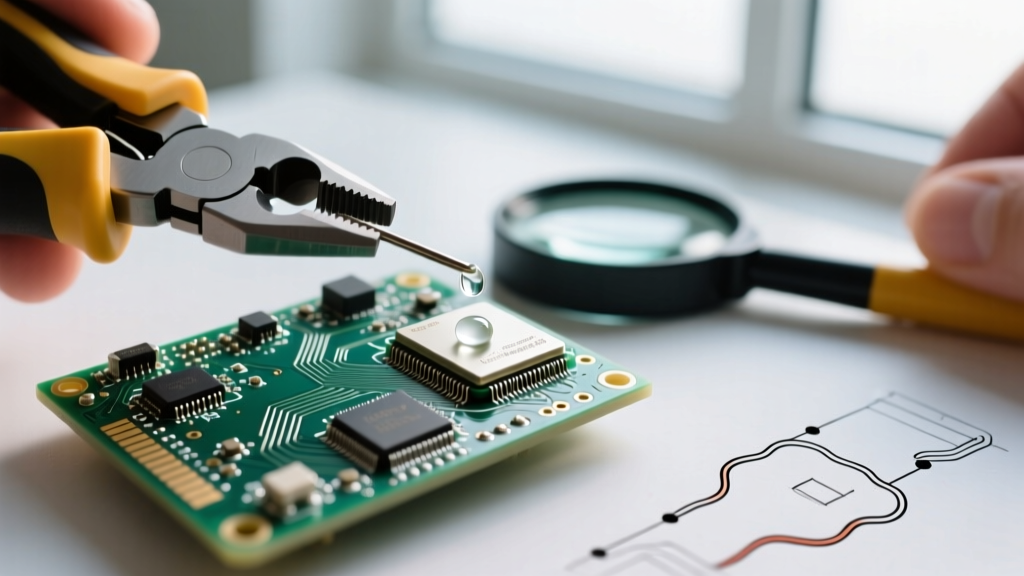

The Hidden Enemy of Precision Measurement: Surface Contamination
When a digital multimeter (DMM) reads 4.82V instead of the expected 5.00V on a precision voltage reference, most technicians immediately suspect a failing semiconductor or a drifting power supply. However, in high-impedance testing environments, the culprit is frequently microscopic surface contamination. Leftover flux residue, skin oils from handling, and environmental dust create parasitic leakage paths that distort your test equipment's readings. Integrating a high-quality electronic component cleaner into your testing and measurement workflow is not just about aesthetic cleanliness; it is a fundamental prerequisite for electrical accuracy.
According to guidelines referenced by the NASA Electronic Parts and Packaging (NEPP) Program, ionic and non-ionic contamination on printed circuit boards (PCBs) drastically reduces Surface Insulation Resistance (SIR). When you are testing high-impedance circuits—such as op-amp feedback loops, piezoelectric sensors, or CMOS logic inputs—even a seemingly invisible layer of contamination can introduce parallel resistance that completely invalidates your measurements.
The Physics of Dirty Contacts: Why Testing Fails
To understand why an electronic component cleaner is a mandatory testing tool, you must look at the input impedance of your measurement gear. A standard benchtop DMM typically features a 10 MΩ input impedance. If your PCB test point is contaminated with acidic flux residue or moisture-tracking dust, it might create a 50 MΩ leakage resistance to ground.
Using basic Ohm's Law for a voltage divider, that 50 MΩ parallel leakage path combined with the DMM's 10 MΩ input impedance will cause a massive measurement error. A true 10.00V signal will read as 8.33V on your multimeter. No amount of calibration will fix this; the circuit must be chemically decontaminated before testing can proceed.
Oscilloscope BNC Connectors and Ground Loops
Contamination isn't limited to PCBs. The BNC connectors on your oscilloscope probes and scope chassis accumulate oxidation and skin oils over time. This degrades the outer shield's ground connection, raising the ground impedance from an ideal <5 mΩ to several ohms. This high-impedance ground path acts as an antenna, introducing 60Hz/50Hz mains hum into low-level signal measurements. Spraying a specialized contact cleaner directly onto a lint-free swab and scrubbing the BNC barrel restores the low-impedance ground path, instantly eliminating phantom noise.
Chemical Profiles: Choosing the Right Cleaner
Not all solvents are created equal. Selecting the correct electronic component cleaner depends on the specific testing scenario, the materials involved, and the type of contamination. Below is a comparison matrix of the most common solvents used in metrology and electronics testing labs in 2026.
| Solvent Type | Product Example (2026 Pricing) | Evaporation Rate | Plastic Safety | Best Testing Application |
|---|---|---|---|---|
| 99.9% Isopropyl Alcohol (IPA) | Lab-Grade IPA (~$15 / 1 Gallon) | Moderate | Safe for most plastics | General PCB flux removal prior to node testing. |
| Hydrofluoroethers (HFE) | Chemtronics Electro-Wash PX (~$24 / 12oz) | Extremely Fast | Exceptional (Safe on polycarbonate) | Quick-drying cleaning of sensitive test probes and optical sensors. |
| Co-Solvent Contact Cleaner | MG Chemicals 402B (~$19.50 / 354ml) | Fast | Poor (Melts ABS/Polystyrene) | Heavy oxidation removal on BNC barrels, banana plugs, and test clips. |
For authoritative data on solvent compatibility and material safety, always consult the manufacturer's technical data sheets, such as those provided by MG Chemicals or Chemtronics, before applying any chemical to expensive test fixtures.
The 4-Step Testing Prep Protocol
Simply spraying a solvent and letting it dry is a rookie mistake that often spreads contamination rather than removing it. Follow this strict protocol to prepare components and test points for precision measurement:
- Visual and UV Inspection: Use a 365nm UV flashlight to identify invisible flux residues. RMA (Rosin Mildly Activated) fluxes often fluoresce under UV light, revealing hidden leakage paths around IC pins.
- Targeted Application (Soak, Don't Spray): Never spray an aerosol electronic component cleaner directly onto a populated PCB from a distance. The propellant can cause thermal shock to ceramic capacitors. Instead, dispense the solvent onto a lint-free foam swab or use a localized brush-on application to soak the contaminated area.
- Mechanical Agitation: Solvents dissolve contamination, but they don't remove it. Use a natural hog-hair brush or a fiberglass scratch pen (for heavy oxidation on copper test pads) to physically dislodge the ionic residues while the solvent is still wet.
- Controlled Drying: Wipe away the dissolved residue with a clean, lint-free microfiber cloth. Follow up with a blast of dry, oil-free compressed air or an ESD-safe ionizing blower to ensure no solvent pools remain under tight-pitch QFN or BGA components, which could cause temporary dielectric absorption errors during high-frequency testing.
Pro-Tip for Metrology Labs: When testing ultra-high impedance circuits (Giga-ohm range), standard IPA is insufficient because it leaves microscopic water traces (even 99.9% IPA contains 0.1% water). Use an HFE-based electronic component cleaner or a specialized precision wipe to ensure absolute zero-residue dryness.
Real-World Troubleshooting Matrix
Use this troubleshooting guide to identify when a measurement anomaly requires chemical intervention rather than component replacement.
| Measurement Anomaly | Likely Contamination Source | Recommended Cleaning Action |
|---|---|---|
| Phantom voltage readings on high-Z CMOS inputs | Water-soluble flux residue creating parallel leakage paths. | Scrub with 99.9% IPA and hog-hair brush; bake at 50°C for 15 mins. |
| 60Hz hum on oscilloscope low-level analog traces | Oxidized BNC connector shields or dirty probe ground clips. | Apply MG Chemicals 402B to a swab; twist inside BNC barrel. |
| Erratic, jumping resistance readings on DMM | Oxidized banana plug jacks or dirty alligator clip teeth. | Spray HFE cleaner directly onto test leads; wipe with abrasive cloth. |
| Drifting capacitance measurements on LCR meter | Hygroscopic dust absorbing ambient moisture on test fixture. | Wipe fixture with lint-free swab and HFE solvent; test in low humidity. |
Critical Warnings: What NOT to Clean
While an electronic component cleaner is vital for testing accuracy, improper application can permanently destroy components, leading to false failure diagnoses. Never spray aerosol contact cleaners directly into unsealed potentiometers, variable resistors, or electromechanical relays. The solvent's capillary action will pull dissolved dirt and oxidation deep into the wiper track or relay contacts. Once the solvent evaporates, the dirt is left behind in an inaccessible area, creating a permanent dead spot or high-resistance contact.
Additionally, avoid using aggressive co-solvent cleaners (like those designed for heavy industrial degreasing) on polycarbonate enclosures, acrylic light pipes, or wire insulation, as they will cause severe stress cracking and dielectric breakdown.
Conclusion
In the realm of testing and measurement, your data is only as reliable as the physical connection between your test equipment and the device under test (DUT). By understanding the physics of surface contamination and selecting the appropriate electronic component cleaner for your specific application, you eliminate parasitic variables that compromise your readings. Make chemical decontamination a standardized step in your pre-test checklist, and you will drastically reduce diagnostic time and false-positive failure rates.


