
The Hidden Bottleneck in Measurement Workflows
When a 10nF ceramic capacitor fails an impedance sweep on a Keysight E4980A LCR meter, the immediate reaction is to check the test fixture or the probing technique. But the root cause often traces back to a degraded batch sitting in an uncontrolled humidity environment or a counterfeit lot. In rigorous testing and measurement environments, your test bench is only as reliable as your component traceability. Using the right electronic component inventory software bridges the gap between the physical bin and the digital measurement log, ensuring that every tested part is linked to its lot code, datasheet, and moisture sensitivity level (MSL).
Why Test Labs Need Specialized Tracking
Under ISO/IEC 17025:2017 guidelines for testing and calibration laboratories, traceability of materials used in testing is paramount. If you are performing failure analysis or validating a prototype, you must be able to prove exactly which batch of components was on the board. Generic spreadsheet tracking fails here because it lacks automated shelf-life alerts, API integrations with test gear, and barcode-driven lot quarantining. Modern labs require software that treats inventory not just as a financial asset, but as a critical variable in the measurement uncertainty budget.
2026 Software Comparison Matrix for Test Labs
| Software | Best For | API/SCPI Integration | MSL Tracking | 2026 Pricing |
|---|---|---|---|---|
| PartsBox | BOM management & API automation | Excellent (REST API) | Custom fields | Free (Hobby) / $29/mo (Pro) |
| Snipe-IT | Test equipment & fixture tracking | Good (REST API) | No native support | Free (Self-hosted) / $40/mo |
| BOMist | Offline/standalone lab environments | None (Local only) | Basic notes | $35 (One-time license) |
| Altium 365 | Enterprise design & test loops | Deep (ECAD integrated) | Native supply chain | Enterprise licensing |
Integrating LCR Meters with Inventory APIs
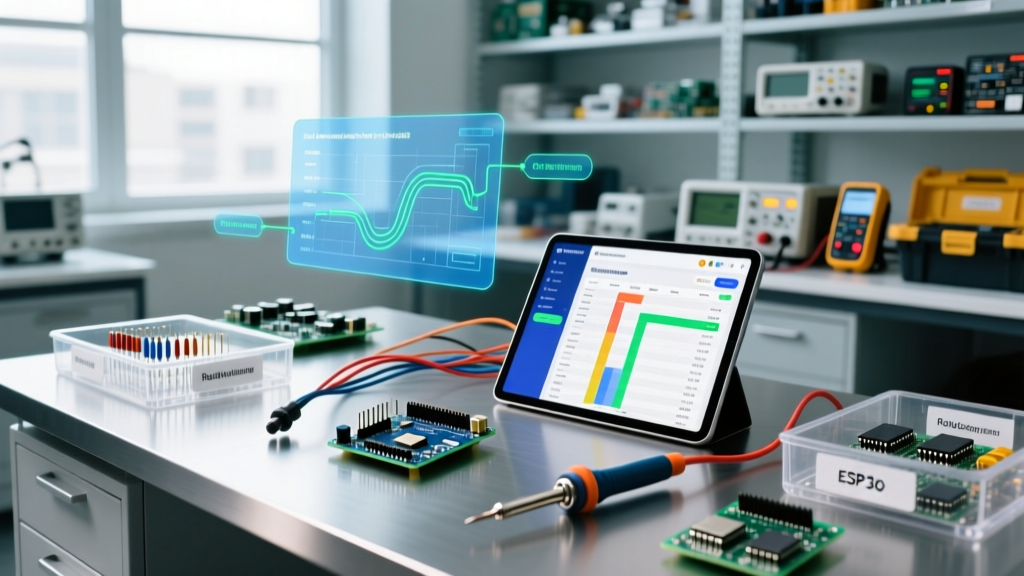
One of the most powerful workflows in a modern measurement lab is automating the sorting and logging of components. When you receive a bulk batch of unmarked or suspect resistors, you can use an automated test jig paired with your inventory software's API to bin them based on actual measured performance.
Step-by-Step: Automating Capacitor Sorting into PartsBox
- Hardware Setup: Connect a tweezers-style test probe to an LCR meter (e.g., Keysight E4982A) via USB or GPIB.
- SCPI Query: Write a Python script using the
PyVISAlibrary to trigger a measurement and fetch the capacitance and Equivalent Series Resistance (ESR) values. - Tolerance Binning: The script calculates the deviation from the nominal value (e.g., 100pF ±1%).
- API Push: Using the PartsBox REST API, the script automatically deducts one unit from the 'Unsorted Bulk' location and adds it to the 'Tested - 1% Tolerance' bin, appending the exact measured ESR to the part's metadata.
This eliminates manual data entry and ensures your measurement logs are permanently tethered to your physical inventory, creating a closed-loop QA system.
Edge Case: Managing Moisture-Sensitive Devices (MSDs)
Testing ICs often requires soldering them to test coupons. If the IC is a Moisture Sensitive Device (MSD), its floor life dictates how long it can be exposed to ambient lab conditions before requiring a bake-out. Popcorning during the reflow process will ruin your thermal testing data and destroy the test coupon.
Pro Tip: Use your inventory software's custom fields to log the 'Bag Open Date' and 'MSL Rating' (per JEDEC J-STD-033). Set automated webhook alerts to notify the lab manager via Slack when an MSL 3 component (168-hour floor life) is approaching expiration.
Handling Destructive Testing Depletion
In failure analysis and reliability testing, components are often destroyed. Whether you are performing decapsulation using fuming nitric acid, cross-sectioning a PCB for impedance validation, or pushing a MOSFET to thermal runaway, the component is consumed. Your electronic component inventory software must account for destructive testing depletion differently than standard BOM consumption.
Standard BOM consumption ties a part to a specific project or prototype build. Destructive testing, however, should be logged against a 'Test Campaign' or 'Engineering Overhead' project code. In platforms like PartsBox, you can create a dummy project named 'Q3 Reliability Testing' and assign consumed parts to it. This ensures your financial accounting remains accurate, separating capital prototype builds from sunk R&D testing costs.
Traceability in High-Voltage and Safety Testing
When testing components for high-voltage isolation (e.g., optocouplers or gate drivers), the specific manufacturing lot can exhibit varying breakdown voltages. If a batch of Avago HCPL-3120 gate drivers fails a 5kV isolation test, you must immediately quarantine the remaining stock. By utilizing barcode scanning integrated with your inventory database, a lab technician can scan the lot code on the anti-static bag, instantly pull up the test logs associated with that specific batch, and execute a bulk 'Move to Quarantine' command. This level of digital-physical synchronization is impossible with paper logs or static Excel sheets.
Database Architecture: Relational vs. Flat-File for Labs
Many DIY labs start with flat-file databases to track components. While adequate for simple storage, flat-files fail when modeling the complex relationships inherent in testing environments. A single component (e.g., a TI LM358 op-amp) might be linked to multiple test footprints, datasheets, SPICE models, and alternative substitute parts. Relational databases, which power dedicated electronic component inventory software, allow you to map these many-to-many relationships.
For instance, if a specific test fixture requires an SOIC-8 adapter, a relational database can automatically flag if the adapter is currently checked out to another lab bench when you attempt to schedule a test run. This prevents scheduling conflicts and ensures that the physical test environment matches the digital BOM requirements before the thermal chamber is even powered on.
Metadata Tagging for Measurement Parameters
Advanced labs use custom metadata fields to store baseline measurement parameters. When a new batch of precision shunt resistors arrives, the lab manager measures a 5% sample size and records the mean resistance, standard deviation, and temperature coefficient of resistance (TCR) in the software's batch notes. When an engineer later pulls that batch for a high-precision current sensing test, they already have the statistical baseline verified, saving hours of preliminary characterization.
Cost Analysis: Free vs. Enterprise Tiers
For independent consultants and university labs, the free tier of PartsBox or a self-hosted Snipe-IT instance is usually sufficient. Snipe-IT is particularly valuable for tracking the test equipment itself—logging calibration due dates for oscilloscopes, thermal chambers, and multimeters. However, once your lab scales past 5,000 unique SKUs and requires multi-user concurrent API writes, expect to pay between $29 and $80 per month per seat for cloud-hosted solutions. The ROI is realized instantly when a single prevented batch-recall or saved calibration audit justifies the software cost.
Frequently Asked Questions
Can I use inventory software to track test probe calibration?
Yes. While PartsBox is optimized for electronic components, platforms like Snipe-IT allow you to create 'asset models' for test probes, oscilloscopes, and fixtures, complete with maintenance schedules and calibration certificates.
How do I handle components that fail QA testing?
Create a virtual 'Quarantine' or 'Failure Analysis' storage location in your software. When a part fails a curve trace or thermal test, scan its barcode and move it to this location. This prevents failed components from accidentally being pulled for a production build or secondary test.