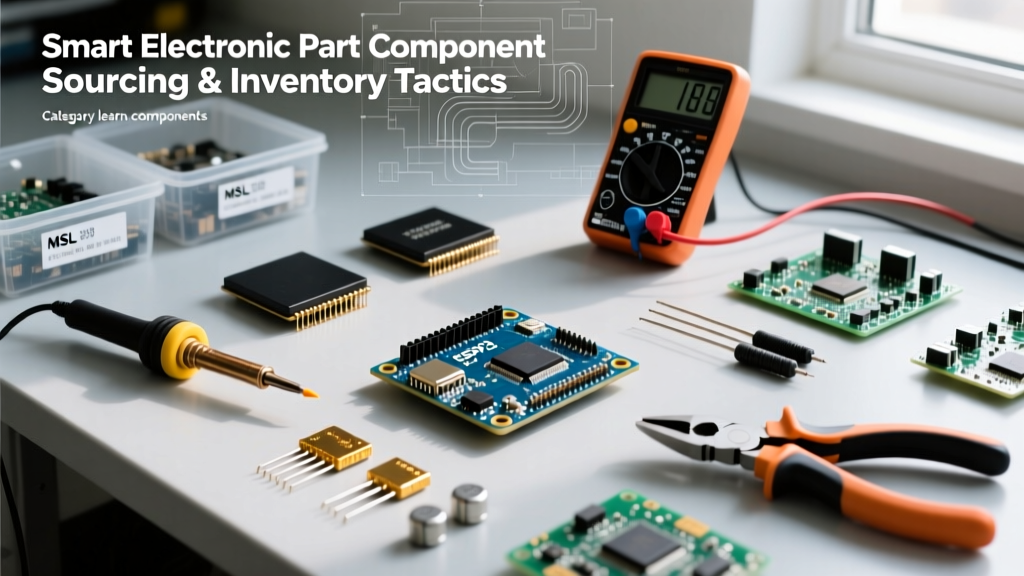

The global semiconductor supply chain has entered a new phase in 2026. While the severe shortages of the early 2020s have largely stabilized for consumer-grade microcontrollers and passive components, specialized analog ICs, automotive-grade sensors, and high-frequency RF modules still face volatile lead times and aggressive gray-market flooding. When you are designing a custom PCB or managing a small-batch hardware startup, sourcing every electronic part component requires more than just sorting by lowest price on an aggregator site. It demands a rigorous approach to distributor vetting, lifecycle forecasting, and environmental storage controls.
This guide provides actionable, engineering-grade strategies for sourcing, verifying, and storing electronic components, ensuring your Bill of Materials (BOM) survives from prototype to mass production without falling victim to counterfeit silicon or moisture-induced reflow failures.
The 2026 Distributor Hierarchy: Where to Actually Buy
Not all suppliers carry the same chain-of-custody guarantees. Understanding the tier system is critical when procuring a mission-critical electronic part component. Below is a breakdown of the primary sourcing channels, their associated risks, and ideal use cases.
| Distributor Tier | Examples | Counterfeit Risk | Best Use Case |
|---|---|---|---|
| Authorized / Franchised | Digi-Key, Mouser, Farnell, Arrow, Avnet | Zero (Direct from OEM) | Production runs, safety-critical designs, medical/aerospace. |
| Verified Catalog / Direct | LCSC, Rapid Electronics, Newark | Very Low | Prototyping, high-volume consumer goods, cost-sensitive BOMs. |
| Independent Brokers | Smith, Win Source, TrustedParts members | Moderate to High | Fulfilling line-down shortages, sourcing legacy/EOL components. |
| Open Marketplaces | AliExpress, eBay, unvetted Amazon 3P sellers | Extreme | Hobbyist learning, non-critical test jigs. Never for production. |
Pro Tip: If you must use an independent broker to source an obsolete IC, require a Certificate of Conformance (CoC) traceable to the original manufacturer and mandate third-party testing via an ISO 9001-certified lab before accepting the shipment.
Decoding Lifecycle Statuses Before You Commit
One of the most expensive mistakes a hardware engineer can make is designing a board around an active component that transitions to End-of-Life (EOL) during the prototype phase. Always check the manufacturer lifecycle status before finalizing your footprint.
- Active: The part is in full production. Safe to design in.
- NRND (Not Recommended for New Designs): The manufacturer is still producing the part to fulfill existing contracts, but they are winding down the tooling. Do not use for new PCB spins.
- Last Time Buy (LTB): The final window to place orders. Once this date passes, you are at the mercy of the gray market.
- EOL / Obsolete: Production has ceased. Only available through brokers or secondary markets.
To stay ahead of these shifts, subscribe to Product Change Notification (PCN) feeds via services like SiliconExpert or IHS Markit. A PCN will alert you if a foundry is changing the bond wire material from gold to copper, or if a specific package outline is being altered by a fraction of a millimeter—changes that can silently ruin your automated optical inspection (AOI) profiles or reflow thermal mass.
Moisture Sensitivity (MSL) and the Baking Trap
Surface-mount ICs with plastic encapsulation are hygroscopic; they absorb ambient moisture. During the 260°C peak temperatures of lead-free reflow soldering, trapped moisture turns to steam, causing the 'popcorn effect'—micro-fractures inside the silicon die or delamination of the bond pads. The JEDEC J-STD-020 standard classifies components by Moisture Sensitivity Level (MSL).
The MSL Floor Life Matrix
- MSL 1: Unlimited floor life at ≤30°C/85% RH.
- MSL 2: 1 year floor life.
- MSL 3: 168 hours (7 days) floor life. Extremely common for QFN and BGA packages.
- MSL 4: 72 hours floor life.
- MSL 5: 48 hours floor life.
- MSL 6: Mandatory bake before reflow. Time on label.
⚠️ The 125°C Baking Myth: Many outdated tutorials recommend baking MSL 3 or 4 components at 125°C for 24 hours to reset the floor life clock. While this drives out moisture, 125°C will melt standard JST connectors, deform LED lenses, and degrade electrolytic capacitors mounted on the same reel or tray. Always use the low-temperature bake profile: 40°C for 192 hours (8 days) with ≤5% RH desiccant cabinets to safely reset floor life without destroying adjacent sensitive materials.
Invest in a dry nitrogen cabinet or an active desiccant dry box (e.g., Sentry Air or Dr. Storage models, typically costing between $800 and $1,500 for benchtop units) to store your BGAs and fine-pitch QFPs. Monitor the humidity indicator cards (HICs); if the 10% dot turns pink, the moisture barrier bag (MBB) has been compromised.
Autopsying Counterfeits: Visual and Chemical Verification
Counterfeit electronic part component trafficking is a multi-billion dollar illicit industry. Bad actors will sand down the markings on salvaged, lower-spec, or completely fake dies, apply a fresh layer of 'blacktop' epoxy, and laser-etch premium part numbers onto them. According to the SAE AS5553 standard for counterfeit avoidance, rigorous inspection protocols are mandatory for high-reliability sectors.
If you source from a broker, implement this 3-step verification autopsy:
- The Acetone Swab Test: Genuine laser etching is permanently burned into the epoxy or ceramic substrate. Counterfeiters often use cheap ink or a thin layer of blacktop paint. Vigorously rub the IC surface with a cotton swab soaked in 99% Isopropyl Alcohol or Acetone. If the swab turns black or the text smears, the part is remarking.
- Pin and Leadframe Inspection: Use a digital microscope (such as the Andonstar AD409 Pro, approx. $250) at 50x magnification. Look for 'board-in' marks—tiny scrape marks on the underside of the pins indicating the part was desoldered from a scrap PCB. Genuine parts will have pristine, uniform matte-tin or gold-plated leads with no oxidation.
- X-Ray and Decapsulation: For high-value batches (e.g., FPGAs or advanced MCUs), send a sample to a lab for X-ray inspection to verify the internal die size and bond wire topology against the OEM datasheet. If the die is physically smaller than the OEM specification, it is a cloned or downgraded silicon revision. You can cross-reference known bad batches via the Electronic Resellers Association International (ERAI) database.
BOM Scrubbing: Engineering Drop-In Replacements
Relying on a single-source electronic part component for a critical power rail or logic function is a massive supply chain vulnerability. 'BOM scrubbing' is the practice of proactively identifying and testing pin-compatible alternatives before you ever send your Gerber files to the fab house.
Step-by-Step Drop-In Replacement Workflow
- Identify the Bottlenecks: Filter your BOM for parts with >12 week lead times or single-source manufacturers. (e.g., specific Texas Instruments buck converters or STMicroelectronics MCUs).
- Parametric Cross-Referencing: Do not rely solely on 'pin-compatible' claims. Compare the Enable pin thresholds, thermal shutdown hysteresis, and switching frequencies. A drop-in replacement might have the same pinout but a different soft-start ramp rate, which could cause your specific inductor to saturate on startup.
- Footprint Accommodation: Design your PCB land pattern to accommodate both the primary and secondary part. For example, if your primary LDO requires a 1µF output capacitor for stability, but the alternative requires 2.2µF, place two 0603 capacitor footprints in parallel on the board.
- Qualify the Thermal Profile: Alternate parts often have different RDS(on) values or quiescent currents. Run a thermal camera sweep (using a FLIR or Seek Thermal module) on the evaluation board under maximum load to ensure the substitute doesn't exceed its junction temperature limits.
Final Thoughts on Inventory Discipline
Treating your component inventory with the same rigor as your schematic design is what separates amateur projects from manufacturable hardware. By leveraging authorized supply chains, respecting JEDEC moisture protocols, aggressively verifying gray-market parts, and engineering flexibility into your BOM, you insulate your project from the unpredictable nature of the global electronics market. Keep your dry boxes powered, your acetone ready, and your PCN alerts active.


