
The Hidden Dangers of Pre-Packaged Beginner Component Kits
When starting out in electronics, the temptation to purchase a $30 pre-packaged beginner component kit from a third-party marketplace is immense. These plastic tackle boxes filled with resistors, capacitors, and blinking LEDs seem like a bargain. However, as we navigate the component landscape in 2026, the risks associated with gray-market kits have never been higher. Industry watchdogs and the Electronic Components Industry Association (ECIA) continuously warn about the proliferation of counterfeit, out-of-spec, and remarketed components flooding unverified supply chains.
What happens when you build a linear power supply using a counterfeit LM317T voltage regulator from an unverified kit? At best, it drifts wildly under thermal load. At worst, it lacks internal short-circuit protection and catastrophically fails, destroying your breadboard and connected microcontrollers. To build a reliable, educational, and safe foundation for your workbench, you must bypass the gray market and source your custom beginner kit directly from the largest electronic component distributor networks, such as Digi-Key or Mouser Electronics.
Why the Largest Electronic Component Distributor Matters
The title of 'largest electronic component distributor' generally belongs to Digi-Key Electronics, which maintains an active inventory of over 15 million unique SKUs, closely followed by Mouser Electronics. Sourcing from these authorized giants provides three critical advantages for beginners:
- Guaranteed Authenticity: Parts are sourced directly from the original component manufacturers (OCMs). You receive genuine Texas Instruments NE555P timers, not remarketed clones with incorrect internal voltage divider networks.
- Access to Datasheets: Every component listing is linked to verified, up-to-date PDF datasheets and application notes, which are essential for learning circuit design.
- Parametric Education: Learning to use the advanced parametric search filters on these platforms is a core engineering skill that pre-packaged kits completely bypass.
Curating the Ultimate 2026 Custom Beginner Kit
Rather than accepting a random assortment of parts, you can build a targeted, high-quality kit for roughly $65 to $85. Here is the exact bill of materials (BOM) to search for, utilizing the parametric filters on major distributor platforms.
1. The Passive Foundation (Resistors & Capacitors)
Cheap kits use 5% carbon film resistors that drift with temperature. Instead, filter your distributor search for 1% Metal Film Resistors. The Vishay MRS25 series (1/4W, 50V) is an industry standard, costing roughly $0.08 per unit on cut tape. Select 20 common values (e.g., 100Ω, 1kΩ, 4.7kΩ, 10kΩ, 100kΩ) to cover 95% of basic voltage divider and pull-up/pull-down needs.
For capacitors, avoid unbranded ceramic discs. Search for Multilayer Ceramic Capacitors (MLCCs) with an X7R dielectric and a 50V rating. The KEMET C315C series offers excellent thermal stability. For electrolytic capacitors, filter for the Nichicon UWT series (105°C rated), ensuring they will not dry out and fail prematurely on your desk.
2. Active Components and ICs
Your kit needs foundational logic and analog building blocks. Add the following to your cart:
- Microchip ATmega328P-PU: The legendary 8-bit AVR microcontroller (DIP-28 package). Sourced directly via Microchip's authorized channels, it guarantees functional hardware I2C and SPI buses, unlike cloned versions that often freeze during serial communication.
- STMicroelectronics LM317T: A robust, adjustable linear voltage regulator (TO-220 package) for learning power supply design.
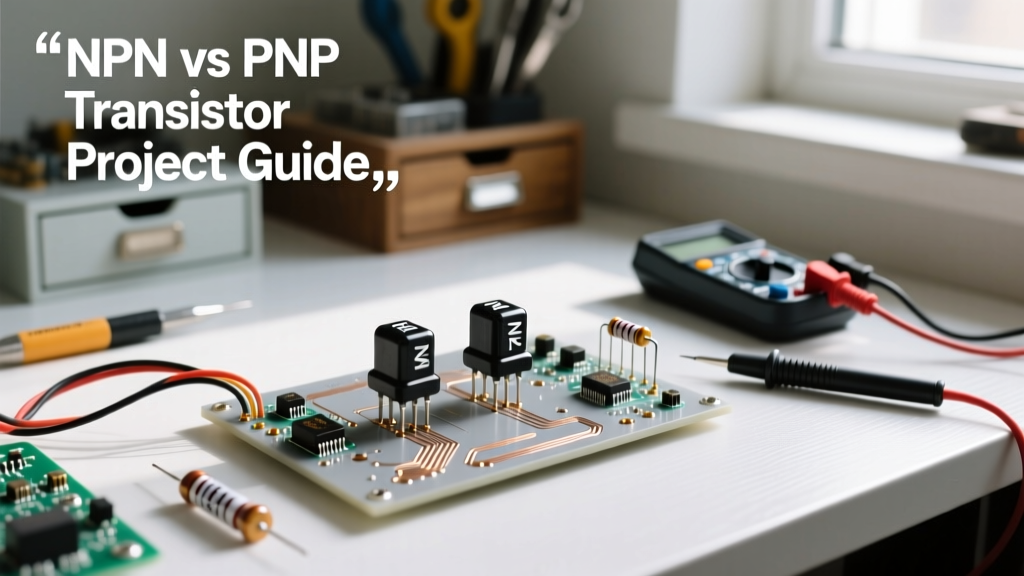
- ON Semiconductor 2N3904 / 2N3906: Matched NPN/PNP bipolar junction transistors (BJTs) for understanding amplification and switching.
3. Prototyping Hardware
Do not skimp on the breadboard. Cheap breadboards suffer from oxidized internal spring clips, leading to intermittent connections that will drive a beginner insane during debugging. Search for Global Specialties or 3M solderless breadboards with gold-plated contacts. Pair these with 22 AWG solid-core jumper wire kits from Amphenol.
Pro-Tip: Navigating Cut Tape Fees
When ordering small quantities of passives from the largest electronic component distributors, parts are often 'cut' from a master reel. Distributors typically charge a $2.00 to $5.00 'cut tape fee' per unique part number. To avoid this, check the 'Standard Pack Quantity' in the pricing matrix. If a reel holds 5,000 units but the cut tape fee is $5, it is sometimes cheaper to buy a bulk pack of 100 resistors from a specialized kit vendor, while keeping your sensitive ICs and microcontrollers strictly tied to the authorized distributor.
Cost vs. Quality: Amazon Kit vs. Distributor-Sourced Kit
To understand the value proposition, let us compare a standard marketplace kit against a custom distributor-sourced kit in 2026.
| Feature | Marketplace 'Tackle Box' Kit (~$35) | Custom Distributor Kit (~$75) |
|---|---|---|
| Component Authenticity | Unverified; high risk of clones | 100% OCM Authorized |
| Resistor Tolerance | 5% Carbon Film (High drift) | 1% Metal Film (Vishay/Yageo) |
| Electrolytic Caps | 85°C rating, unknown ESR | 105°C rated (Nichicon/Panasonic) |
| Breadboard Contacts | Tin-plated, high contact resistance | Gold/Nickel plated, reliable grip |
| Datasheet Access | None provided | Direct links to verified OCM PDFs |
| Learning Value | Low (Copy-paste tutorials only) | High (Parametric search & BOM skills) |
Mastering the Parametric Search Filters
The true educational value of using the largest electronic component distributor lies in learning how to filter their massive databases. When building your kit, apply these strict filters to ensure you receive beginner-friendly, through-hole components:
- Mounting Type: Select Through Hole. Surface mount (SMD) components like 0402 or 0603 packages are impossible to use on standard breadboards without adapters.
- Package / Case: For ICs, filter for PDIP or DIP-28 / DIP-14. For transistors, select TO-92. For power regulators, select TO-220 (which allows for easy attachment of heatsinks).
- Availability: Check In Stock and Exclude Marketplace. This ensures the parts are sitting in the distributor's climate-controlled, ESD-safe warehouse, ready to ship, rather than being drop-shipped from an unverified third-party vendor.
- RoHS Status: Ensure RoHS Compliant is checked to guarantee lead-free terminations, which is critical if you eventually transition to soldering these components on perfboards.
Shipping Thresholds and ESD Precautions
In 2026, major US-based distributors typically offer free shipping on orders over $35 to $50. By bundling your passive assortments, active ICs, and prototyping hardware into a single BOM, you will easily cross this threshold. However, when your kit arrives, you must respect Electrostatic Discharge (ESD) protocols. The ATmega328P-PU and CMOS logic gates (like the CD4017BE) are highly sensitive to static electricity. Always store these ICs in the anti-static pink poly bags or rigid conductive foam they ship in, and ground yourself before handling them on the breadboard.
Frequently Asked Questions
Can I buy just one or two components from the largest distributors?
Yes. Unlike wholesale platforms that require minimum order quantities (MOQs) of 1,000+ units, authorized distributors cater to engineers prototyping single units. You can buy exactly one TI NE555 timer or three specific Vishay resistors, though you must factor in the base shipping cost if your total order is under the free-shipping threshold.
Are the components in these kits good for soldering practice?
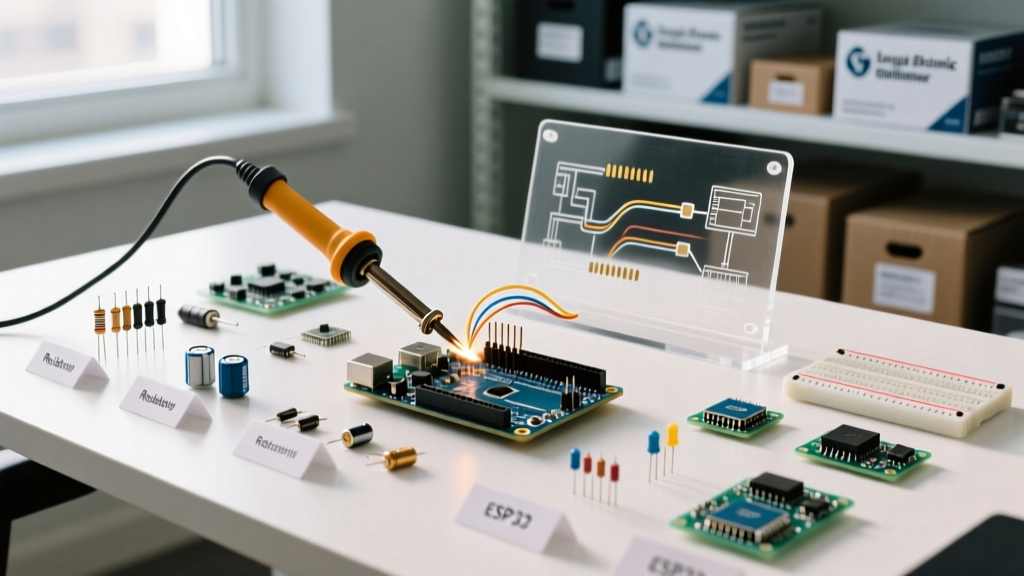
Absolutely. The through-hole components recommended above (TO-220, DIP, and 1/4W axial resistors) are the gold standard for learning to solder on copper-clad perfboards and stripboards. The authentic leads from OCMs are properly tinned and free of heavy oxidation, meaning they will accept rosin-core solder instantly, providing a much better learning experience than oxidized gray-market parts.
What if I need an Arduino-compatible board for my kit?
While you can buy pre-assembled development boards, a true beginner component kit should include the raw ATmega328P-PU chip, a 16MHz HC-49/U crystal oscillator, and two 22pF load capacitors. This allows you to build your own standalone Arduino-compatible circuit on a breadboard from scratch, teaching you fundamental clock-circuit design that simply plugging in a USB cable cannot.