
The Architecture of Decentralized Multi-Agent Systems
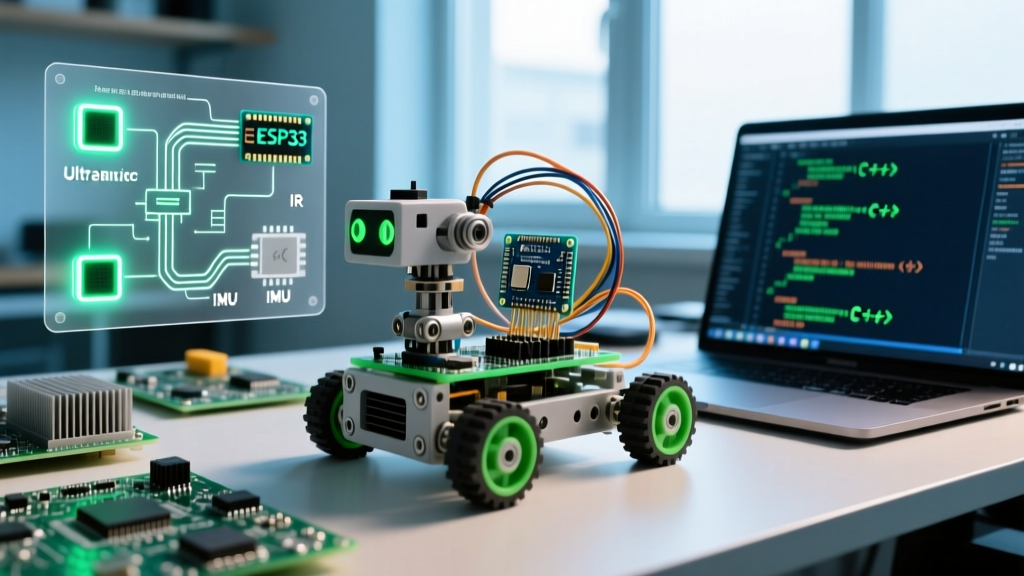
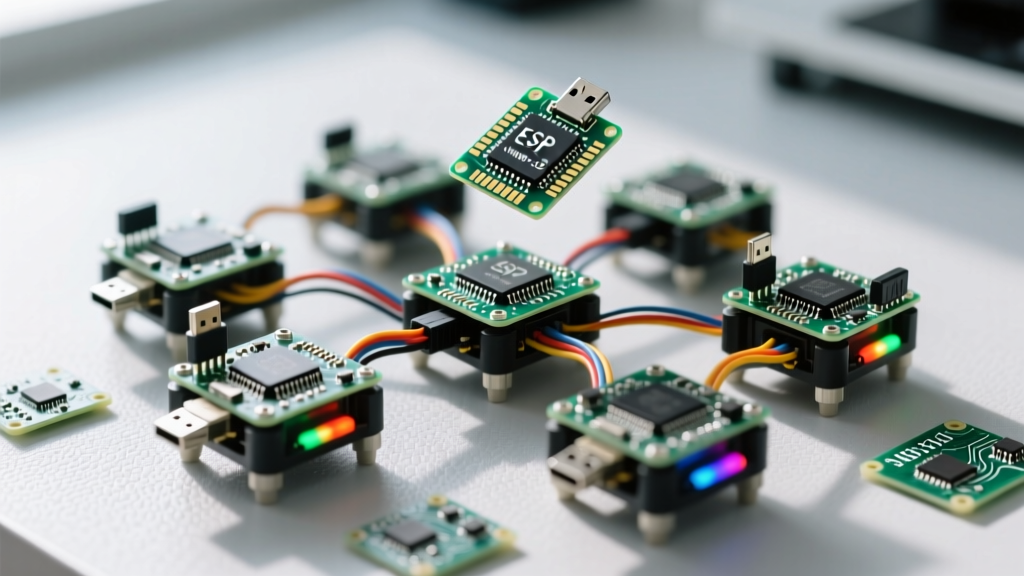
When engineers transition from single-agent automation to advanced swarm robotics projects, the fundamental paradigm shifts from centralized control to emergent, decentralized behavior. In a true swarm, there is no master node. If one robot fails, the collective mission continues uninterrupted. This requires a radical rethinking of hardware selection, communication protocols, and power management. For advanced DIYers and robotics engineers, the ESP32-S3 has emerged as the undisputed brain for multi-agent fleets, offering dual-core processing, vector instructions for rapid math, and native Layer-2 mesh capabilities.
Building a reliable swarm is not simply about duplicating a single robot design ten times. It is about managing inter-node interference, clock drift, and distributed sensor fusion. In this advanced build guide, we will dissect the hardware, communication layers, and algorithmic frameworks required to deploy a robust, flocking-capable ESP32 swarm.
Why the ESP32-S3 Dominates Swarm Nodes
The original ESP32 was a breakthrough, but the ESP32-S3 introduces critical features for swarm robotics. The dual-core Xtensa LX7 running at 240 MHz allows you to dedicate one core entirely to motor control and sensor polling, while the second core handles Wi-Fi/Bluetooth stacks and ESP-NOW packet processing. Furthermore, the S3 variant includes vector instructions that accelerate the floating-point math required for localization and vector-based flocking algorithms, reducing calculation latency by up to 40% compared to standard ARM Cortex-M0+ boards.
Hardware Selection: Sensors and Communication
Choosing the right microcontroller and sensor suite dictates the physical limits of your swarm. Below is a comparison of popular microcontrollers used in advanced swarm robotics projects, evaluating their viability for high-density mesh networks.
| Microcontroller | Approx. Cost (Bulk) | Clock Speed & Cores | Mesh Protocol | Swarm Viability |
|---|---|---|---|---|
| ESP32-S3-WROOM | $4.50 | 240 MHz Dual-Core | ESP-NOW / Wi-Fi Mesh | Excellent (Low latency, high compute) |
| Raspberry Pi Pico W | $6.00 | 133 MHz Dual-Core | Custom UDP / TCP | Fair (TCP overhead causes jitter) |
| nRF52840 (Nano 33 BLE) | $10.50 | 64 MHz Single-Core | Thread / BLE Mesh | Good (Ultra-low power, limited payload) |
| Arduino Nano RP2040 | $9.00 | 133 MHz Dual-Core | None (Requires external RF) | Poor (Adds BOM complexity) |
For our advanced build, the ESP32-S3 paired with the Espressif ESP-NOW protocol is the optimal choice. ESP-NOW bypasses the TCP/IP stack entirely, operating at the MAC layer. This reduces packet transmission latency to under 3 milliseconds and eliminates the handshake overhead that causes jitter in standard Wi-Fi networks.
Overcoming RF Multipath Fading in Indoor Swarms
A common failure mode in indoor swarm robotics projects is RF multipath fading. When ten robots operate in a room with reflective surfaces (glass, drywall, metal studs), 2.4 GHz signals bounce and cancel each other out, leading to dropped ESP-NOW packets. To mitigate this, advanced builders implement channel hopping and redundant broadcast topologies. Instead of relying on a single point-to-point link, configure your ESP32 swarm to broadcast state vectors to a multicast MAC address. Additionally, integrating a secondary sub-GHz transceiver like the LoRa SX1262 for critical heartbeat signals ensures the swarm maintains cohesion even if the 2.4 GHz spectrum becomes saturated.
Implementing Reynolds' Flocking Rules via ESP-NOW
The foundation of most autonomous swarm robotics projects is Craig Reynolds' Boids Flocking Model. To achieve organic, fluid movement without central coordination, each robot must continuously calculate three steering behaviors based on the telemetry of its nearest neighbors:
- Separation: Steer to avoid crowding local flockmates.
- Alignment: Steer towards the average heading of local flockmates.
- Cohesion: Steer to move toward the average position (center of mass) of local flockmates.
Vector Math for Separation and Cohesion
Because the ESP32-S3 receives neighboring coordinates via ESP-NOW, it must perform rapid Euclidean distance calculations. If Robot A receives a payload from Robot B containing coordinates (x2, y2), Robot A calculates the distance vector. If the distance falls below a predefined separation threshold (e.g., 250mm), a repulsive force vector is generated.
Pro-Tip: Avoid using the
sqrt()function for distance comparisons on the microcontroller. Comparing the squared distance (dx*dx + dy*dy) against the squared threshold is computationally cheaper and prevents pipeline stalls in the FPU, allowing for higher control loop frequencies (up to 500Hz).
Power Management and Brownout Failure Modes
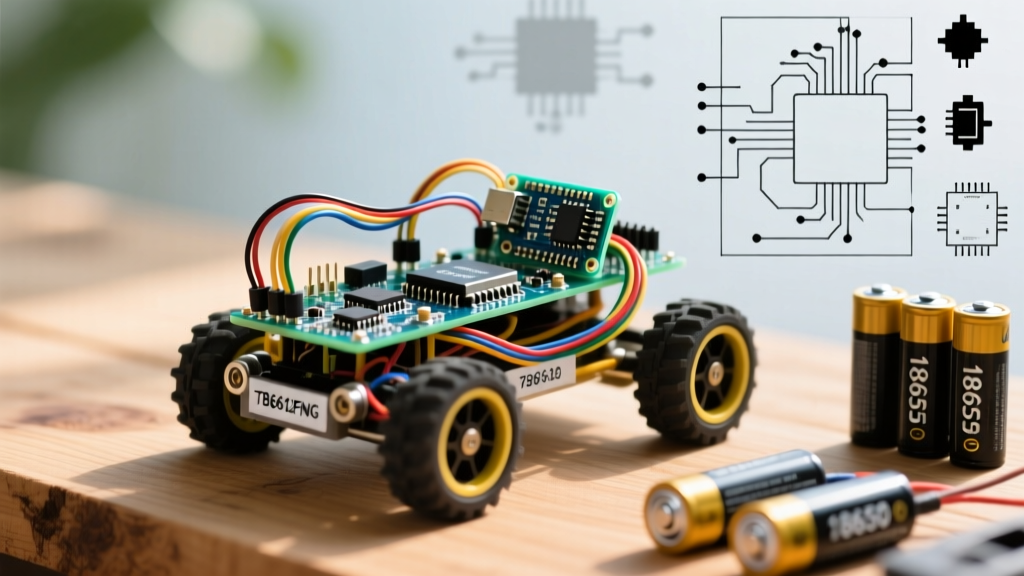
Power distribution is where most amateur swarm builds fail. When a swarm executes a synchronized turn or starts from a dead stop, the simultaneous current spike across multiple nodes can cause catastrophic voltage sags. A standard 2S LiPo battery (7.4V) feeding a cheap linear LDO will experience a brownout if four N20 gear motors stall simultaneously, drawing upwards of 1.2A per motor.
Mitigating Motor-Induced Voltage Sags
To prevent the ESP32-S3 from resetting during high-torque maneuvers, you must physically isolate the logic power rail from the motor power rail. Use a dedicated buck converter (like the TPS5430) for the motor drivers (e.g., DRV8833), and a separate, ultra-low-noise LDO (like the AMS1117-3.3) for the microcontroller and sensors. Furthermore, solder a 470µF tantalum capacitor and a 1F 5.5V supercapacitor directly across the motor VCC and GND pins on the custom PCB. This local energy reservoir absorbs the microsecond current spikes that the battery's internal resistance cannot supply fast enough.
Calibrating Distributed Time-of-Flight Arrays
For collision avoidance and formation keeping, advanced swarms rely on Time-of-Flight (ToF) sensors like the VL53L1X. These sensors emit a 940nm VCSEL laser pulse and measure the photon return time. However, when you place 20 VL53L1X sensors in a tight formation, you encounter a massive real-world problem: optical crosstalk.
Solving 940nm IR Crosstalk in Dense Formations
If Robot A fires its ToF sensor at the exact moment Robot B's sensor is listening for a photon return, Robot B will register a phantom obstacle, causing the swarm to halt or scatter unpredictably. To solve this in advanced swarm robotics projects, engineers implement a TDMA (Time Division Multiple Access) optical schedule.
- Assign each robot a unique time slot within a 50ms master frame.
- Use ESP-NOW to broadcast a synchronized 'tick' from a designated (but interchangeable) beacon node.
- Robot 1 fires its forward ToF array at 0ms; Robot 2 fires at 5ms; Robot 3 at 10ms, and so on.
This requires precise timing. You must use hardware I2C with a TCA9548A multiplexer to read the sensors, and trigger the VCSEL via direct GPIO manipulation rather than relying on the standard Arduino Wire library, which introduces unpredictable millisecond delays.
Localization: Beyond Dead Reckoning
Wheel encoders and IMUs (like the BNO055) suffer from drift. In a swarm, a 2-degree yaw drift per minute compounds into massive formation errors over an hour. For advanced indoor localization, integrate the DWM1000 Ultra-Wideband (UWB) module. Using the Arduino DW1000 library, nodes can perform Two-Way Ranging (TWR) to calculate the exact distance between peers with an accuracy of ±10 centimeters. By fusing UWB ranging data with IMU dead reckoning via an Extended Kalman Filter (EKF) running on the ESP32-S3's second core, the swarm maintains perfect geometric cohesion even in GPS-denied environments.
Final Thoughts on Swarm Deployment
Executing advanced swarm robotics projects requires a holistic understanding of embedded systems, RF physics, and distributed mathematics. By leveraging the ESP32-S3, isolating power domains, implementing ESP-NOW mesh topologies, and solving optical crosstalk via TDMA scheduling, you can build a fleet that is far greater than the sum of its parts. The leap from a single robot to a coordinated swarm is challenging, but the resulting emergent behaviors are the pinnacle of modern DIY robotics engineering.