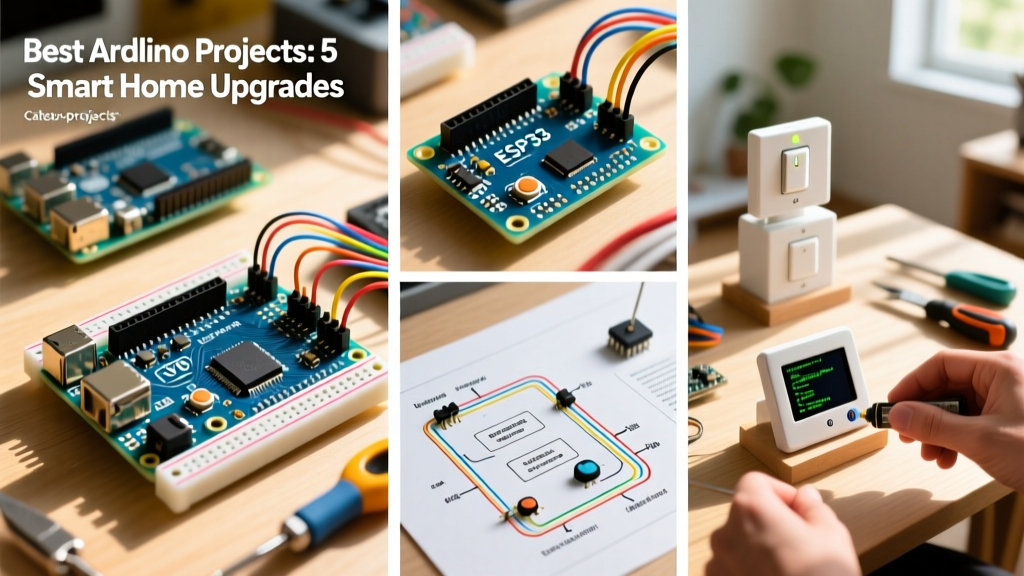

The Evolution of Community-Built Automation
The landscape of DIY electronics has shifted dramatically. While early tutorials focused on blinking LEDs and basic serial outputs, the modern maker community is engineering robust, 24/7 home automation systems. When evaluating the best Arduino projects emerging from forums, GitHub repositories, and maker spaces in 2026, a clear trend stands out: a demand for industrial-grade reliability in consumer-grade enclosures. Makers are no longer satisfied with breadboard prototypes; they are deploying soldered, enclosed, and optically isolated systems that rival commercial smart home products.
In this community showcase, we dissect three highly-rated, real-world smart home builds. We will cover the exact Bill of Materials (BOM), wiring topologies, code logic, and—most importantly—the failure modes that separate weekend prototypes from permanent home installations.
Project 1: The Uno R4 WiFi HVAC Zoning Matrix
Multi-zone HVAC control is a premium feature in modern homes, but retrofitting a legacy single-zone system with commercial dampers costs thousands. The community solution leverages the Arduino Uno R4 WiFi to read multiple BME280 temperature sensors and actuate motorized duct dampers.
Hardware & BOM
- Microcontroller: Arduino Uno R4 WiFi ($27.50)
- Sensors: 3x Adafruit BME280 (I2C, $14.50 each)
- Actuation: Omron G3MB-202P Solid State Relays (SSR) for 24VAC damper motors ($8.00 each)
- Power: 24VAC to 5VDC isolated buck converter ($12.00)
Engineering Deep Dive: Handling 24VAC Inductive Loads
The most common failure mode in community HVAC projects is the destruction of the microcontroller or the welding of mechanical relay contacts. Motorized dampers are inductive loads. When a mechanical relay switches off a 24VAC inductive load, the collapsing magnetic field generates a massive voltage spike (inductive kickback) that causes arcing. Over time, this arcs melts the relay contacts shut, leaving your damper permanently open.
The Fix: The community standard is to abandon mechanical relays for 24VAC switching. Instead, use zero-crossing Solid State Relays (SSRs) like the Omron G3MB-202P. Furthermore, you must wire an RC snubber network (a 0.1µF X2 capacitor in series with a 100-ohm resistor) across the 24VAC load terminals to suppress transient voltage spikes. This ensures the Uno R4 WiFi survives years of continuous cycling without resetting.
Project 2: ESP32-S3 Capacitive Irrigation Mesh
According to the EPA WaterSense program, outdoor water use accounts for nearly 30% of total household water consumption, much of which is wasted by inefficient timing. This community project builds a mesh network of soil moisture sensors that trigger 12V solenoid valves only when the soil's volumetric water content drops below a specific threshold.
Hardware & BOM
- Microcontroller: ESP32-S3 DevKitC-1 ($9.50)
- Sensors: Capacitive Soil Moisture Sensor v1.2 ($3.50 each)
- Actuation: 12V DC Solenoid Valve + Logic-Level MOSFET (IRLZ44N) ($18.00)
- Power: 12V 2A waterproof switching supply, stepped down to 5V via LM2596 ($14.00)
Engineering Deep Dive: Sensor Degradation & ADC Noise
Early iterations of this project used resistive soil sensors, which succumb to galvanic corrosion within two weeks, rendering them useless. The v1.2 capacitive sensor solves the corrosion issue by measuring the dielectric permittivity of the soil through a solder mask. However, two critical edge cases remain:
- PCB Trace Corrosion: While the sensing pads are protected, the exposed solder joints at the top of the v1.2 board will corrode in humid environments. Makers must coat the entire upper PCB and solder joints in marine-grade epoxy or Plasti Dip, leaving only the lower capacitive pads exposed.
- ESP32 ADC Non-Linearity: The ESP32's internal Analog-to-Digital Converter is notoriously noisy and non-linear at the voltage extremes. Instead of using
analogRead(), the community standard is to useanalogReadMilliVolts()combined with a 50-sample moving average filter in the C++ code to stabilize the readings. Additionally, soldering a 100nF ceramic decoupling capacitor directly across the sensor's VCC and GND pins at the connector eliminates high-frequency switching noise from the ESP32's internal WiFi radio.
Project 3: MKR WiFi 1010 RFID Mailbox Sentinel
Package theft remains a persistent issue. This project creates a low-power, battery-operated mailbox monitor that detects when the lid is opened, reads an RFID tag to verify if it is the mail carrier or a resident, and pushes a secure alert via Arduino Cloud.
Hardware & BOM
- Microcontroller: Arduino MKR WiFi 1010 ($29.90)
- RFID Reader: MFRC522 Module ($4.00)
- Trigger: Magnetic Reed Switch ($1.50)
- Power: 3.7V 2000mAh LiPo + TP4056 charging module ($12.00)
Engineering Deep Dive: Deep Sleep & SPI Bus Hanging
To run on a LiPo battery for months, the MKR WiFi 1010 must spend 99% of its time in deep sleep, drawing roughly 40µA. The system wakes only when the magnetic reed switch is broken (mailbox opened). The critical failure mode here is the SPI bus hanging upon wake-up.
Community Insight: 'If you don't hard-reset the MFRC522 after waking from deep sleep, the chip will ignore all SPI commands. You must pull the RST pin LOW for 10ms, then HIGH, before calling
PCD_Init().' - Hackaday Forum User
By implementing a strict hardware reset sequence in the setup() function immediately following the wake interrupt, developers have achieved over 8 months of continuous runtime on a single 2000mAh LiPo charge.
Hardware Cost & Complexity Matrix
When planning your next build, use this matrix to align the project with your budget and skill level.
| Project | Core MCU | Est. BOM Cost | Complexity | Standby Power Draw |
|---|---|---|---|---|
| HVAC Zoning Matrix | Uno R4 WiFi | $75.00 | High (AC Mains) | ~120mA (Always On) |
| Irrigation Mesh | ESP32-S3 | $45.00 | Medium (Analog Tuning) | ~80µA (Deep Sleep) |
| Mailbox Sentinel | MKR WiFi 1010 | $47.40 | Medium (Power Mgmt) | ~40µA (Deep Sleep) |
Common Community Pitfalls & How to Avoid Them
Even the best Arduino projects fail when deployed in the real world. Here are three systemic issues frequently encountered in community builds, along with their engineering solutions:
1. Ground Loops in Distributed Sensor Networks
When running I2C sensor cables (like the BME280) over distances greater than 2 meters, parasitic capacitance and ground loops will corrupt the SDA/SCL lines, causing the microcontroller to freeze. Solution: Use an I2C bus extender IC like the PCA9615, which converts the I2C signal to a differential pair, allowing reliable transmission up to 30 meters over standard Cat5e ethernet cable.
2. Power Supply Ripple Crashing the WiFi Stack
Transmitting a WiFi packet requires a sudden current spike of up to 500mA. If your 5V buck converter cannot handle this transient load, the voltage dips below 3.3V, causing the ESP32's internal brownout detector to trigger a reboot loop. Solution: Place a 470µF low-ESR electrolytic capacitor in parallel with a 100nF ceramic capacitor directly on the 5V input rail of the microcontroller to act as a local energy reservoir.
3. Flash Memory Wear from Excessive Logging
Many makers use the internal SPIFFS or LittleFS file system to log sensor data locally. The ESP32's NAND flash memory has a limited write cycle lifespan (typically ~100,000 cycles). Writing a log file every 5 seconds will destroy the flash chip in under a week. Solution: Buffer sensor readings in the MCU's SRAM and perform a single batch write to the flash memory once per hour, or offload logging entirely to an external I2C EEPROM like the AT24C256.
Frequently Asked Questions
Can I use the classic Arduino Uno R3 for these smart home projects?
While the Uno R3 is a legendary board, it lacks native WiFi and has limited SRAM (2KB). For modern IoT smart home projects requiring secure cloud connectivity and TLS encryption, the Uno R4 WiFi or ESP32-based boards are mandatory. TLS handshakes alone can consume more RAM than the R3 possesses.
How do I protect outdoor Arduino enclosures from UV degradation?
Standard 3D-printed PLA or PETG enclosures will become brittle and shatter after a few months of UV exposure. For outdoor deployments, use ASA filament for 3D printing, or purchase IP65-rated polycarbonate junction boxes (like the Bud Industries PN-1321) which feature integrated UV stabilizers and neoprene gaskets.