
The Physics of Precision: Why Standard Relays Fail
When engineers tackle advanced projects with Arduino, thermal control is often the ultimate test of both hardware architecture and software algorithms. Building a Polymerase Chain Reaction (PCR) thermal cycler requires rapid, bidirectional temperature ramping with an accuracy of ±0.1°C. Standard mechanical relays or basic MOSFET setups using on/off hysteresis are entirely inadequate for this task. The thermal mass of the sample block, combined with the latent heat of the biological samples, introduces massive phase delays that cause severe overshoot and oscillation.
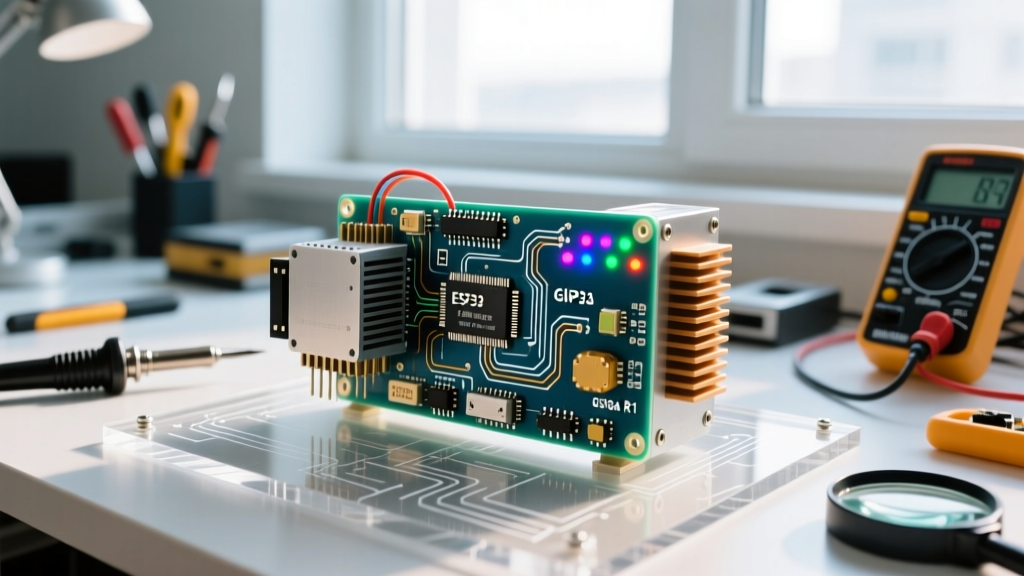
To achieve the 3.5°C/s heating and 2.0°C/s cooling ramp rates required for modern DNA amplification, we must utilize a Peltier module (Thermoelectric Cooler or TEC) driven by a high-current H-bridge, managed by a dual-core microcontroller executing a feed-forward PID algorithm. In this 2026 advanced build guide, we will construct a professional-grade thermal cycler using the Arduino Giga R1 WiFi, moving far beyond basic blinking LEDs into the realm of precision metrology and control theory.
2026 Bill of Materials (BOM) and Cost Matrix
Sourcing high-reliability components is critical. The pricing below reflects early 2026 market rates for authentic, non-counterfeit electronics from authorized distributors like Mouser and Digi-Key.
| Component | Model / Specification | Role | Est. Cost (USD) |
|---|---|---|---|
| Microcontroller | Arduino Giga R1 WiFi (STM32H747XI) | Dual-core processing, high-res PWM | $82.00 |
| TEC Module | TEC1-12710 (12V, 10A, 120W Max) | Bidirectional active heating/cooling | $14.50 |
| H-Bridge Driver | IBT-2 Module (BTS7960 based) | 43A continuous, handles PWM reversal | $11.00 |
| Temperature Sensor | Pt1000 RTD (3-wire, Class A) | High-precision thermal feedback | $18.00 |
| RTD Amplifier | Adafruit MAX31865 Breakout | SPI ADC with lead-wire cancellation | $15.95 |
| Power Supply | Mean Well LRS-150-12 (12V, 12.5A) | Stable DC rail for TEC and logic | $34.00 |
| Thermal Block | CNC 6061-T6 Aluminum (150g) | Sample interface and heat distribution | $45.00 |
Total estimated hardware cost: ~$220.45 (excluding enclosure, wiring, and PCB fabrication).
Hardware Architecture: Driving the Peltier Module
The TEC1-12710 module operates on the Peltier effect: applying DC current in one direction pumps heat from one ceramic face to the other, while reversing the polarity reverses the heat flow. This bidirectional capability is what makes Peltiers ideal for thermal cyclers, but it necessitates an H-bridge motor driver rather than a simple single MOSFET switch.
The 3.3V Logic Threshold Challenge
The Arduino Giga R1 WiFi operates at 3.3V logic. The BTS7960 H-bridge IC has a typical high-level input voltage ($V_{IH}$) of 2.0V, meaning 3.3V will successfully trigger the logic gates. However, for optimal enhancement of the internal MOSFETs and to minimize $R_{DS(on)}$ conduction losses at 10A, a 5V logic signal is preferred. For this advanced build, we bypass the onboard optocouplers of the IBT-2 module and drive the BTS7960 gates directly using a BSS138 logic level shifter, ensuring crisp, nanosecond-level PWM switching edges from the Giga R1's 16-bit hardware timers.
Expert Insight: Never use software-based PWM (like standard analogWrite() on basic AVRs) for Peltier control. Software PWM introduces timing jitter that translates directly into thermal noise. The Giga R1's STM32H747 hardware timers must be configured to output a 20kHz PWM signal, keeping the switching frequency above the audible range and ensuring a smooth DC-equivalent current through the TEC's inductive windings.
Sensor Metrology: Pt1000 vs. Thermistors
In beginner projects, 10k NTC thermistors are ubiquitous. In advanced metrology, they are unacceptable. NTCs suffer from severe non-linearity, self-heating errors, and beta-value drift over time. According to National Instruments' guide on RTDs, Platinum Resistance Temperature Detectors (RTDs) offer superior linearity, long-term stability, and repeatability.
We utilize a 3-wire Pt1000 sensor. The 1000-ohm base resistance (at 0°C) reduces the impact of lead wire resistance compared to a Pt100, while the 3-wire configuration allows the MAX31865 RTD-to-Digital Converter to mathematically cancel out the resistance of the copper traces connecting the sensor to the PCB. This is critical because a 0.385-ohm lead resistance error translates to roughly a 0.1°C measurement offset—completely destroying the tight thermal margins required for PCR annealing phases.
Advanced PID Implementation: Defeating Integral Windup
The standard Brett Beauregard Arduino PID library is an excellent starting point, but thermal cyclers expose its limitations during rapid setpoint changes. When commanding the block to drop from 95°C (denaturation) to 60°C (annealing) in under 15 seconds, the error term becomes massively negative. The integral term accumulates this error (integral windup), causing the system to overcool and oscillate wildly around the 60°C target.
To solve this, we implement a custom PID architecture on the Giga R1's M7 core with three specific modifications:
- Integral Clamping: The integral sum is hard-limited to ±20% of the maximum PWM output. This prevents the historical error from overpowering the immediate proportional response.
- Derivative on Measurement: Instead of taking the derivative of the error ($dE/dt$), we take the derivative of the process variable ($dPV/dt$). This eliminates 'derivative kick'—a massive spike in the control output that occurs the exact millisecond the setpoint is changed manually.
- Feed-Forward Estimation: We inject a baseline PWM value based on the steady-state power required to maintain the target temperature against ambient heat loss, allowing the PID loop to only correct for transient disturbances.
Real-World Failure Modes and Edge Cases
Building the circuit is only 30% of the battle. The remaining 70% involves mitigating physical and environmental failure modes that destroy precision.
1. Thermal Runaway and Sensor Decoupling
If the Pt1000 sensor is not perfectly coupled to the aluminum block using high-thermal-conductivity epoxy (e.g., Arctic Alumina), the sensor will read the ambient air temperature rather than the block temperature. During a heating cycle, the PID will push 100% duty cycle into the Peltier, causing the actual block temperature to exceed 120°C, boiling the samples and potentially melting the 3D-printed enclosure. Mitigation: Implement a software watchdog that triggers a hardware fault if $dPV/dt$ drops below 0.1°C/s while PWM is at 100%.
2. Condensation and Galvanic Corrosion
When the Peltier cools the block below the ambient dew point (typically around 15°C during the initial chill phase), atmospheric moisture condenses on the cold aluminum and the exposed copper traces. This creates parasitic leakage paths that corrupt the high-impedance analog signals and eventually causes galvanic corrosion on the MAX31865 SPI lines. Mitigation: Conformal coat all low-voltage PCBs, hermetically seal the sample chamber, and purge the internal volume with dry nitrogen or use a regenerative silica gel desiccant cartridge.
3. Electromagnetic Interference (EMI) from Switching
Switching 10A at 20kHz through the BTS7960 generates massive $di/dt$ spikes, radiating EMI that can corrupt the SPI communication between the Giga R1 and the MAX31865, resulting in CRC faults and dropped temperature readings. Mitigation: Use a star-grounding topology. The high-current ground return from the Mean Well PSU must go directly to the Peltier/H-Bridge ground plane. The 3.3V logic ground must connect to the PSU ground at exactly one single point (the star point) to prevent ground bounce from injecting noise into the microcontroller's logic references.
Conclusion
Executing complex projects with Arduino at a professional level requires abandoning the 'plug-and-play' mentality in favor of rigorous systems engineering. By combining the raw computational power of the Arduino Giga R1, the bidirectional thermal pumping of a TEC1-12710, and the metrological precision of a 3-wire Pt1000 RTD, you can build a thermal cycler that rivals $15,000 commercial laboratory equipment. The true mastery lies not in the code itself, but in the meticulous management of thermal mass, EMI, and control theory edge cases.