
The $30,000 Problem: Why Sump Pumps Fail Silently
Water damage remains one of the most frequent and costly home insurance claims. According to FEMA flood insurance guidelines, just one inch of water can cause $25,000 in property damage. For homes with basements, the sump pump is the primary defense against catastrophic flooding. Yet, most sump pumps fail silently. The impeller jams, the float switch sticks, or the check valve fails, and the homeowner only discovers the issue when water is already pouring over the floor joists.
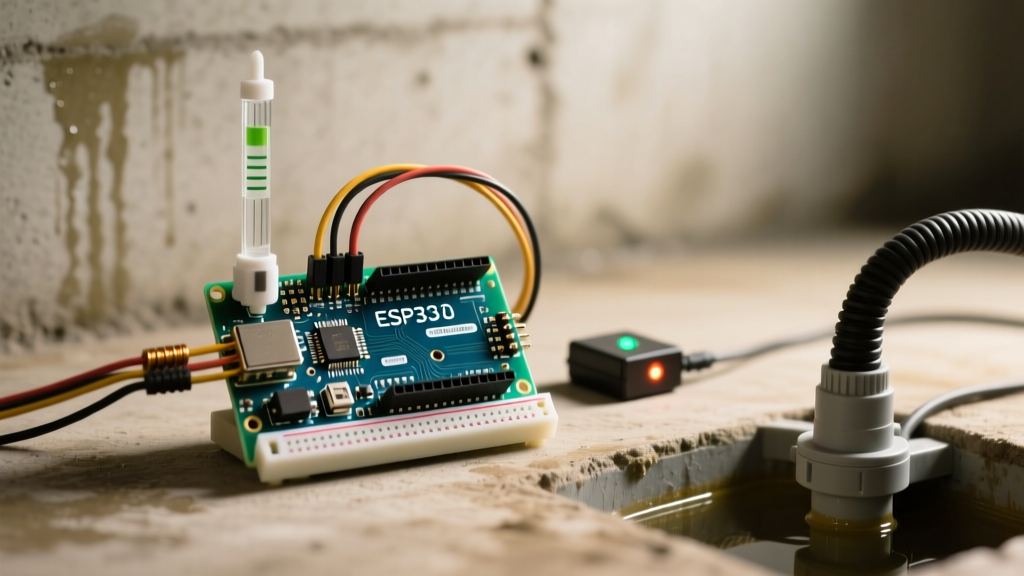
Commercial IoT water alarms are often limited to simple leak detection on the floor—alerting you only after the pump has already failed and the basement is flooding. As a real-world problem solver, we need predictive, actionable data. By building a custom Arduino IoT sump pump monitor, we can track the actual water level in the pit, monitor the electrical current drawn by the pump motor to detect jams or burnouts, and push real-time alerts to our phones before a single drop of water hits the basement floor.
Hardware Architecture: Beyond the Basic Ultrasonic Sensor
Many beginner tutorials suggest using the standard HC-SR04 ultrasonic sensor for water level measurement. In a damp, humid sump pit, the HC-SR04 will fail within weeks. Condensation builds up on the metal mesh, scattering the acoustic waves and resulting in phantom '0 cm' readings. To build a reliable system, we must select industrial-grade components.
The Microcontroller: Arduino Nano ESP32
For this project, the Arduino Nano ESP32 is the optimal choice. Priced around $21, it packs the dual-core ESP32-S3 chip into a breadboard-friendly Nano footprint. It features native WiFi, Bluetooth, and seamless over-the-air (OTA) update capabilities via the Arduino IoT Cloud, eliminating the need to unplug the device and drag a laptop into a damp basement every time you tweak the code.
Sensing the Unseen: Waterproof Level and Current Sensors
To measure the water level, we will use the JSN-SR04T waterproof ultrasonic sensor. Unlike the HC-SR04, the JSN-SR04T separates the transducer (which is sealed and can be submerged) from the control board via a 2.5-meter cable. This allows you to mount the control electronics safely above the water line while the acoustic cone hangs directly into the pit.
To detect pump failures, we will inline an ACS712-30A current sensor. If the float switch triggers but the ACS712 reads 0 Amps, the motor is dead or disconnected. If it reads a massive locked-rotor current spike, the impeller is jammed with debris. This dual-sensor approach provides complete situational awareness.
Bill of Materials and Wiring Strategy
| Component | Model / Spec | Approx. Cost | Role in System |
|---|---|---|---|
| Microcontroller | Arduino Nano ESP32 | $21.00 | WiFi processing, Cloud sync, logic |
| Level Sensor | JSN-SR04T (Waterproof) | $12.50 | Non-contact pit water level measurement |
| Current Sensor | ACS712-30A Module | $4.50 | Monitors pump motor draw and jams |
| Power Supply | LM2596 Buck Converter | $3.00 | Steps down 12V backup battery to 5V |
| Enclosure | IP65 ABS Junction Box | $8.00 | Protects electronics from humidity |
Power Considerations for Basements
A sump pump monitor is useless during a power outage—which is exactly when heavy storms cause the most flooding. Do not power this project via a standard USB wall adapter. Instead, tap into the 12V DC backup battery system that powers your sump pump's secondary DC motor, or use a dedicated 12V SLA (Sealed Lead Acid) battery. Use the LM2596 buck converter to step the 12V down to a clean 5V for the Nano ESP32 and the sensors.
Arduino IoT Cloud Configuration
The Arduino IoT Cloud abstracts away the complex MQTT broker setup required for traditional ESP32 projects. To configure your 'Thing', create the following variables:
- water_level_cm (Float, Read-Only, On Change): Tracks the distance from the sensor to the water surface.
- pump_current_amps (Float, Read-Only, On Change): Logs the real-time amperage draw of the pump.
- pump_status (Boolean, Read-Only, On Change): True if current > 2.0A.
- critical_alert (Boolean, Read-Only, On Change): Triggers push notifications if water exceeds the danger threshold.
On your Cloud Dashboard, map water_level_cm to a Gauge widget, and pump_current_amps to a Chart widget. The chart is crucial for identifying slow degradation in the pump motor over months of operation.
Writing Resilient Firmware: Handling Edge Cases
Writing code for the real world means assuming sensors will lie. Ultrasonic sensors are prone to acoustic echoes off the corrugated walls of the sump pit liner. If you simply take a single reading and push it to the cloud, your dashboard will look like a chaotic seismograph.
Always implement a median filter or a moving average array for ultrasonic readings in wet environments. Discard the top and bottom 20% of a 10-sample array before calculating the final distance.
Furthermore, basements are notorious WiFi dead zones due to the Faraday cage effect of concrete and rebar. Your code must include a robust reconnection loop. Instead of using delay(), which blocks the processor, use a millis() based timer to poll the sensors every 5 seconds, and check ArduinoCloud.connected() on every loop iteration to trigger a WiFi restart if the connection drops for more than 60 seconds.
Real-World Failure Modes and Troubleshooting
Even with premium hardware, environmental factors will test your build. Here is a troubleshooting framework based on field deployments of Arduino IoT water monitors:
1. The 'Condensation Blindness' Failure
Symptom: The JSN-SR04T reads a constant 0cm or 450cm (timeout).
Cause: While the transducer is waterproof, the acoustic cone can trap humid air, causing internal condensation.
Solution: Drill a tiny 1mm weep hole at the very bottom of the sensor housing to allow moisture to drain, and coat the exterior threads with marine grease to ensure an airtight seal against the pit lid.
2. The Phantom Current Spike
Symptom: The Arduino IoT dashboard shows the pump drawing 40 Amps for 10 milliseconds, triggering a false 'jammed motor' alert.
Cause: The ACS712 Hall-effect sensor is highly susceptible to electromagnetic interference (EMI) from the heavy-gauge AC wires powering the pump.
Solution: Keep the ACS712 and its low-voltage signal wires at least 6 inches away from the 120V AC pump wiring. Add a 0.1µF ceramic capacitor across the ACS712 analog output pin and GND to filter high-frequency noise.
3. Cloud Sync Timeouts
Symptom: Device connects to local WiFi but shows 'Offline' in Arduino IoT Cloud.
Cause: The concrete foundation attenuates the 2.4GHz signal below the threshold required for the MQTT TLS handshake.
Solution: Upgrade the Nano ESP32's antenna. The board features a U.FL connector; bypass the onboard PCB antenna and route a high-gain 2.4GHz dipole antenna up to the first-floor joists using an extension cable.
Conclusion
Building an Arduino IoT sump pump monitor transitions your home infrastructure from reactive to predictive. By combining the processing power of the Nano ESP32, the ruggedness of the JSN-SR04T, and the analytical depth of current monitoring, you create a system that doesn't just tell you when your basement is wet—it tells you when your pump is about to fail, giving you the critical window needed to intervene and save your home from catastrophic water damage.