
The Paradigm Shift: From Super-Loop to RTOS Task Commands
For years, the Arduino loop() function has been the default crutch for embedded development. While sufficient for blinking LEDs or reading a single sensor, modern IoT applications demand concurrent execution. When projects require simultaneous Wi-Fi provisioning, BLE scanning, and high-speed motor control, the sequential super-loop inevitably bottlenecks. This is where migrating to a Real-Time Operating System (RTOS) becomes mandatory.
When engineers search for freertos tasks command esp32, they are rarely looking for a single CLI terminal command. Instead, they are seeking the architectural pattern of commanding and managing tasks within the FreeRTOS ecosystem on Espressif's dual-core ESP32 silicon. Migration from a bare-metal Arduino sketch to a multi-threaded RTOS environment requires a fundamental shift in how we pass commands, manage state, and allocate hardware resources.
Anatomy of the FreeRTOS Tasks Command ESP32 Ecosystem
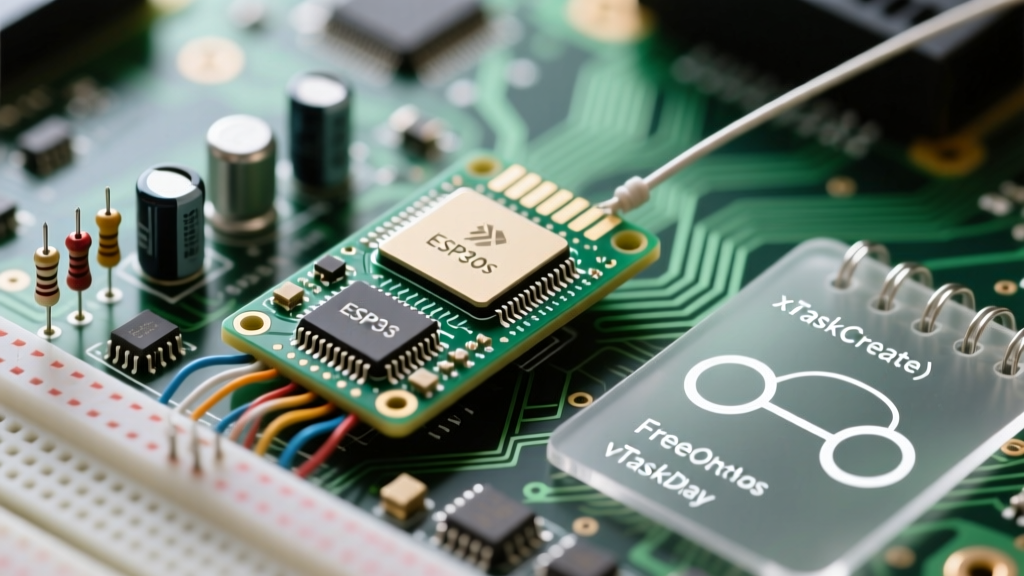
The ESP32 features two distinct Xtensa LX6 cores: the PRO_CPU (Core 0) and the APP_CPU (Core 1). By default, the Espressif IoT Development Framework (ESP-IDF) and the Arduino-ESP32 core reserve Core 0 for handling the heavy lifting of Wi-Fi and Bluetooth stacks. This leaves Core 1 primarily available for user-defined application tasks.
Core Pinning and Task Creation
To effectively command tasks, you must first instantiate them with precision. The standard Arduino setup() function is the ideal launchpad for spawning RTOS tasks. Unlike standard desktop threading, ESP32 FreeRTOS requires explicit stack allocation and core pinning.
The primary API for this is xTaskCreatePinnedToCore. This function dictates the task's code pointer, name, stack depth (in words, not bytes), parameters, priority, task handle, and the specific core ID. A common migration mistake is assigning a stack depth of 1024 words (4KB) to a task that utilizes Serial.printf or complex string formatting, which routinely demands 3000+ words of stack space, leading to immediate memory corruption.
Passing Commands via Queues and Notifications
In a legacy loop, commands are passed via global variables—a dangerous practice in an RTOS environment due to race conditions. To safely command a task, we utilize Inter-Process Communication (IPC). The FreeRTOS Queue Management system allows one task to send a structured command payload to another task's inbox, blocking or yielding until the receiving task processes it.
For lightweight, boolean-style commands (e.g., "wake up" or "reset state"), Task Notifications (xTaskNotifyGive) are vastly superior. They operate up to 45% faster than queues and consume zero additional RAM, as they leverage the intrinsic TCB (Task Control Block) of the receiving task.
Migration Matrix: Arduino Super-Loop vs. RTOS Commands
Understanding the direct translation of legacy concepts to RTOS paradigms is critical for a successful upgrade. The following table outlines the architectural shifts required during migration.
| Architecture Feature | Legacy Arduino loop() |
FreeRTOS Task Command |
|---|---|---|
| Execution Flow | Sequential, blocking, single-threaded | Preemptive, priority-driven, multi-core |
| Timing & Delays | delay() (Halts CPU entirely) |
vTaskDelay() (Yields to scheduler) |
| State Management | Global variables (Prone to race conditions) | Queues, Semaphores, Event Groups |
| Hardware Interrupts | ISRs modifying global flags | ISRs using xQueueSendFromISR |
| Core Utilization | Core 1 only (Core 0 handles RF) | Explicit pinning via xCoreID |
Step-by-Step Upgrade: Refactoring Legacy ESP32 Code
Migrating an existing codebase requires a methodical teardown of the super-loop. Do not attempt to wrap the entire loop() inside a single RTOS task; this defeats the purpose of the migration and often triggers the Task Watchdog Timer (TWDT).
Step 1: Decoupling the Polling Loop
Identify the distinct functional domains of your application. A typical smart-home sensor node might have three domains: Sensor Acquisition, Network Telemetry, and Local Actuation. Each domain must become an independent task. Create a dedicated TaskFunction_t for each, ensuring that the infinite loop inside the task ends with a vTaskDelay() to yield control back to the FreeRTOS scheduler.
Step 2: Implementing the Command Queue
Suppose your Network Telemetry task receives an MQTT payload commanding the Local Actuation task to toggle a relay. Instead of setting a global boolean, define a C-struct representing the command:
struct RelayCommand { uint8_t relayId; bool state; };
Initialize a queue in setup() using xQueueCreate(10, sizeof(RelayCommand)). When the MQTT callback fires, it packages the struct and pushes it via xQueueSend. The Actuation task waits indefinitely on xQueueReceive, awakening only when a valid command arrives, thereby consuming zero CPU cycles while idle.
Critical Pitfalls in ESP32 Task Migration
The transition to FreeRTOS is fraught with hardware-specific traps. The Espressif FreeRTOS API Reference highlights several ESP32-specific deviations from standard FreeRTOS that catch migrating developers off guard.
The Task Watchdog Timer (TWDT) Reset
If you create a high-priority task that enters a tight while(1) loop without yielding, the ESP32's TWDT will trigger a hardware reset. Unlike standard desktop operating systems, the ESP32 requires the Idle Task to run periodically to feed the watchdog and perform background memory cleanup. Always ensure your task loops contain a yield point, even if it is a microscopic vTaskDelay(1).
Stack Overflow and the High Water Mark
Allocating too little stack memory results in silent memory corruption, overwriting adjacent heap allocations and causing random, unreproducible crashes. To diagnose this during the migration testing phase, utilize the uxTaskGetStackHighWaterMark() function. This returns the minimum amount of free stack space (in words) that was available since the task started. If this value approaches zero, you must increase the usStackDepth parameter in your task creation command.
Pro-Tip for Migration: Never usestd::stringor heavy C++ objects on the stack of an ESP32 FreeRTOS task. These objects dynamically allocate memory and can cause unpredictable stack spikes. Prefer static allocation or heap allocation viaps_mallocif utilizing external PSRAM.
Upgrading to ESP-IDF 5.x and Arduino-ESP32 v3.x
As we move through 2026, the Arduino-ESP32 Core Repository has undergone massive structural changes, particularly with the release of v3.x, which aligns with ESP-IDF v5.1. Migrating your task commands requires awareness of these underlying shifts.
First, the default FreeRTOS tick rate (CONFIG_FREERTOS_HZ) has been standardized to 1000Hz (1ms ticks) in newer configurations, vastly improving the resolution of vTaskDelay and queue timeouts compared to the legacy 100Hz default. Second, memory allocation strategies for task stacks have been optimized to utilize internal SRAM2 before spilling into slower, SPI-bound PSRAM. When issuing task creation commands, developers can now leverage xTaskCreateStatic to allocate task memory from specific memory caps, ensuring that latency-critical tasks remain entirely within the ultra-fast internal SRAM, bypassing the PSRAM cache bottlenecks entirely.
Mastering the freertos tasks command esp32 architecture is not merely about copying and pasting API calls. It is about embracing a concurrent mindset, respecting the dual-core hardware topology, and utilizing IPC mechanisms to maintain thread safety. By systematically dismantling the super-loop and replacing it with robust, queue-driven task commands, your ESP32 projects will achieve the stability, responsiveness, and scalability required for modern commercial deployments.