
The Core Question: How Do I Wire an Electrical Outlet to Code?
When homeowners and DIYers ask, "how do i wire an electrical outlet," the focus is often on simply making the device work. However, as a senior electrical technician, my priority is ensuring your installation meets the rigorous safety standards of the National Electrical Code (NEC). Electrical malfunctions remain a leading cause of residential fires. According to the National Fire Protection Association (NFPA), electrical distribution and lighting equipment fires account for thousands of home structure fires annually, frequently stemming from loose connections, improper wire gauging, or bypassed ground paths.
This guide transcends basic tutorials. We will cover exact torque specifications, NEC article mandates for 2023/2026 adoption cycles, and the specific failure modes that cause standard receptacles to melt or arc.
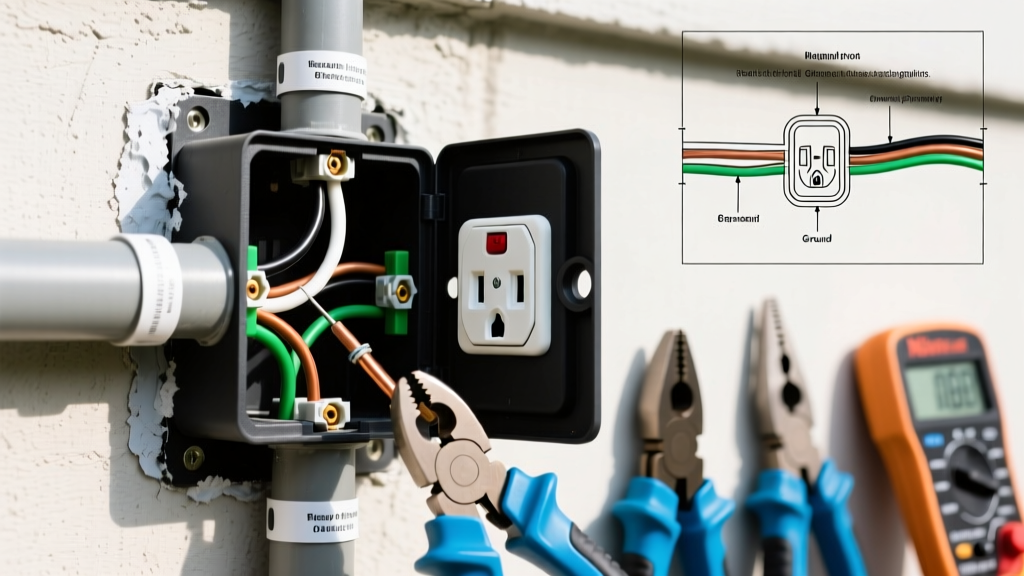
CRITICAL SAFETY WARNING: Always verify power is off using a dual-lead multimeter or a certified non-contact voltage tester (NCVT) before touching any conductors. If you are not the sole occupant of the home, apply a Lockout/Tagout (LOTO) device to the breaker panel to prevent accidental re-energization.
Essential Tools for Code-Compliant Wiring
Professional electricians do not rely on generic multi-tools for termination. Using the correct tools ensures you meet UL listing requirements and NEC mandates.
- Wire Strippers: Klein Tools 11055 (handles 10-20 AWG solid/stranded with precision shear stops to avoid nicking the copper).
- Torque Screwdriver: CDI 401SM or Ideal 35-078 (inch-pound calibrated). NEC 110.14(D) strictly requires terminations to be torqued to manufacturer specifications.
- Voltage Tester: Fluke T+PRO (verifies AC/DC voltage and tests GFCI trip circuits simultaneously).
- Receptacles: Leviton T5262 (15A Tamper-Resistant) or Eaton TR20W (20A Tamper-Resistant).
Step-by-Step Wiring Guide: Standard 15A and 20A Receptacles
Step 1: Prepare the Cable and Box (NEC 300.15)
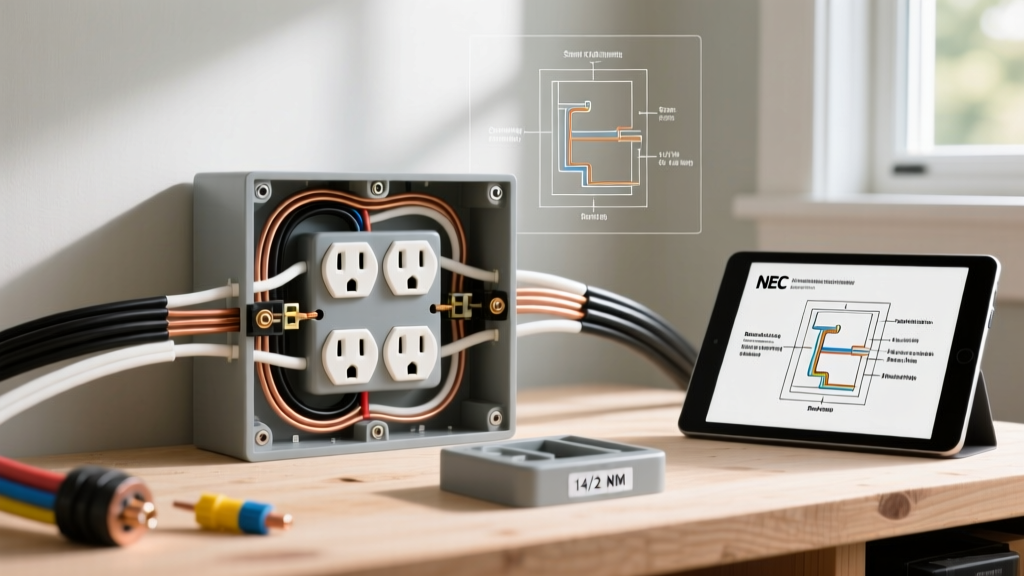
NEC Article 300.15 dictates that the outer jacket of NM-B (Romex) cable must extend at least 1/4 inch inside the electrical box. Stripping the jacket flush with the knockout hole exposes the inner conductors to the sharp metal edges of the box, which can slice the insulation over time and cause a ground fault or short circuit. Use a cable ripper to score the jacket and strip it back, ensuring 8 to 10 inches of free conductor length inside the box.
Step 2: Precision Wire Stripping
Nicking the copper conductor during stripping creates a microscopic weak point that will snap under thermal expansion cycles. Use the gauge hole on your receptacle as a stripping guide. Typically, 14 AWG and 12 AWG solid copper require exactly 3/4 inch of exposed conductor. If the bare copper extends past the terminal plate, you risk a short; if it is too short, the insulation will be clamped under the screw, resulting in a high-resistance connection and eventual thermal failure.
Step 3: Termination and Torque (NEC 110.14)
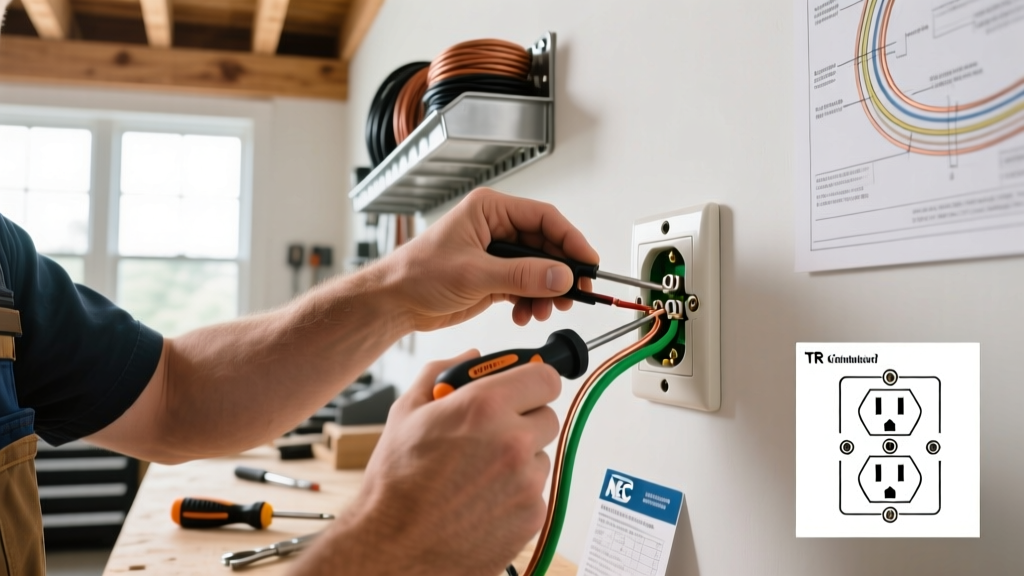
Form a J-hook in the stripped wire using needle-nose pliers. Hook the wire clockwise around the brass (hot) and silver (neutral) terminal screws. As you tighten the screw, the clockwise rotation pulls the loop tighter around the shaft. Connect the bare copper ground to the green screw.
Using your torque screwdriver, tighten the terminals to the manufacturer’s specification. For most standard 15A and 20A Leviton and Eaton receptacles, this is 14 inch-pounds. Under-torquing causes arcing; over-torquing strips the brass threads or deforms the wire.
Receptacle Wiring Matrix: Gauge, Breaker, and Torque
| Receptacle Rating | Wire Gauge (AWG) | Max Breaker Size | Min. Box Volume (cu in) | Standard Torque Spec |
|---|---|---|---|---|
| 15 Amp (Standard) | 14 or 12 | 15 Amp | 18.0 | 14 in-lbs |
| 20 Amp (Heavy Duty) | 12 Only | 20 Amp | 18.0 | 14 in-lbs |
| 20 Amp (Multi-Wire) | 12 (2 Hots, 1 Neutral) | 2x 20A (Handle Tied) | 20.25 | 14 in-lbs |
Note: Box volume calculations are based on NEC 314.16. Each 14 AWG conductor counts as 2.0 cu in; each 12 AWG counts as 2.25 cu in. The receptacle device itself counts as two conductor volumes.
Critical Code Compliance: TR, GFCI, and AFCI Rules
Understanding National Electrical Code updates is vital for passing inspections and ensuring life safety.
Tamper-Resistant (TR) Mandate (NEC 406.12)
All 15A and 20A, 125V and 250V non-locking receptacles installed in dwelling units must be Tamper-Resistant. TR receptacles feature internal spring-loaded shutters that only open when equal pressure is applied to both slots simultaneously (like a plug prong). Replacing a damaged standard outlet with a non-TR outlet is a direct code violation.
GFCI Protection (NEC 210.8)
Ground Fault Circuit Interrupter (GFCI) protection is mandatory in areas where water and electricity intersect. This includes kitchens, bathrooms, garages, outdoors, crawlspaces, unfinished basements, and within 6 feet of a wet bar sink. You can achieve this via a GFCI receptacle at the first point of the circuit or a GFCI breaker in the panel.
AFCI Protection (NEC 210.12)
Arc Fault Circuit Interrupter (AFCI) protection is required for almost all 120V, single-phase, 15A and 20A branch circuits supplying outlets in living rooms, bedrooms, hallways, and closets. This is typically handled at the breaker panel via a Combination Type AFCI breaker.
Common Failure Modes & Edge Cases
- The "Backstab" Push-In Connector Trap: Standard push-in (backstab) terminals on 15A receptacles are UL-listed only for 14 AWG solid wire. Inserting 12 AWG wire into a backstab damages the internal spring grip. Furthermore, thermal cycling causes the wire to expand and contract, eventually working loose and causing high-resistance arcing. Expert Advice: Never use backstabs. Use the screw terminals or the newer "back-wire" clamp plates found on commercial-spec receptacles.
- Multi-Wire Branch Circuits (MWBC): If you open a box and find two hot wires (usually black and red) sharing a single white neutral, you are on an MWBC. NEC 210.4 requires these breakers to have a handle tie or be a dual-pole breaker so both hots are disconnected simultaneously. Failing to do this can leave the neutral energized at 120V while you work on the circuit, resulting in lethal shock.
- Open Bootleg Grounds: In older homes, some DIYers wire a jumper between the neutral and ground screw to trick a receptacle tester into showing a "correct" wiring status. This is incredibly dangerous; if the neutral fails upstream, the metal chassis of any plugged-in appliance becomes fully energized at 120V.
Expert FAQ: Code Clarifications
Can I wire a 20A receptacle on a 15A breaker?
Yes. NEC 210.21(B)(3) allows 20A receptacles on a 15A circuit, provided it is not a single-receptacle circuit. However, you cannot wire a 15A receptacle on a 20A breaker, as the 15A device could be overloaded before the 20A breaker trips.
Do I need to pigtail the ground wire if I have multiple cables in the box?
Yes. If multiple cables enter the box, all bare ground wires must be spliced together with a wire nut (or Wago lever connector) and a single pigtail must run to the receptacle’s green ground screw. You cannot daisy-chain the ground through the receptacle itself, as removing the device would break the ground path for downstream outlets.
What is the maximum number of wires under one terminal screw?
NEC 110.14(A) states that terminals are generally approved for only one conductor unless the terminal is specifically identified and listed for multiple conductors. Never put two wires under a single standard receptacle screw.