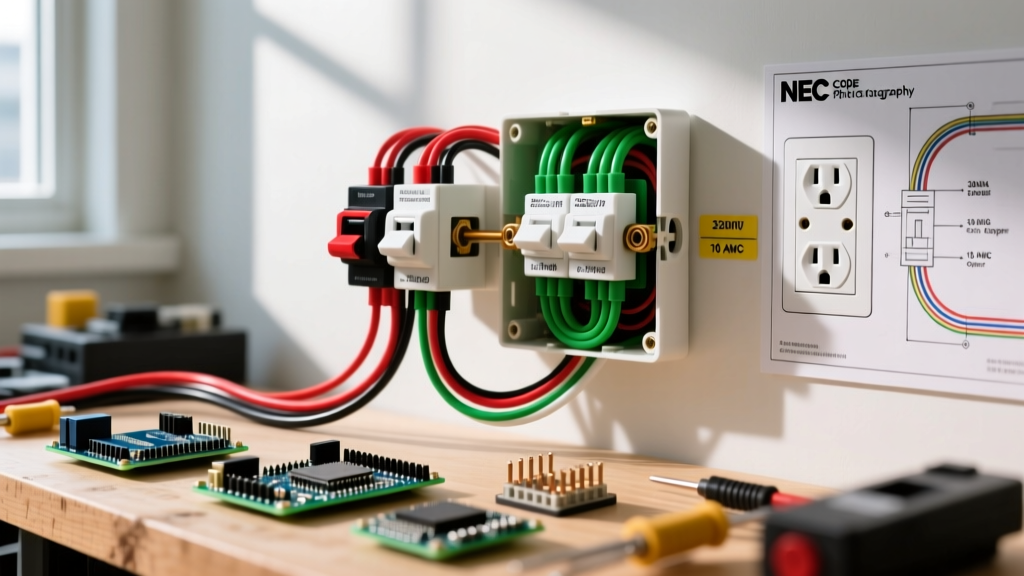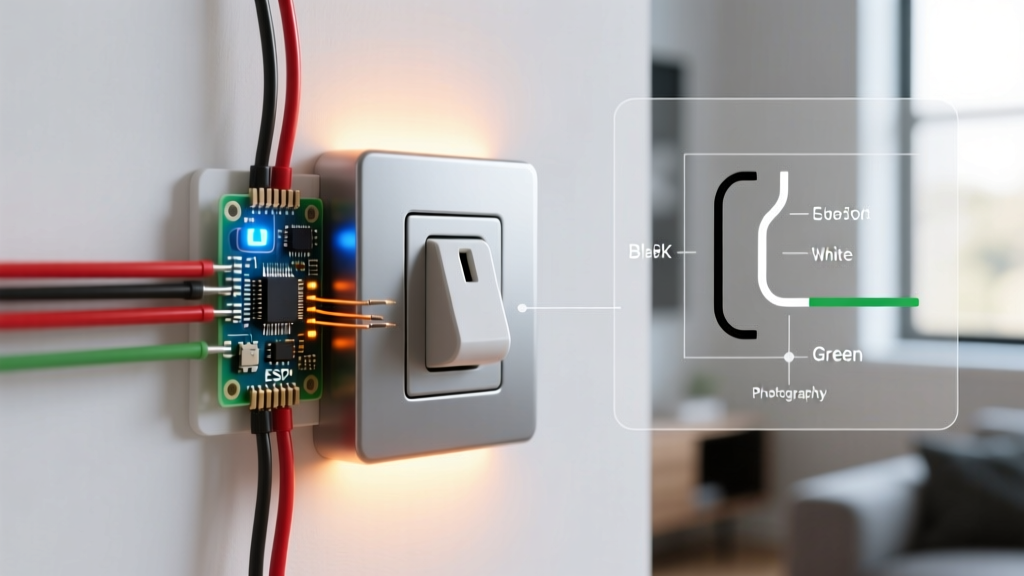

The Hidden Danger: What Is an Open Ground Electrical Outlet?
If you typed 'what is open ground electrical outlet' into a search engine after your receptacle tester lit up with a red warning, you are dealing with one of the most common—and potentially dangerous—electrical faults found in residential wiring. An open ground occurs when the equipment grounding conductor (the bare copper or green insulated wire) is disconnected, broken, or entirely missing from the circuit path between the receptacle and the main service panel.
In a properly wired 120-volt AC circuit, the ground wire does not carry current under normal operating conditions. Instead, it acts as an emergency safety valve. If a hot wire (black) frays and touches the metal chassis of an appliance like a refrigerator or washing machine, the ground wire provides a low-resistance path back to the panel. This massive surge of fault current instantly trips the circuit breaker, cutting power before a human touching the appliance can complete the circuit to the earth. When an open ground is present, that metal chassis remains energized at 120 volts, turning everyday appliances into lethal shock hazards.
Common Failure Modes and Root Causes
Understanding how this fault occurs is critical for accurate troubleshooting. The Occupational Safety and Health Administration (OSHA) frequently cites improper grounding in workplace and residential inspections. In modern homes, an open ground usually stems from one of the following physical failures:
- Daisy-Chain Breaks: In circuits where outlets are wired in series (line-to-load), a loose ground wire nut or a disconnected pigtail at an upstream receptacle will kill the ground for every downstream outlet.
- Backstabbed Connections: Older receptacles utilizing push-in backwire holes often fail to grip the bare ground wire securely, leading to thermal expansion and eventual disconnection over years of use.
- Drywall Screw Punctures: Renovations often result in drywall screws piercing the NM-B (Romex) cable inside the wall, severing the bare ground wire while leaving the insulated hot and neutral wires intact.
- Missing Ground in Older Wiring: Homes built before 1965 often utilized 2-wire (hot and neutral only) knob-and-tube or early NM cable. If a previous homeowner swapped 2-prong outlets for 3-prong outlets without pulling new wire, the ground terminal is completely unconnected.
Identifying the Fault: Advanced Testing & Diagnostics
While a standard $12 three-light receptacle tester can indicate an open ground (typically showing one yellow and one red light, depending on the brand), it cannot tell you why or where the fault is. For professional-grade diagnostics in 2026, electricians rely on advanced digital testers like the Klein Tools RT250 or the Amprobe INSP-3.
These LCD-based testers measure the exact impedance of the ground path and can detect 'bootleg grounds' (a dangerous code violation explained below). When testing, insert the tester firmly into the top and bottom receptacles. If the top reads 'Correct' and the bottom reads 'Open Ground', you have a broken internal jumper or a loose terminal screw on the receptacle itself. If both read 'Open Ground', the fault is upstream in the wall or at the panel.
NEC Code Compliance: Your Legal Repair Options
The National Fire Protection Association (NFPA) outlines strict rules for addressing ungrounded receptacles in the National Electrical Code (NEC). Under NEC Article 406.4(D), you cannot simply install a standard 3-prong receptacle on an ungrounded circuit. You must choose one of three compliant paths:
| Repair Method | NEC Code Reference | Avg. Cost (2026) | Safety Level | Surge Protector Compatible? |
|---|---|---|---|---|
| Full Circuit Rewire (Run new 12/2 or 14/2 NM-B) | NEC 250.118 / 406.4(D)(1) | $180 - $350 per drop | Maximum (True Ground) | Yes |
| GFCI Receptacle Replacement | NEC 406.4(D)(2)(c) | $25 - $45 (Parts) | High (Shock Protection Only) | No |
| Revert to 2-Prong Receptacle | NEC 406.4(D)(2)(a) | $5 - $10 (Parts) | Moderate (No false security) | No |
Option 1: Full Circuit Rewiring (The Gold Standard)
Pulling new wire is the only way to establish a true equipment ground. This involves running a new 12/2 AWG (for 20A circuits) or 14/2 AWG (for 15A circuits) NM-B cable from the panel or a properly grounded junction box to the outlet. While it requires drywall cutting, fishing wires, and patching, it is mandatory if you plan to plug in sensitive electronics, medical equipment (CPAP machines), or whole-house surge protectors that require a true ground to dissipate voltage spikes.
Option 2: GFCI Receptacle Replacement (The Code-Compliant Workaround)
If rewiring is structurally impossible (e.g., in a finished basement with no attic or crawlspace access), NEC 406.4(D)(2)(c) permits the installation of a Ground Fault Circuit Interrupter (GFCI). A GFCI does not create a ground wire; instead, it monitors the current balance between the hot and neutral wires. If it detects a variance as small as 4 to 6 milliamps (indicating current is leaking through a person to the earth), it trips in under 25 milliseconds, preventing lethal electrocution. Crucial Code Requirement: You must apply the 'No Equipment Ground' and 'GFCI Protected' stickers (included in the receptacle box) to the faceplate. Without these stickers, the installation fails municipal inspection.
Option 3: Reverting to a 2-Prong Receptacle
If you do not need a 3-prong plug and want to avoid the cost of a GFCI, you can legally replace the faulty 3-prong outlet with a standard 2-prong receptacle. This removes the false sense of security provided by an ungrounded 3-prong outlet.
Why 'Bootleg Grounds' Are a Fatal Code Violation
WARNING: A bootleg ground (jumpering the neutral terminal to the ground terminal) will trick a standard 3-light tester into reading 'Correct', but it creates an extreme electrocution hazard.
When unscrupulous handymen want to pass a home inspection without pulling new wire, they sometimes install a short jumper wire between the silver (neutral) screw and the green (ground) screw on the back of the receptacle. This is called a 'bootleg ground.' Because the neutral wire carries return current back to the panel, the tester sees continuity and registers a false 'pass.'
However, if the neutral wire ever becomes disconnected upstream (at a wire nut or the panel), the appliance chassis connected to that ground terminal will instantly become energized at 120 volts. Anyone touching the appliance will receive a fatal shock. Always verify a ground path using an impedance tester or by opening the receptacle box to visually confirm a dedicated bare/green wire connected to the grounding system.
Step-by-Step: Installing a GFCI on an Open Ground Circuit
If you are utilizing the NEC 406.4(D)(2)(c) workaround, follow these exact steps to ensure a safe, code-compliant installation using a modern slim-profile GFCI like the Leviton GFNT2-W (2026 retail price: ~$24).
- Kill the Power: Turn off the circuit breaker and verify zero voltage using a non-contact voltage tester (NCVT) and a digital multimeter (DMM) set to AC Volts. Test from hot-to-neutral and hot-to-ground.
- Extract and Inspect: Remove the old receptacle. Identify the 'LINE' wires (power coming from the panel) and 'LOAD' wires (power continuing to downstream outlets). Use a voltage sniffer to confirm which black/white pair is the LINE.
- Strip and Prepare: Strip exactly 3/4 inch of insulation from the 14 AWG or 12 AWG wires. Do not leave exposed copper outside the terminal.
- Terminate LINE Wires Only: Connect the LINE hot (black) and LINE neutral (white) to the brass and silver screws marked 'LINE' on the GFCI. Do not connect anything to the green ground screw, as the circuit lacks a ground.
- Apply Torque: Per NEC 110.14(D), use a calibrated torque screwdriver (e.g., Wiha 61080) set to the manufacturer's specification. Leviton requires 12 in-lbs for their 15A/20A GFCI terminal screws to prevent thermal arcing.
- Wrap and Secure: Wrap the perimeter of the receptacle with high-quality electrical tape (e.g., 3M Super 33+) to cover the terminal screws, protecting against accidental short circuits inside a crowded metal or plastic junction box.
- Label the Faceplate: Affix the 'No Equipment Ground' and 'GFCI Protected' labels to the visible exterior of the cover plate.
- Test the Circuit: Restore power. Press the 'TEST' button on the GFCI to ensure it trips, then press 'RESET'. Use your receptacle tester to verify it now reads 'GFCI Protected / Open Ground'.
Frequently Asked Questions (FAQ)
Can I use a surge protector on an open ground outlet?
No. Standard plug-in surge protectors rely on Metal Oxide Varistors (MOVs) to divert excess voltage spikes to the ground wire. Without a true equipment ground, the MOVs have nowhere to route the surge, rendering the surge protector useless. Furthermore, plugging a surge protector into an ungrounded outlet violates the UL listing of the device and voids any connected equipment warranties. For surge protection on ungrounded circuits, you must rely on a whole-home Type 1 or Type 2 Surge Protective Device (SPD) installed at the main service panel.
Does a GFCI work without a ground wire?
Yes. The Electrical Safety Foundation International (ESFI) confirms that GFCIs operate entirely on the principle of current balance (Kirchhoff's Current Law), not grounding. The internal toroidal transformer measures the current leaving on the hot wire and returning on the neutral wire. If 5 milliamps 'leaks' out of the circuit (e.g., through a person's body to a concrete floor), the GFCI detects the imbalance and trips, regardless of whether a copper ground wire is present in the box.
Will an open ground cause a breaker to trip?
No. A standard thermal-magnetic circuit breaker only trips when the current exceeds the breaker's amperage rating (e.g., 15A or 20A) or during a direct hot-to-neutral short circuit. An open ground will not trip a standard breaker during a ground fault, which is exactly why the metal chassis of an appliance remains energized and dangerous until a human touches it and completes the circuit.