
The Anatomy of a Level 2 EV Charging Circuit
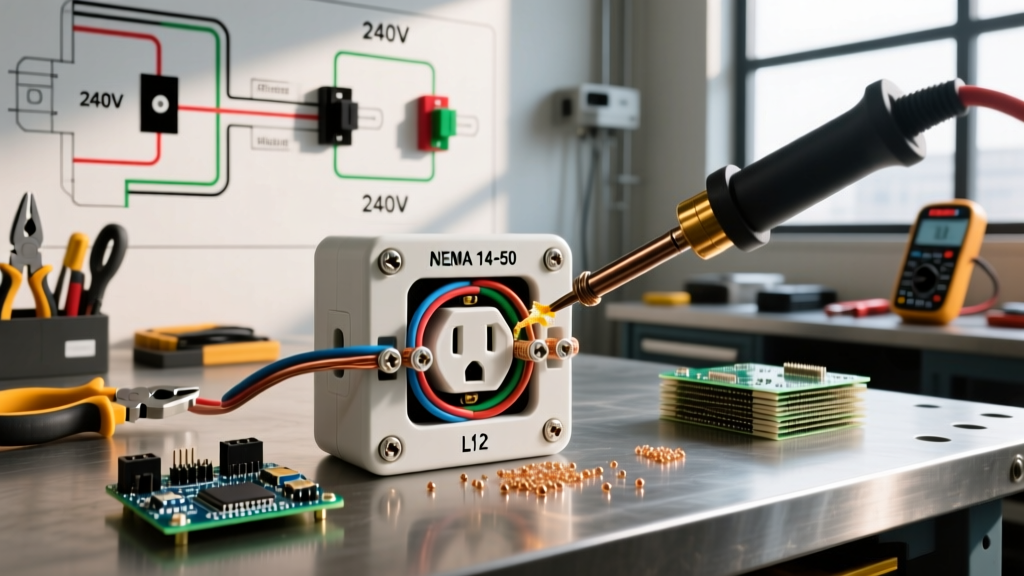
As electric vehicle (EV) adoption accelerates in 2026, upgrading from a standard 120V Level 1 trickle charger to a 240V Level 2 setup is the most impactful modification an EV owner can make. Learning how to install 240 volt outlet for electric car charging requires a firm grasp of National Electrical Code (NEC) continuous load rules, proper wire sizing, and thermal management. The undisputed industry standard for residential EV charging is the NEMA 14-50R receptacle, capable of delivering up to 12.5 kW of power when paired with a 50-amp circuit.
Unlike a standard dryer outlet, an EV charger draws maximum current for 8 to 12 hours straight. This classifies it as a continuous load under NEC Article 100, triggering strict 125% sizing multipliers for both the breaker and the conductors. According to the U.S. Department of Energy, a properly installed Level 2 home charger can add up to 30 miles of range per hour of charging, making a robust, code-compliant installation critical for daily usability and fire safety.
Why NEMA 14-50R is the Industry Standard
The NEMA 14-50 configuration features four prongs: two hot legs (120V each, 180 degrees out of phase for 240V total), one neutral, and one ground. While some older homes use NEMA 6-50 (which lacks a neutral), modern EVSE (Electric Vehicle Supply Equipment) units from Tesla, Rivian, Ford, and ChargePoint universally utilize the 14-50 plug to accommodate internal 120V logic boards and future-proofing requirements.
⚠️ CRITICAL HARDWARE WARNING: Do not use standard residential-grade receptacles (like the Leviton 279-S00) for EV charging. Continuous 40A loads cause standard brass contacts to expand, arc, and melt over time. You must use a commercial/industrial grade receptacle like the Hubbell 9450A or Bryant 9450FR, which feature massive copper-alloy contacts designed for sustained thermal loads.
Materials & Cost Breakdown (2026 Pricing)
Below is a realistic bill of materials for a standard 50-foot conduit run from a 200-amp main panel to a garage wall. Prices reflect 2026 market averages for copper and steel.
| Component | Specification / Model Number | Est. Cost |
|---|---|---|
| Receptacle | Hubbell 9450A (Industrial Grade NEMA 14-50R) | $85.00 |
| Circuit Breaker | Square D HOM250 or Eaton BR250 (50A 2-Pole) | $45.00 |
| Conductors | 4 AWG Copper THHN/THWN-2 (Black, Red, White, Green) | $110.00 |
| Conduit & Fittings | 3/4" EMT, connectors, and LL conduit body | $65.00 |
| Wall Box | 2-Gang Extra-Duty Metallic Box | $18.00 |
| Miscellaneous | Wire lugs, EMT straps, torque screwdriver rental | $40.00 |
| Total Estimated Material Cost | $363.00 | |
Step-by-Step Installation Guide
Step 1: Panel Capacity & Load Calculation
Before purchasing materials, you must perform an NEC Article 220 load calculation. A 50-amp breaker draws heavily on your electrical service. If you have a 100-amp main panel with electric heat, an electric oven, and an electric dryer, adding a 50A EV circuit will likely exceed your panel's capacity, requiring a service upgrade or a smart load-management panel (like the Span drive or Emporia VUE). A 200-amp panel typically has ample headroom for a 50A EVSE circuit.
Step 2: Running the Conduit and Wire
- Mount the Box: Secure the 2-gang metallic box to a wall stud. The NEC requires the receptacle to be mounted between 18 and 48 inches above the garage floor to prevent damage and ensure easy cord management.
- Run the EMT: Use 3/4-inch Electrical Metallic Tubing (EMT) from the panel to the box. EMT provides superior physical protection and acts as an additional ground path, though we will still pull a dedicated green grounding wire.
- Pull the Conductors: Use a fiberglass fish tape to pull four strands of 4 AWG THHN copper wire.
- Black & Red: Hot legs (X and Y phases)
- White: Neutral (required for NEMA 14-50, even if the EVSE doesn't actively use it)
- Green: Equipment Grounding Conductor (EGC)
Pro-Tip on Wire Sizing: While 6 AWG copper is technically rated for 55A at 60°C and legally permitted on a 50A breaker, the Electrical Safety Foundation International (ESFI) and master electricians strongly recommend upsizing to 4 AWG copper for EV circuits. This mitigates voltage drop on runs over 50 feet and provides vital thermal headroom inside the receptacle enclosure during 10-hour charging sessions.
Step 3: Terminating the NEMA 14-50R
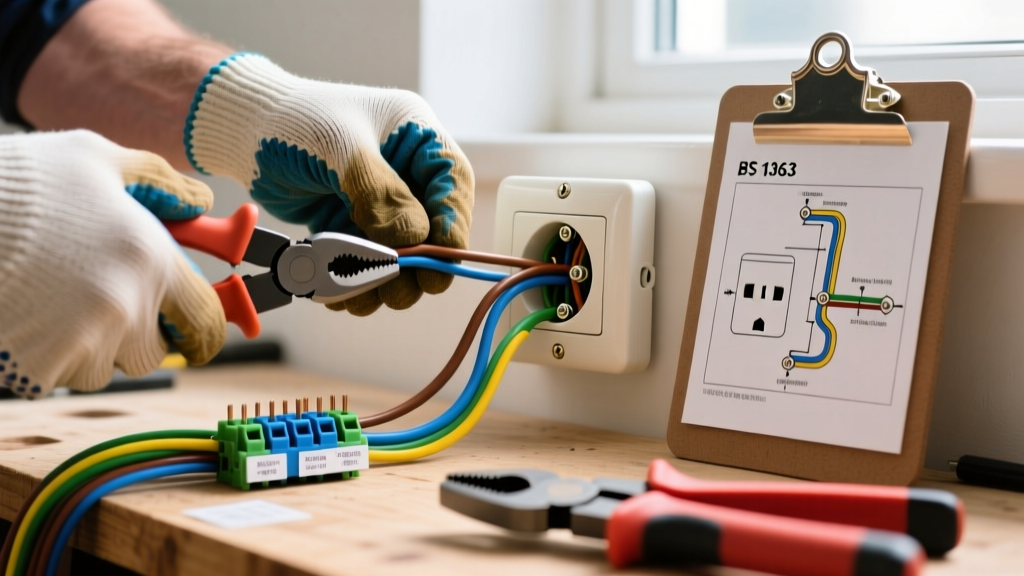
Terminating 4 AWG wire requires precision and the right tools. Strip exactly 1 inch of insulation from the wire ends. Insert the wires into the Hubbell 9450A terminal blocks.
The Torque Requirement (NEC 110.14(D)): Since 2017, the NEC mandates that all terminations must be tightened to the manufacturer's specified torque. The Hubbell 9450A requires 75 inch-pounds of torque. You must use a calibrated torque screwdriver. Under-tightening causes arcing and fires; over-tightening shears the screw heads or damages the wire strands.
Common Failure Modes & Edge Cases
The "Continuous Load" NEC Trap
Many DIYers mistakenly believe that because their EVSE is rated for 40 amps, they can wire it to a 40-amp breaker. This is a direct violation of NEC Article 210.19(A)(1). Because EV charging is a continuous load (3 hours or more), the circuit must be sized at 125% of the load.
40A EVSE × 1.25 = 50A Breaker.
If you buy a 48A EVSE, you must multiply by 1.25, resulting in a 60A minimum breaker, which requires a NEMA 14-60 outlet or a hardwired connection. Always match the breaker to the EVSE's maximum continuous draw, not its peak surge.
Thermal Runaway in Residential Receptacles
Why do we insist on the Hubbell 9450A? Standard residential 14-50 receptacles use thin, stamped brass internal wipers. When a 40A load is applied for 8 hours, the electrical resistance generates heat. The brass softens, losing its spring tension. The next time you plug the car in, the loose connection creates an arc, generating temperatures exceeding 400°F, melting the plastic faceplate and potentially igniting the garage wall. The Hubbell 9450A uses heavy-duty copper-alloy contacts and a thermoset phenolic faceplate that will not melt or catch fire. For deeper code context, refer to the National Fire Protection Association (NFPA) guidelines on continuous load thermal management.
Frequently Asked Questions
Do I need a GFCI breaker for a garage NEMA 14-50?
Yes. Under NEC 2020 and later editions (including 2026), all 50-amp receptacles installed in garages, basements, and outdoors require Ground Fault Circuit Interrupter (GFCI) protection. You must use a 50A 2-pole GFCI breaker (e.g., Square D HOM250GFIC). Note that some EVSE units have built-in GFCI logic; if a nuisance trip occurs due to "double GFCI" protection, the NEC allows the receptacle to be removed and the EVSE to be hardwired directly, which bypasses the receptacle GFCI requirement.
Can I use aluminum wire to save money?
You can use aluminum, but you must upsize significantly. To achieve the equivalent ampacity and thermal safety of 4 AWG copper, you must use 2 AWG aluminum (XHHW-2). Furthermore, you must use anti-oxidant paste (Noalox) on the aluminum terminations and ensure the Hubbell receptacle terminals are explicitly rated for aluminum (AL/CU). Due to the difficulty of bending 2 AWG aluminum in 3/4" conduit, copper remains the preferred choice for residential retrofits.
What if my panel is full?
If your panel lacks physical spaces, do not use "tandem" or "cheater" breakers to free up room for a 2-pole 50A breaker; tandem breakers only provide 120V. You will need to install a sub-panel or utilize a smart breaker solution like the Leviton Smart Load Center to dynamically shed loads (like turning off the electric oven while the car charges) to stay within your main breaker's limit.