
Why Testing Precedes Every Outlet Upgrade
Upgrading an electrical outlet in 2026 is rarely as simple as swapping a $2 standard duplex receptacle for a $25 USB-C combo or a $35 GFCI model. Behind the faceplate lies a branch circuit that may harbor hidden faults, degraded wiring, or code violations. If you install a high-draw smart receptacle or a GFCI on a compromised circuit, you risk nuisance tripping, equipment damage, or electrical fires. According to the U.S. Consumer Product Safety Commission (CPSC), faulty receptacles and degraded wiring connections are leading contributors to residential electrical fires. Before you purchase upgrade materials, you must rigorously test electrical outlet circuits to establish a baseline of safety and capacity.
The Diagnostic Toolkit: Precision Over Guesswork
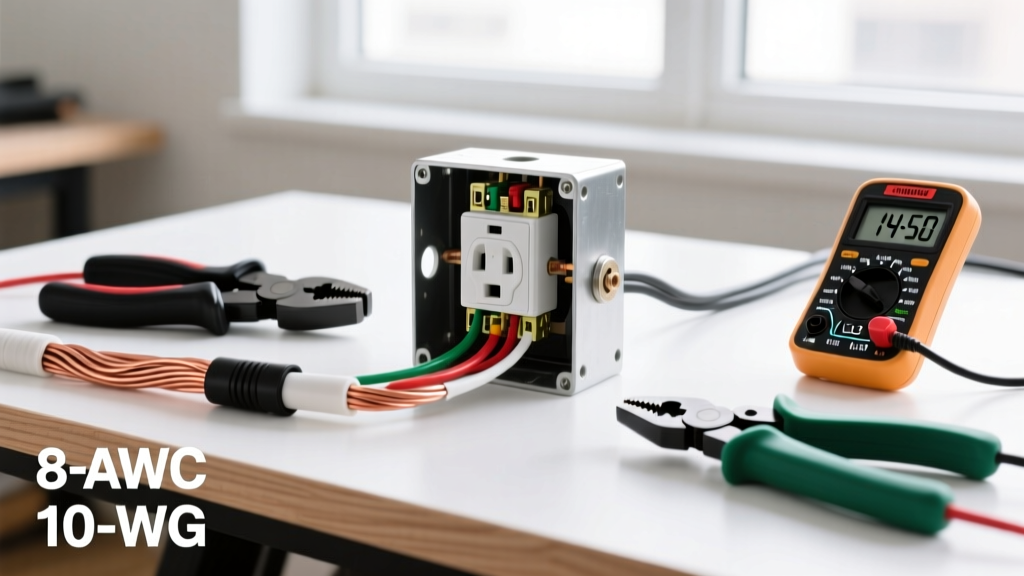
To accurately diagnose receptacle health, abandon the cheap $5 neon testers. Professional-grade diagnostics require tools that measure true RMS voltage, detect phantom voltages, and verify ground impedance.
- Klein Tools RT250 GFCI Receptacle Tester (~$28): Unlike basic 3-light testers, the RT250 features an LCD screen that displays exact line voltage, verifies GFCI trip times, and detects bootleg grounds.
- Fluke 117 True RMS Multimeter (~$220): Essential for measuring neutral-to-ground voltage drop and identifying shared neutral (MWBC) configurations.
- Ideal SureTest Circuit Analyzer (~$180): For advanced diagnostics, this tool measures exact ground impedance in ohms and verifies the let-through energy of existing GFCIs.
Step-by-Step: How to Test Electrical Outlet Wiring
Follow this sequential diagnostic flow to evaluate the physical and electrical integrity of the receptacle before planning your upgrade.
Phase 1: Physical Tension and Visual Inspection
Before applying power, test the physical grip of the receptacle contacts. Plug in a standard 3-prong appliance cord and pull it straight out. If the plug slides out with less than 3 to 4 pounds of force, the internal brass tension springs are fatigued. Loose contacts cause arcing, which melts the thermoplastic faceplate and creates a severe fire hazard. Action: The receptacle must be replaced immediately; no upgrade to smart or USB models will fix degraded internal contacts.
Phase 2: Polarity and Voltage Verification
- Plug the Klein RT250 into the top receptacle.
- Verify the LCD reads between 115V and 125V. Readings below 110V indicate a voltage drop issue (often caused by undersized wire or loose connections upstream).
- Check the fault indicators. If the screen reads 'HOT/NEU REV', the wiring is reversed—a common DIY error that leaves the device energized even when switched off.
Phase 3: The Neutral-to-Ground Voltage Drop Test
This is the most critical test for determining if a circuit can handle a modern upgrade. Set your Fluke 117 to AC Volts. Insert the black probe into the neutral slot (the longer slot) and the red probe into the ground hole (the U-shape).
Expert Benchmark: A healthy circuit will read less than 1.0V (ideally under 0.5V) between neutral and ground. If you read 2.0V or higher, the circuit is either overloaded, or there is a loose neutral connection somewhere upstream in the panel or a junction box. Do not upgrade to high-draw receptacles until the neutral path is secured.
Phase 4: Hunting for 'Bootleg' Grounds
In older homes (pre-1960s), ungrounded 2-prong outlets were often illegally upgraded to 3-prong outlets by jumpering the neutral terminal to the ground screw. This is a 'bootleg ground.' It tricks standard 3-light testers into showing a 'correct' wiring status, but it poses a lethal shock hazard if the neutral wire ever disconnects. To test for this, turn off the breaker, remove the receptacle cover, and inspect the side terminals. If you see a bare copper or green wire connecting the silver (neutral) screw to the green (ground) screw, you have a bootleg ground. Remove the jumper immediately.
Decoding Test Results: The Upgrade Decision Matrix
Use the results from your diagnostic tests to determine the correct upgrade path. The National Fire Protection Association (NFPA) outlines strict requirements for receptacle replacements in the National Electrical Code (NEC).
| Diagnostic Test Result | Underlying Fault | Required Upgrade Action & NEC Compliance |
|---|---|---|
| Open Ground (No Equipment Ground) | Missing ground wire in older NM-B or BX cable. | Upgrade to a GFCI receptacle. Label faceplate 'No Equipment Ground' per NEC 406.4(D)(4). Do not connect the GFCI ground screw to the metal box unless the box is verifiably grounded. |
| Neutral-to-Ground > 2.0V | Loose neutral, long wire run, or overloaded circuit. | Do NOT upgrade to USB or smart receptacles yet. Tighten all neutral connections upstream. Check panel bus bar for oxidation. |
| 14 AWG Wire on 15A Breaker | Standard residential lighting/outlet circuit. | Upgrade to 15A Tamper-Resistant (TR) duplex or 15A GFCI. Never install a 20A receptacle on 14 AWG wire. |
| 12 AWG Wire on 20A Breaker | Kitchen, dining, or heavy appliance circuit. | Upgrade to 20A TR receptacles (e.g., Leviton T-Rex 20A). Ensure the new device has internal back-wire clamps, not push-in backstabs. |
| Open Neutral | Broken neutral wire or failed backstab connection upstream. | Immediate hazard. Power must remain OFF. Trace and repair the open neutral before any receptacle upgrade is attempted. |
Strategic Upgrade Paths for 2026
Once your test electrical outlet diagnostics confirm a healthy baseline circuit, choose your upgrade based on location and modern load requirements.
1. The GFCI Upgrade (Wet & Damp Locations)
Under recent NEC adoptions, GFCI protection is required in kitchens, bathrooms, garages, outdoors, crawl spaces, and unfinished basements. If you are replacing a standard receptacle in these areas, you must upgrade to a GFCI. Pro Tip: Use a 20A rated GFCI (like the Leviton GFNT2) even if the breaker is 15A, as 20A GFCIs feature heavier-duty internal contacts that dissipate heat better and last longer under frequent testing.
2. The AFCI Upgrade (Living Spaces)
If your testing reveals an older standard receptacle in a bedroom, living room, or hallway, the circuit should ideally be protected by an Arc Fault Circuit Interrupter (AFCI). While AFCI breakers in the panel are preferred, if the panel is full or incompatible, upgrading the first receptacle in the branch to an AFCI receptacle (e.g., Eaton AFTR15) provides downstream protection for the rest of the room.
3. The USB-C PD (Power Delivery) Upgrade
For nightstands and home offices, upgrading to a USB-C PD receptacle is highly desirable. However, these devices draw a continuous internal standby load and generate heat. Only install USB-C PD receptacles (like the Leviton USB-C PD 30W model) on circuits where your neutral-to-ground voltage test confirmed a robust, low-resistance path. Avoid installing them in deep, crowded junction boxes where heat cannot dissipate; always use deep 22-cubic-inch boxes for USB upgrades.
Wiring Best Practices During Replacement
When you execute the physical upgrade, abandon the use of push-in 'backstab' connections. Spring-loaded backstabs are notorious for loosening over time due to thermal expansion and contraction, leading to high-resistance faults. Instead, use the side-wiring terminals or, preferably, the screw-and-clamp 'back-wire' mechanism found on commercial-grade receptacles (typically costing $4 to $8 each, compared to $1.50 for builder-grade). Always torque the terminal screws to the manufacturer's specification, usually around 14 in-lbs, using a calibrated torque screwdriver to ensure optimal contact pressure.
Frequently Asked Questions
Can I test an electrical outlet without removing the cover plate?
Yes, for basic voltage, polarity, and GFCI trip-time testing, a plug-in analyzer like the Klein RT250 is sufficient. However, you cannot test for bootleg grounds, verify wire gauge, or check terminal torque without removing the faceplate and extracting the receptacle from the junction box.
Why does my new GFCI trip immediately after upgrading?
If your newly installed GFCI trips instantly, you likely have a neutral-to-ground fault downstream, or you have wired the LINE and LOAD terminals backward. Furthermore, if the circuit is a Multi-Wire Branch Circuit (MWBC) with a shared neutral, a standard GFCI will not function correctly and will trip continuously. You must use a 2-pole GFCI breaker for MWBCs instead of a receptacle-based GFCI.
Is it safe to upgrade a 2-prong outlet to a 3-prong outlet without a ground wire?
Under NEC 406.4(D), you are legally permitted to replace an ungrounded 2-prong receptacle with a 3-prong GFCI receptacle, provided you affix the included 'GFCI Protected' and 'No Equipment Ground' labels to the faceplate. The GFCI will protect against shock, but it will not provide a true equipment ground for surge protectors or sensitive electronics. For a true ground, a licensed electrician must pull a new equipment grounding conductor back to the panel.
Safety Directive: Always verify that the circuit is de-energized using a non-contact voltage tester (NCVT) and a multimeter before touching any bare wires. As outlined by OSHA electrical safety standards, treating every conductor as live until proven dead is the foundational rule of electrical diagnostics.