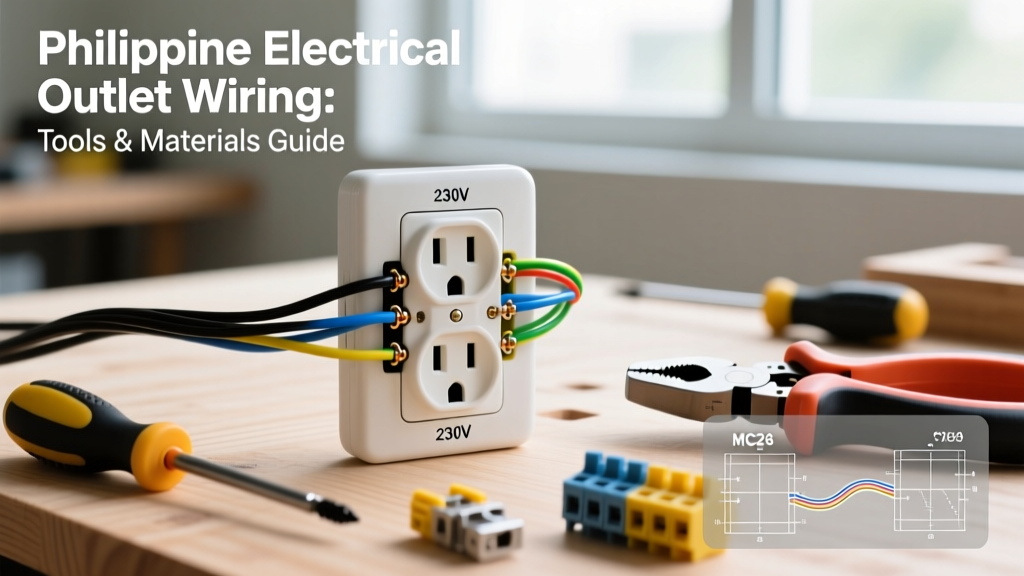

The Great Paradox: NEMA Plugs at 230V
If you are an expatriate, traveling electrician, or DIY enthusiast working in the Philippines, you will immediately notice a visual paradox: the wall receptacles look exactly like standard North American NEMA 1-15 (Type A) or NEMA 5-15 (Type B) outlets. However, the power flowing through them is 230V at 60Hz. This unique configuration is a hallmark of the Philippine Electrical Code (PEC), which historically adapted US physical standards but aligned with international voltage levels.
CRITICAL SAFETY WARNING: Never plug a standard US 120V appliance directly into a Philippine electrical outlet without a step-down transformer. The physical plug will fit perfectly, but the 230V supply will cause immediate catastrophic failure, component explosion, and severe fire hazards. Always verify voltage with a multimeter before connecting foreign equipment.
As of 2026, the nominal voltage standard in the Philippines has fully transitioned to 230V ±10% (up from the legacy 220V designation) to harmonize with international grids, while maintaining the 60Hz frequency. This guide details the exact tools, materials, and installation protocols required to safely wire, upgrade, and troubleshoot Philippine electrical outlets.
Essential Tools for Philippine Electrical Work
Working on Philippine grids requires tools that can handle metric wire sizing, 230V potential, and occasionally noisy provincial power supplies. Here is the professional-grade toolkit required for the job.
Diagnostic & Testing Equipment
- Fluke 117 True RMS Multimeter: Provincial grids in the Philippines often suffer from harmonic distortion due to heavy inductive loads (like aging air conditioning units and water pumps). A True RMS meter is non-negotiable for getting accurate 230V readings on non-linear loads.
- Fluke 2AC VoltAlert Non-Contact Voltage Tester: Essential for verifying dead circuits before removing receptacle faceplates. Note that in older Philippine homes with shared neutral/ground buses, phantom voltages can trigger standard testers; the Fluke 2AC's adjustable sensitivity helps mitigate false positives.
- Receptacle Tester (Custom 230V): Standard US 120V receptacle testers will blow their internal neon bulbs or LEDs if plugged into a PH outlet. You must source or build a 230V-rated polarity tester, or rely on your multimeter to check Line-to-Neutral (230V), Line-to-Ground (230V), and Neutral-to-Ground (~0V).
Hand Tools for Termination
- Klein Tools 11063W Wire Strippers: Philippine wiring utilizes both AWG and metric cross-sectional areas. This tool cleanly strips 2.0 mm² (approx. 14 AWG) and 3.5 mm² (approx. 12 AWG) THHN/THWN solid copper wire without nicking the conductor.
- Wera VDE Insulated Screwdrivers: Rated for 1,000V, these are critical when working in tight uPVC junction boxes where 230V conductors are in close proximity to the grounding terminal.
Material Selection: Receptacles, Wire, and Boxes
Selecting the right materials is where local knowledge separates a safe installation from a fire hazard. The Philippine market is dominated by specific local and regional brands.
Receptacle Brands and Models
The most common receptacle found in the Philippines is the "Universal" socket, designed to accept Type A (flat), Type B (flat with ground), and Type C (Europlug round pins). While convenient, they are not all created equal.
- Panasonic Nano Series (e.g., WEG7502): The gold standard for Philippine residential wiring. Features high-retention internal brass grips and superior arc-resistant urea resin housing. Priced around $4.50 - $6.00 USD per unit.
- Royu Universal Receptacle: Ubiquitous in hardware stores across the archipelago. Highly affordable ($1.50 - $2.50 USD) and accepts almost any global plug. Expert caveat: The internal leaf springs on standard Royu universal sockets tend to fatigue and loosen after 2-3 years of heavy use, leading to arcing. Reserve these for low-draw lighting circuits, not heavy appliance circuits.
- Omni / Schneider Electric: Excellent for commercial and industrial applications, offering heavy-duty 20A rated NEMA 5-20R equivalents adapted for 230V.
Wire Sizing and Insulation Types
The PEC mandates the use of THHN or THWN copper conductors. Unlike the US, which strictly uses AWG, Philippine electrical suppliers primarily sell wire by metric cross-sectional area.
- 2.0 mm² (Equivalent to 14 AWG): Rated for 15A to 20A circuits. Standard for general-purpose 230V lighting and receptacle circuits.
- 3.5 mm² (Equivalent to 12 AWG): Rated for 20A to 25A circuits. Required for window-type air conditioners, water heaters, and kitchen appliance dedicated outlets.
- 5.5 mm² (Equivalent to 10 AWG): Used for heavy 30A loads like central air conditioning condensing units or large electric ranges.
Top Local Brands: Phelps Dodge (now part of a larger conglomerate but still the legacy name), Metro Cables, and Pacific Cables. Always look for the PS (Philippine Standard) mark or ICC (Import Commodity Clearance) sticker on the wire insulation.
US vs. Philippine Electrical Specifications
Understanding the exact deviations between North American standards (NEC) and Philippine standards (PEC) is vital for material procurement and safety. For deeper reference on international plug types, consult the IEC World Plugs database.
| Specification | United States (NEC) | Philippines (PEC) |
|---|---|---|
| Nominal Voltage | 120V / 240V (Split-Phase) | 230V (Single-Phase) |
| Frequency | 60 Hz | 60 Hz |
| Standard Plug Type | NEMA 1-15 / NEMA 5-15 | NEMA 1-15 / 5-15 / Universal |
| Standard Wire Sizing | AWG (14, 12, 10) | Metric mm² (2.0, 3.5, 5.5) |
| Hot Wire Colors | Black, Red, Blue | Black, Red, Blue |
| Neutral Wire Color | White or Gray | White or Gray |
| Ground Wire Color | Green, Green/Yellow, Bare | Green, Green/Yellow, Bare |
| Wall Box Material | Steel / Fiberglass | uPVC (Masonry) / Steel |
Step-by-Step Installation Protocol
Installing a receptacle in a Philippine masonry wall (the most common residential construction method) involves specific techniques due to the use of embedded uPVC junction boxes.
- Isolate and Verify: Turn off the 2-pole or 1-pole breaker at the main distribution panel. Use the Fluke 2AC to verify the absence of voltage at the faceplate.
- Prepare the Conductors: Strip exactly 12mm (1/2 inch) of insulation from the 2.0 mm² or 3.5 mm² THHN wires. Do not over-strip; exposed copper outside the terminal block is a severe shock hazard at 230V.
- Terminate Line and Neutral: Wrap the Black (Line) wire clockwise around the brass terminal screw. Wrap the White (Neutral) wire clockwise around the silver terminal screw. Tighten to 1.2 Nm (12 in-lbs) to prevent thermal creep.
- Secure the Ground: Attach the Green/Bare wire to the green grounding screw. Crucial Note: In many older Philippine homes built before the 2000s, a true equipment grounding conductor may be missing. If no ground wire exists in the uPVC box, you must pull a new ground wire back to the panel or install a 230V GFCI receptacle (labeled "No Equipment Ground") as permitted by the PEC for retrofit scenarios.
- Mount and Test: Secure the receptacle to the uPVC box using the provided M4 machine screws. Restore power and test with a True RMS multimeter: Line-to-Neutral should read ~230V; Line-to-Ground ~230V; Neutral-to-Ground < 2V.
Common Failure Modes and Troubleshooting
When troubleshooting Philippine electrical outlets, electricians frequently encounter edge cases born from legacy wiring practices and grid instability.
The "Bootleg Ground" Hazard
Because many older provincial homes lack a grounding rod or grounding busbar, some unlicensed handymen install a jumper wire between the Neutral terminal and the Ground terminal on the receptacle. This is known as a bootleg ground. If the neutral wire ever breaks upstream, the metal chassis of any plugged-in 230V appliance will become fully energized at 230V. Always test for this by measuring resistance between Neutral and Ground with the power off; a reading of near-zero ohms indicates a dangerous bootleg ground.
Provincial Voltage Drop and Brownouts
In areas outside Metro Manila, particularly during the dry season when hydroelectric output fluctuates, grid voltage can sag to 190V–210V under heavy neighborhood load. While modern switching power supplies (like laptop chargers) can handle this, 230V AC compressor motors (refrigerators, AC units) will draw excess amperage to compensate for the low voltage, leading to overheating. If you measure consistent voltage below 215V at the outlet under load, recommend the installation of a whole-house Automatic Voltage Regulator (AVR) or a dedicated UPS for sensitive electronics.
References and Code Compliance
All electrical work in the Philippines must comply with the latest iteration of the Philippine Electrical Code (PEC), which is heavily based on the NFPA 70 (National Electrical Code) but adapted for local materials and 230V single-phase distribution. Always ensure your installations are inspected and signed off by a licensed Professional Electrical Engineer (PEE) or Registered Master Electrician (RME) to secure the necessary permits from the local Office of the Building Official (OBO) and the local electric cooperative (e.g., Meralco, VECO, or provincial co-ops).


