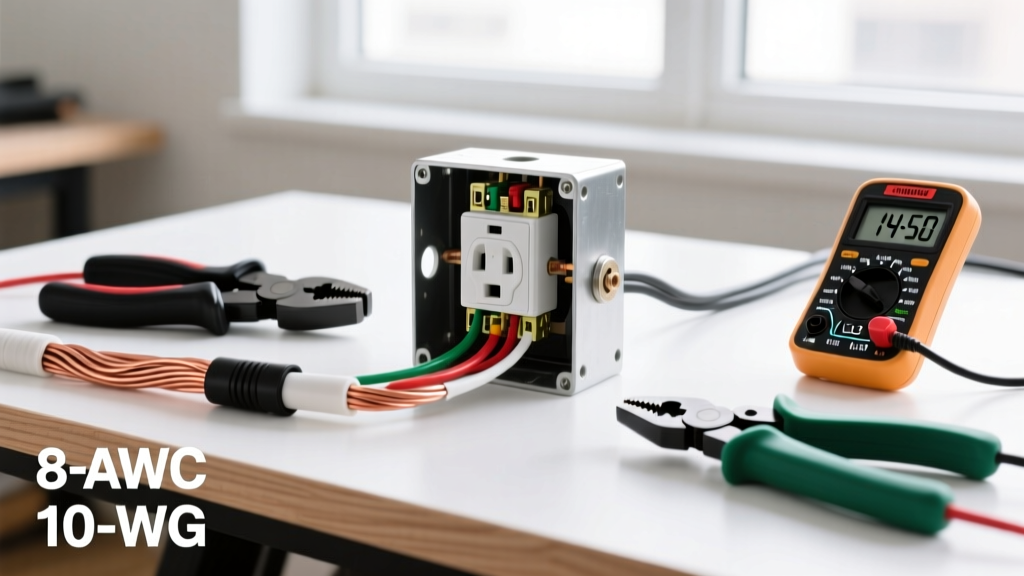

The Foundation: NEC Article 210.52 and the '6/12 Rule'
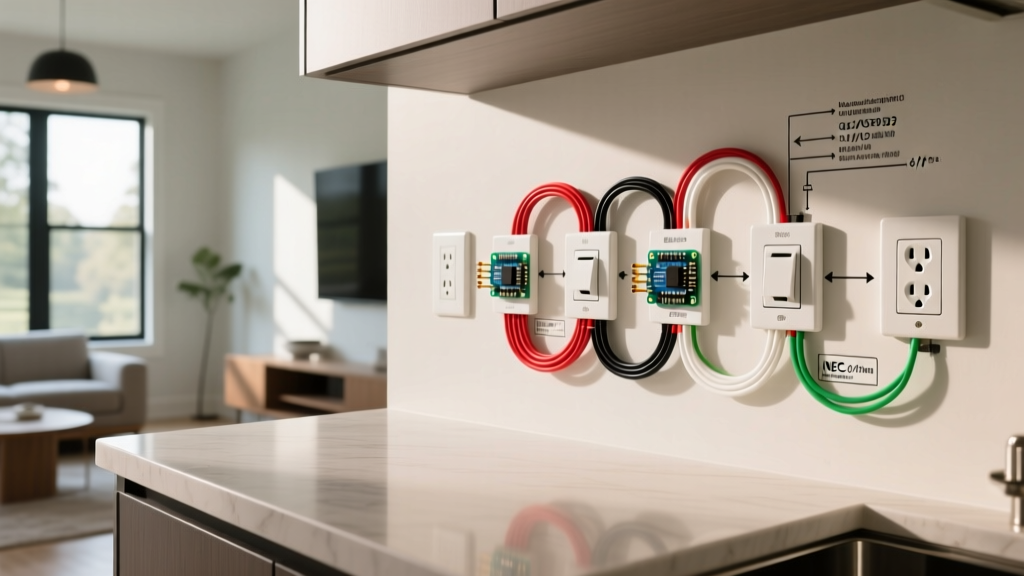
The electrical outlet spacing code is not an arbitrary suggestion; it is a critical fire safety standard designed to eliminate the reliance on extension cords. According to the U.S. Consumer Product Safety Commission (CPSC), extension cords are responsible for approximately 3,300 home fires annually, causing dozens of deaths and hundreds of injuries. The National Electrical Code (NEC), specifically Article 210.52, dictates exactly where receptacles must be placed to ensure that a standard 6-foot appliance cord can reach an outlet from any point along a wall.
This is universally known among electricians as the 6/12 Rule. The logic is straightforward: if no point along the floor line can be more than 6 feet from a receptacle, then receptacles can be spaced a maximum of 12 feet apart. However, applying this rule requires a precise understanding of what constitutes 'wall space' and how different rooms alter the baseline requirements.
Pro Tip: Always verify your local jurisdiction's adopted code cycle. While the National Fire Protection Association (NFPA) publishes the NEC, local municipalities may adopt the 2020 or 2023 versions, which contain significant differences regarding kitchen islands and AFCI protection.
Room-by-Room Electrical Outlet Spacing Code Matrix
Different environments demand different spacing and circuit requirements. Below is a comprehensive matrix detailing the NEC requirements for standard residential spaces.
| Room / Area | NEC Section | Max Spacing / Placement Rule | Special Requirements |
|---|---|---|---|
| Living / Family Rooms | 210.52(A) | 12 feet apart; 6 ft from any corner | Walls 2 ft or wider require an outlet. Floor receptacles count if within 18 inches of the wall. |
| Bedrooms | 210.52(A) | 12 feet apart; 6 ft from any corner | Must be on an AFCI-protected circuit. Outlets cannot be blocked by fixed furniture. |
| Kitchen Countertops | 210.52(C) | No point > 24 inches from a receptacle | Requires at least two 20A Small Appliance Branch Circuits (SABC). Max 4 feet between outlets. |
| Bathrooms | 210.52(D) | Within 3 feet of the basin outside edge | Must be GFCI protected. Cannot be the sole outlet for a light fixture. No face-up countertop outlets. |
| Hallways | 210.52(H) | At least one if hallway is 10 ft or longer | Measured along the centerline of the hallway. Wall space includes areas broken by doorways. |
| Unfinished Basements | 210.8(A)(5) | At least one receptacle required | Must be GFCI protected. Spacing rules of 210.52(A) do not strictly apply unless finished. |
The 2023 NEC Island and Peninsula Update: A Major Shift
One of the most significant changes in recent electrical history—and a vital piece of knowledge for anyone studying the electrical outlet spacing code today—is the treatment of kitchen islands and peninsulas. Under the 2020 NEC and earlier, receptacles were mandatory on islands and peninsulas. This resulted in cords stretching across cooking surfaces, creating a severe hazard where hot pots of water or oil could be pulled down onto children or adults.
Under the 2023 NEC (Section 210.52(C)(2) and (3)), receptacles are no longer required to be installed at islands and peninsulas. Furthermore, if you choose to install them, they cannot be the only receptacles serving the countertop, and they must be mounted on the side, not face-up on the countertop surface. As of 2026, most progressive jurisdictions have adopted this safety update, meaning electricians must actively advise homeowners against adding top-mount island outlets during kitchen remodels.
How to Measure Wall Space for Code Compliance
Inspectors use a specific methodology to verify compliance with the electrical outlet spacing code. To pass inspection, you must measure the 'wall space' exactly as defined by NEC 210.52(A)(2). Here is the step-by-step professional method:
- Start at the Doorway: Begin your measurement at the edge of a door frame or opening that is wider than 2 feet.
- Follow the Floor Line: Measure continuously along the unbroken floor line. This includes measuring around outside corners, but you stop at inside corners if the wall space is broken by a doorway or fireplace.
- Account for Fixed Objects: Fireplaces, fixed bookcases, and doorways break the wall space. A new 6-foot measurement begins on the other side of the obstruction.
- Identify 'Nibs' and Short Walls: Any isolated wall space that is 2 feet or more in width (such as the space between a door frame and a corner) legally requires its own receptacle.
- Verify Furniture Clearance: The code assumes standard furniture placement. An outlet located behind a permanently fixed radiator or a built-in entertainment center does not count toward the spacing requirement.
Common Spacing Violations That Fail Inspections
Even experienced DIYers and novice electricians frequently trigger red tags from local inspectors. Avoid these common electrical outlet spacing code violations:
- The 'Behind the Door' Trap: Installing an outlet on a wall space that is entirely covered when a door swings open 90 degrees. The receptacle must be accessible without moving the door or removing obstacles.
- Ignoring the 2-Foot Nib Rule: Failing to place a receptacle on a 2.5-foot wall section between a sliding glass door and the corner of the room. Because it is over 2 feet, it requires a dedicated outlet, even if one is 5 feet away on the adjacent wall.
- Countertop Spacing Errors: Using the 6/12 rule for kitchen counters. Countertops require that no point along the wall line is more than 24 inches from a receptacle, meaning outlets must be spaced no more than 48 inches apart.
- Non-Tamper Resistant (TR) Receptacles: While not strictly a 'spacing' issue, installing standard receptacles instead of TR-rated models (like the Leviton T5280-W) in any area requiring spacing compliance will result in an automatic failure in modern jurisdictions.
Do USB and Smart Receptacles Count Toward Spacing?
With the rise of integrated charging, many homeowners ask if USB-equipped outlets count toward the electrical outlet spacing code. The answer is yes, provided the device is UL-listed and maintains the standard 15A or 20A 120V receptacle configuration. For example, the Leviton T5632-2BW (a 15A Tamper-Resistant duplex receptacle with USB Type-C and Type-A ports, retailing around $22.00) perfectly satisfies NEC 210.52 spacing requirements while adding modern utility. However, dedicated USB-only charging plates that lack standard 120V prong slots do not satisfy the code.
Frequently Asked Questions
Does the electrical outlet spacing code apply to finished basements?
Yes. Once a basement is finished with drywall and flooring, it is treated as standard living space under NEC 210.52(A). The 6/12 rule applies, and all 120V, 15A and 20A receptacles must be AFCI protected.
Can floor receptacles be used to meet the 6/12 rule?
Floor receptacles can only be counted toward the wall space spacing requirement if they are located within 18 inches of the wall. This is governed by NEC 210.52(A)(3). You must use UL-listed floor boxes rated for the specific flooring material (e.g., concrete vs. wood joist).
What is the minimum height for a wall receptacle?
Surprisingly, the NEC does not specify a minimum height for general wall receptacles in standard residential construction. However, the Fair Housing Act and ADA guidelines often influence local codes, pushing standard installation heights to between 15 and 48 inches from the floor. In garages, receptacles are typically mounted at 48 inches to avoid physical damage and keep them above potential flood levels.
How do I handle outlets in rooms with vaulted ceilings and short walls?
If a wall is less than 2 feet in width at the floor line due to an angled vaulted ceiling, it does not require a receptacle. The measurement is strictly based on the horizontal floor line. For deeper insights into complex architectural compliance, Mike Holt Enterprises provides excellent visual diagrams and code breakdowns for edge-case residential layouts.
Understanding and applying the electrical outlet spacing code ensures your home is not only legally compliant but fundamentally safer. By adhering to NEC Article 210.52, you eliminate the fire hazards associated with daisy-chained power strips and undersized extension cords, creating a resilient electrical infrastructure for modern living.