
The Hidden Code Traps in Outlet Repair
When an electrical receptacle fails, the physical act of swapping it out takes less than fifteen minutes. However, the legal and safety requirements governing that swap are dictated by the National Electrical Code (NEC). As local jurisdictions enforce the 2023 NEC and transition into the 2026 code cycle, simply replacing a broken outlet with an identical-looking model from the hardware store is often a direct code violation.
According to the National Fire Protection Association (NFPA), electrical distribution and lighting equipment failures are a leading cause of home structure fires. The NEC updates its receptacle requirements to mitigate these exact failure modes. Whether you are a homeowner tackling a DIY repair or an apprentice electrician, understanding the code requirements when fixing an electrical outlet is non-negotiable for safety, insurance validity, and passing inspections.
1. The Tamper-Resistant (TR) Mandate (NEC 406.12)
If you are fixing an electrical outlet in almost any area of a modern home, you can no longer use a standard, non-tamper-resistant receptacle. NEC Article 406.12 mandates that all 15-amp and 20-amp, 125-volt and 250-volt non-locking receptacles installed in dwelling units must be listed as Tamper-Resistant (TR).
- The Mechanism: TR receptacles feature internal shutter mechanisms that require simultaneous, equal pressure on both slots to insert a plug. This prevents children from inserting single objects like paperclips or keys.
- The Code Trap: If a TR outlet breaks in a living room, you cannot replace it with a cheaper standard duplex receptacle (which costs around $1.25). You must install a TR model, such as the Leviton T5320-W (typically $3.50 to $4.50).
- Exceptions: Receptacles located more than 5.5 feet above the floor, or those dedicated to specific appliances (like a behind-the-fridge outlet), are exempt, but using TR universally is the safest baseline.
2. The "No Equipment Ground" Loophole (NEC 406.4(D))
One of the most common scenarios when fixing an electrical outlet in older homes (pre-1960s) is discovering an ungrounded metal box or a two-wire Romex cable with no bare copper ground wire. You cannot simply install a standard 3-prong receptacle; doing so creates a "false ground," a severe shock hazard and an immediate code violation.
NEC 406.4(D)(2) provides a specific, legal pathway to fix this without tearing open your walls to run new grounded cable:
- Install a GFCI Receptacle: Replace the ungrounded outlet with a Ground-Fault Circuit Interrupter (GFCI), such as the Hubbell GFR83-W ($22.00 - $28.00).
- Apply the Sticker: You must apply the "No Equipment Ground" sticker (included in the GFCI packaging) to the faceplate.
- Downstream Protection: If you wire standard TR receptacles to the "LOAD" terminals of this GFCI, they are also protected, but they too must bear the "No Equipment Ground" and "GFCI Protected" labels.
Expert Note: A GFCI protects against lethal ground faults by monitoring current imbalance, but it does not provide an actual equipment ground. Surge protectors plugged into a GFCI-protected, ungrounded outlet will not function correctly, as they require a true ground path to divert transient voltage.
3. GFCI and AFCI Upgrade Triggers (NEC 210.8 & 210.12)
The NEC operates on a "grandfather" clause for existing installations—meaning you don't have to rewire your whole house every time the code changes. However, the moment you are fixing or replacing an outlet, you trigger the requirement to bring that specific location up to current code.
GFCI Expansion Zones
If you are replacing an outlet in a location that now requires GFCI protection under recent NEC cycles, you must upgrade. Current zones include:
- Kitchens (all countertop receptacles)
- Bathrooms, laundry areas, and utility sinks
- Garages, accessory buildings, and crawl spaces
- Outdoors (including balconies and decks)
- Basements and unfinished areas
AFCI Considerations
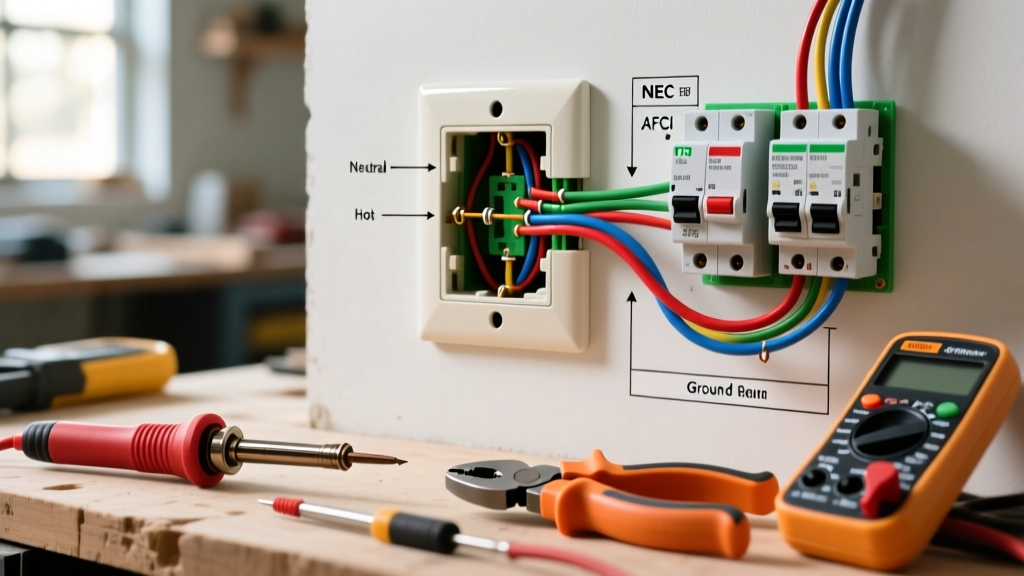
Arc-Fault Circuit Interrupter (AFCI) protection is typically handled at the breaker panel rather than the receptacle itself. However, if you are fixing an outlet in a bedroom or living room and the breaker is already an AFCI type, ensure your replacement receptacle does not create nuisance tripping through improper neutral sharing or backstabbed connections.
4. Mechanical and Wiring Code Standards
How you physically terminate the wires is just as regulated as the type of outlet you choose. The Occupational Safety and Health Administration (OSHA) and the NEC emphasize reliable mechanical connections to prevent thermal arcing.
Termination Torque (NEC 110.14(D))
Since the 2017 NEC cycle, and strictly enforced in 2023/2026, terminations must be torqued to the manufacturer's specifications. For standard 15A and 20A receptacles, this is typically 14 in-lbs. Professionals use a calibrated torque screwdriver (like the Klein Tools 70305 or Wiha 61014) to ensure the screw is tight enough to prevent arcing, but not so tight that it strips the brass terminal plate.
Wire Stripping and Placement
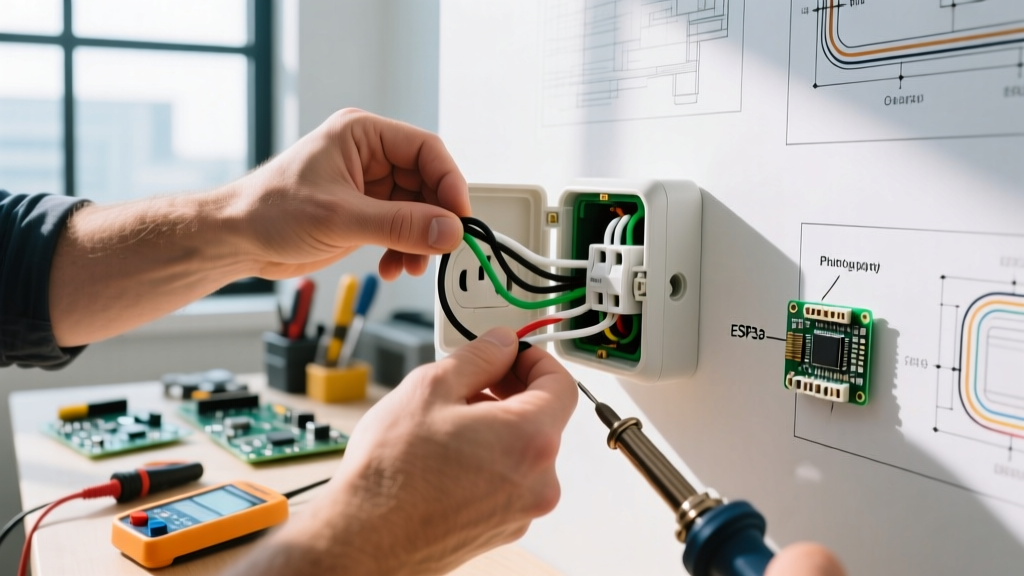
Every UL-listed receptacle features a wire stripping gauge molded into the back of the yoke. Stripping too much wire leaves exposed copper outside the terminal (a shock and short-circuit hazard). Stripping too little results in the screw clamping onto the wire insulation, leading to a high-resistance connection and eventual melting.
Code Violation vs. Compliant Fix: Comparison Matrix
| Scenario | Common (Illegal) DIY Fix | Code-Compliant Solution | Estimated Material Cost |
|---|---|---|---|
| Broken 2-prong outlet in 1950s home | Install standard 3-prong outlet and ignore ground | Install GFCI receptacle + apply "No Equipment Ground" label | $25.00 (GFCI + Cover) |
| Cracked outlet in modern living room | Replace with standard $1.25 non-TR duplex | Install 15A Tamper-Resistant (TR) Spec-Grade receptacle | $3.50 - $5.00 |
| Loose wires on back of receptacle | Push wires into "back-stab" push-in holes | Form J-hook, wrap clockwise around side terminal, torque to 14 in-lbs | $0 (Labor/Tool adjustment) |
| Outlet near kitchen sink is dead | Replace with standard TR receptacle | Replace with 20A GFCI TR receptacle (if on countertop circuit) | $22.00 - $30.00 |
5. Prohibited Practices: Instant Code Violations
When fixing an electrical outlet, avoid these common pitfalls that violate the NEC and compromise safety:
- Backstabbing (Push-In Connectors): While technically allowed by UL for 14 AWG solid wire on cheap receptacles, the NEC's mandate for reliable connections makes this a liability. The internal spring contacts loosen over time due to thermal expansion and contraction, causing arcing fires. Always use side-wiring or screw-clamp back-wiring.
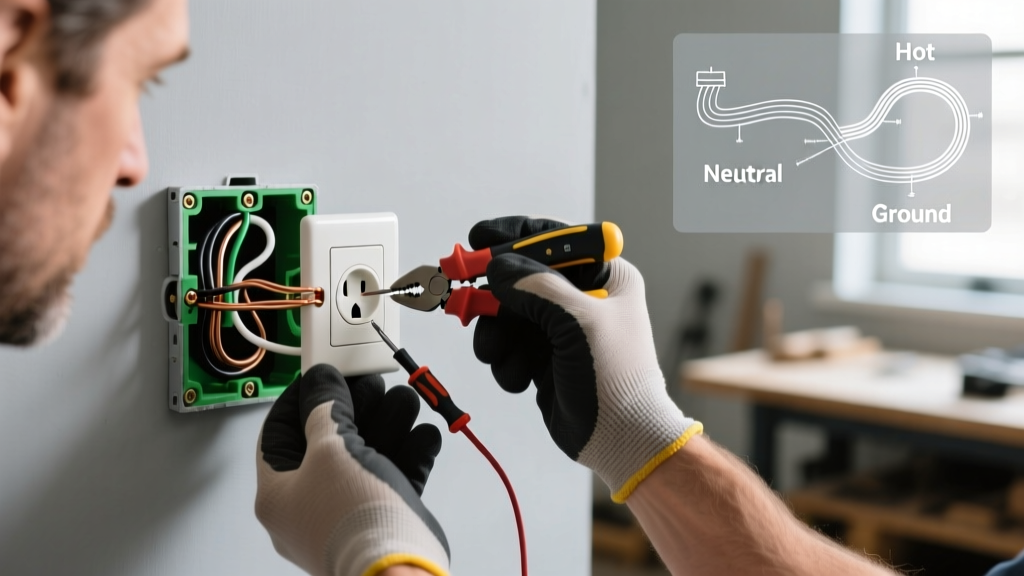
- Bootleg Grounds: Never install a jumper wire between the neutral (silver) terminal and the ground (green) terminal to trick a receptacle tester into showing a "correct" wiring status. This is a lethal violation; if the neutral wire breaks upstream, the metal casing of any plugged-in appliance will become energized at 120V.
- Box Fill Violations (NEC 314.16): If you are adding pigtails to fix a damaged wire, ensure the electrical box has the cubic inch capacity to handle the extra wire nuts and conductors. Overstuffing a box crushes the drywall and damages wire insulation.
- Reversed Polarity: The hot (black/red) wire must terminate on the brass screw, and the neutral (white) wire must terminate on the silver screw. Reversing these means the internal switch of a plugged-in lamp will interrupt the neutral, leaving the bulb socket energized even when turned off.
Final Safety and Inspection Notes
The U.S. Consumer Product Safety Commission (CPSC) strongly advises that any electrical work, including seemingly simple outlet replacements, be verified for safety. After fixing an electrical outlet, always use a digital multimeter or a dedicated receptacle tester (like the Klein Tools RT210) to verify correct wiring, GFCI trip functionality, and proper grounding status before plugging in any loads.
By adhering strictly to NEC Articles 406, 210, and 110, you ensure that your repair not only restores power but actively protects the occupants and the structure from electrical hazards for decades to come.