
The Core Mechanism of GFCI Electrical Outlets
Ground Fault Circuit Interrupters (GFCIs) are non-negotiable life-safety devices designed to prevent lethal electrocution. Unlike standard circuit breakers that protect wiring from thermal overloads (typically tripping at 15 or 20 amps), GFCI electrical outlets monitor the current differential between the hot and neutral conductors. If the internal toroidal current transformer detects a leakage as small as 4 to 6 milliamps (mA)—indicating that electricity is escaping the intended path, potentially through a human body—the device trips in under 25 milliseconds. As of 2026, the U.S. Consumer Product Safety Commission (CPSC) estimates that GFCIs have prevented tens of thousands of fatal shocks since their widespread adoption.
2023 NEC Code Expansions for GFCI Protection
The National Electrical Code (NEC) continuously evolves to close safety loopholes. Under the 2023 NEC cycle, which governs most municipal inspections through 2026, Article 210.8 has expanded GFCI requirements significantly. Previously, protection was largely limited to 125-volt, single-phase, 15- and 20-ampere receptacles. The modern code now mandates GFCI protection for receptacles rated 150 volts to ground or less, and up to 60 amperes in high-risk zones. Furthermore, specific hardwired appliances and specialty circuits now require ground-fault protection.
NEC Article 210.8(A) Dwelling Unit Requirements
| Location | NEC Code Reference | Specific Parameters & Exceptions |
|---|---|---|
| Bathrooms | 210.8(A)(1) | All 15A/20A receptacles. Exhaust fans and lights do not require GFCI unless on a shared receptacle circuit. |
| Garages & Grade-Level Accessory Buildings | 210.8(A)(2) | Includes EV charging receptacles. Hardwired EV chargers now require Class A GFCI protection integrated into the unit. |
| Outdoors | 210.8(A)(3) | Excludes snow-melting equipment and de-icing systems, which have dedicated Article 426 protections. |
| Crawlspaces | 210.8(A)(4) | Applies to 125V through 250V receptacles at or below grade level. |
| Unfinished Basements | 210.8(A)(5) | Excludes dedicated fire alarm or sump pump circuits (though AFCI/GFCI dual protection is increasingly common for sumps). |
| Kitchens & Sinks | 210.8(A)(6) & (7) | Any receptacle within 6 feet of the outside edge of a sink basin, including kitchen islands and peninsulas. |
| Dishwashers | 210.8(D) | Mandates GFCI protection for dishwasher outlets, whether hardwired or cord-and-plug connected. |
Hardware Selection: Receptacles vs. Breakers
When designing or upgrading a circuit, electricians must choose between GFCI receptacles and GFCI circuit breakers. While both provide identical personnel protection, their application depends on circuit topology and accessibility.
- GFCI Receptacles (Point-of-Use): Ideal for localized protection and retrofitting older homes where panel space is limited. Premium models like the Leviton SmartlockPro GFNT1-W ($18-$24) or the Hub 2095TR ($16-$22) feature tamper-resistant (TR) shutters and end-of-life (EOL) lockouts that prevent reset once internal components degrade.
- GFCI Circuit Breakers (Point-of-Origin): Installed directly in the load center. These protect the entire branch circuit, including the wiring hidden behind the drywall. They are mandatory for Multi-Wire Branch Circuits (MWBCs) and are preferred for outdoor or damp locations where a receptacle might be difficult to access for resetting. Expect to pay $45-$85 for a standard 20A GFCI breaker from Eaton or Square D.
Step-by-Step Code-Compliant Wiring Protocol
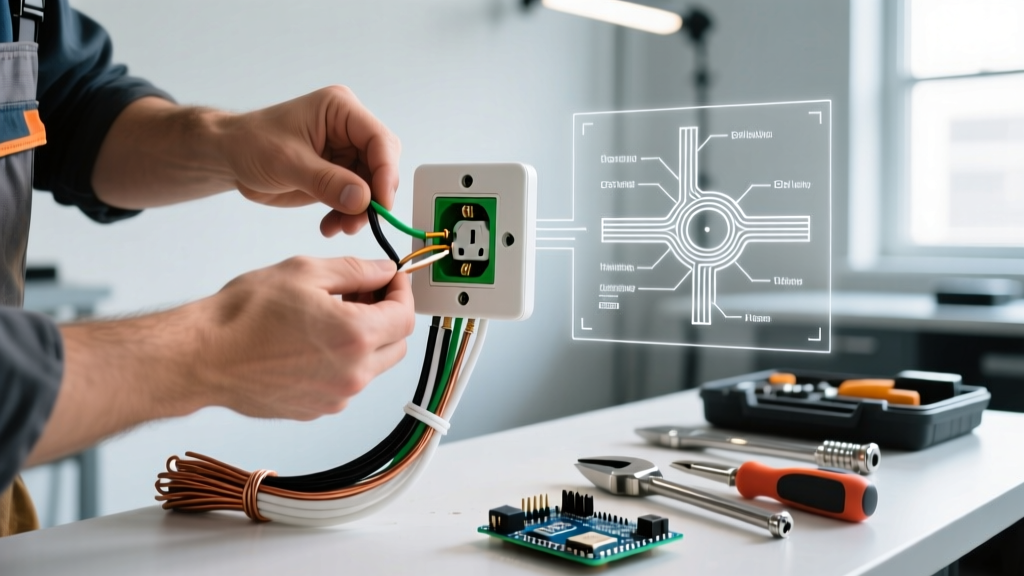
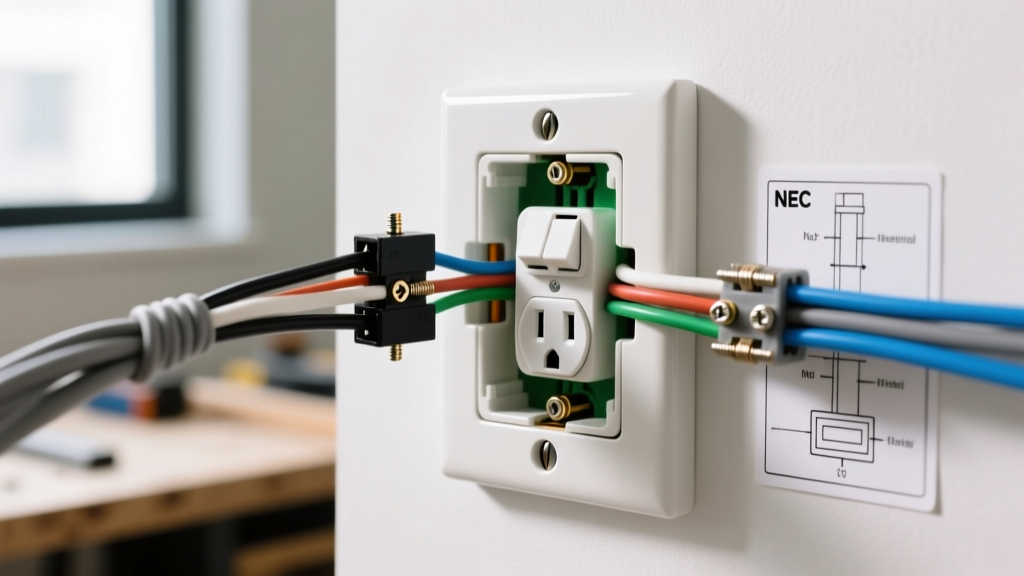
Improper wiring of GFCI electrical outlets is a leading cause of nuisance tripping and false security. The most critical concept is distinguishing between the LINE (power source) and LOAD (downstream protection) terminals.
- Verify Power and Strip Wire: Use a non-contact voltage tester (e.g., Klein Tools NCVT-4IR) to confirm the circuit is dead. Strip exactly 5/8 inch of insulation from 12 AWG or 14 AWG solid copper conductors.
- Identify Line vs. Load: Locate the single hot and neutral wire pair originating from the breaker panel. Connect these exclusively to the brass (hot) and silver (neutral) LINE terminals.
- Connect Downstream (Optional): If you intend to protect standard receptacles further down the circuit, connect the continuing hot and neutral wires to the LOAD terminals. If no downstream protection is needed, cap the LOAD wires and apply the yellow warning tape provided by the manufacturer.
- Terminate Ground: Connect the bare copper or green insulated ground wire to the green grounding screw. Note: A GFCI will function without a ground wire (protecting against shock via differential sensing), but the National Electrical Code (NFPA 70) requires a 'No Equipment Ground' label on the faceplate if an equipment grounding conductor is absent.
- Torque to Specification: Use a calibrated torque screwdriver to tighten terminal screws. For most 15A/20A Leviton and Hubbell GFCIs, the required torque is 14 in-lbs (inch-pounds). Under-torquing leads to arc faults; over-torquing strips the brass threads.
- Box Fill and Dressing: GFCI bodies are significantly deeper than standard duplex receptacles. Ensure the electrical box meets NEC 314.16 volume requirements (minimum 22.5 cubic inches for a standard GFCI with 12 AWG wire and two cables).
Troubleshooting Edge Cases and Nuisance Tripping
When GFCI electrical outlets trip without an obvious fault, the issue is rarely the device itself. It is usually a symptom of complex circuit interactions or environmental factors.
| Symptom | Root Cause | Technical Resolution |
|---|---|---|
| Immediate trip upon reset | Line/Load reversal or Shared Neutral (MWBC) | Verify LINE/LOAD orientation. If on a Multi-Wire Branch Circuit, a standard GFCI will trip. You must use a 2-pole GFCI breaker or separate the neutrals. |
| Random tripping during storms | Capacitive Leakage / Induced Voltage | Long cable runs (>250 ft) or parallel wiring near lightning strikes can induce cumulative mA leakage. Reduce downstream load or move GFCI to the end of the run. |
| Trips when large motor starts | Transient Voltage Spikes | Older GFCIs lack spike suppression. Upgrade to a modern UL 943 compliant model with integrated transient filters. |
| Will not reset at all | End-of-Life (EOL) Lockout or Open Hot | Internal SCR has failed safely5. Check for 120V at the LINE terminals. If power is present and EOL LED is lit, replace the device. |
Testing and Lifecycle Maintenance
The Electrical Safety Foundation International (ESFI) mandates that all GFCI electrical outlets be tested monthly. Pressing the 'TEST' button mechanically forces an internal fault, verifying that the sensing coil and solenoid trip mechanism are functional. Relying solely on a standard plug-in receptacle tester (the kind with three neon lights) is insufficient for verifying trip thresholds, as these tools only inject a fixed ~15mA fault and do not measure the exact trip time or milliamperes. For professional verification, use a dedicated GFCI tester like the Amprobe AT-3500, which provides digital readouts of the exact trip current and millisecond response time.
Critical Safety Warning: Never bypass a tripping GFCI by replacing it with a standard receptacle, and never create a 'bootleg ground' by jumpering the neutral and ground terminals to fool a tester. This creates a severe shock hazard where the appliance chassis can become energized at 120V if the neutral connection fails upstream. If a GFCI trips repeatedly, diagnose the downstream fault or replace the device; do not defeat the safety mechanism.
By adhering to the latest NEC standards, utilizing precision torque tools, and understanding the underlying physics of ground faults, DIYers and professionals alike can ensure their electrical systems remain compliant and, most importantly, safe from lethal shock hazards.