
Diagnosing Kitchen Island Electrical Outlet Code Violations
Kitchen islands are the operational heart of the modern home, but from an electrical standpoint, they are a notorious minefield. If you are remodeling, building, or troubleshooting a failed inspection in 2026, understanding the kitchen island electrical outlet code is critical. The rules governing island receptacles have undergone massive shifts in recent National Electrical Code (NEC) cycles, specifically transitioning from NEC 2017 to 2020, and most importantly, the sweeping changes introduced in NEC 2023 which are now being strictly enforced by local municipalities.
As a master electrician or an advanced DIYer, you must navigate the hazards of dangling cords, liquid ingress on face-up receptacles, and strict Ground Fault Circuit Interrupter (GFCI) mandates. This guide provides a deep-dive diagnostic framework to troubleshoot code violations, pass inspections, and ensure your island wiring is safe, compliant, and functional.
The 2026 Inspection Landscape: The NEC 2023 Shift
Before troubleshooting, you must understand the baseline code. Under older codes (NEC 2017 and earlier), if a kitchen island exceeded a certain square footage, installing at least one receptacle was mandatory. However, fire marshals and electrical inspectors noted a severe hazard: cords from blenders or slow cookers dangling over the edge of an island often snagged on clothing or appliances, pulling boiling liquids or hot cookware onto occupants.
According to the National Fire Protection Association (NFPA 70 / NEC), the 2023 code revision fundamentally changed this. Receptacles are no longer required to be installed in island and peninsular countertops. However, if you choose to install them—or if you are troubleshooting an existing installation—they must adhere to strict safety parameters. They cannot serve as the required wall countertop receptacles, and they must be GFCI protected.
Inspector's Note: "We see homeowners fail permits weekly because they try to use an island outlet to satisfy the mandatory countertop receptacle spacing rule. The island outlet is strictly supplemental. If the perimeter walls don't meet the 4-foot spacing rule, the island outlet won't save your inspection." — Senior Electrical Inspector, 2026.
Diagnostic Matrix: Common Island Outlet Failures
When an inspector red-tags a kitchen island, it almost always falls into one of four categories. Use this matrix to identify your specific failure mode and apply the correct remediation.
| Failure Mode | Code Violation | Diagnostic Symptom | Required Fix |
|---|---|---|---|
| Non-Listed Pop-Up Outlet | NEC 406.5(E) / UL 962A | Cheap plastic pop-up installed face-up on stone/quartz. | Replace with UL 962A listed unit or switch to side-mount. |
| Missing GFCI Protection | NEC 210.8(A)(7) | Standard 15A/20A duplex receptacle installed on island. | Install 20A GFCI receptacle or use GFCI breaker. |
| Improper Circuit Sizing | NEC 210.23 / 210.11(C) | Island outlet daisy-chained to dining room lighting. | Run dedicated 12 AWG wire on a 20A Small Appliance Branch Circuit. |
| Dangling Cord Hazard | NEC 210.52(C)(2) | Receptacle mounted on the side cabinet facing a walkway. | Recess the outlet or use a specialized corbel mount. |
Deep Dive 1: The Pop-Up Receptacle Trap (UL 962A)
The most frequent troubleshooting scenario we encounter in 2026 involves the "pop-up" receptacle. Homeowners love the aesthetic of a hidden outlet that springs out of the quartz countertop. However, standard furniture pop-up outlets (listed under UL 962) are illegal for use in horizontal kitchen countertops.
Why Standard Pop-Ups Fail Inspection
Kitchen countertops are wet environments. Standard furniture outlets lack the necessary liquid ingress protection. If a glass of water spills over a standard pop-up, it drains directly into the live electrical contacts and the cabinet below, creating a severe shock and fire hazard. Furthermore, Underwriters Laboratories (UL) created a specific standard, UL 962A, exclusively for outlets installed in countertops.
The Fix: Sourcing Compliant Hardware
If your inspector has flagged your pop-up outlet, you must verify its listing. Look for the UL mark specifically denoting compliance with UL 962A.
- Compliant Example: Hubbell SystemOne or Hubbell HBLPTW series (specifically rated for countertop liquid ingress and fire-rating preservation).
- Alternative Solution: Abandon the top-mount entirely. Cut a hole in the drywall panel on the side of the island and install a standard tamper-resistant (TR) GFCI receptacle with an extra-duty while-in-use weatherproof cover, ensuring it does not protrude into the knee-space or walkway.
Deep Dive 2: Circuit Sizing and the GFCI Mandate
Troubleshooting an island that constantly trips its breaker or fails to provide adequate power requires looking at the panel and the wire gauge.
The 20-Ampere Small Appliance Branch Circuit (SABC)
Kitchen islands frequently house high-draw appliances: stand mixers, instant pots, and microwaves. Under NEC Article 210.11(C)(1), all kitchen receptacles must be supplied by at least two 20-ampere small-appliance branch circuits.
- Wire Gauge: You must use a minimum of 12 AWG copper wire (e.g., 12/2 NM-B Romex). Using 14 AWG wire on a 20A breaker is a critical fire hazard and an instant inspection failure.
- Circuit Isolation: The island outlet cannot share a circuit with the kitchen lighting, the dishwasher, or the garbage disposal. It must be tied to the general countertop SABC.
GFCI Protection is Non-Negotiable
Even though NEC 2023 removed the requirement to install an island outlet, the moment you wire one, NEC 210.8(A)(7) dictates it must have Ground-Fault Circuit-Interrupter protection.
- Diagnostic Tip: If you are troubleshooting a GFCI that trips immediately upon resetting, check for a shared neutral. Many DIYers attempt to wire an island using a Multi-Wire Branch Circuit (MWBC) to save wire. If the pigtails on the GFCI receptacle are crossed with the neutral from the adjacent perimeter counter circuit, the GFCI will sense an imbalance and trip. Keep the load and line neutrals strictly isolated.
Step-by-Step Troubleshooting Workflow for Existing Islands
If you are diagnosing an older home (built between 2010 and 2020) and attempting to bring the island up to current 2026 safety standards without tearing out the cabinetry, follow this workflow:
Step 1: Assess the Physical Location
Measure the distance from the receptacle to the nearest edge of the countertop. Under older codes, face-up receptacles were allowed if they were within 12 inches of the edge. Under current safety best practices and localized 2026 adoptions, face-up standard receptacles are banned. If your existing outlet is a standard duplex mounted face-up into the stone, it must be removed and the stone patched by a fabricator.
Step 2: Verify the Breaker and Wire
Go to the main service panel. Identify the breaker feeding the island.
- Is it a 15A breaker? Violation. Upgrade to 20A (provided the wire is 12 AWG).
- Is it a 20A breaker but the wire is 14 AWG? Violation. You must pull new 12/2 NM-B wire through the cabinets or downgrade the breaker to 15A (though 20A is highly recommended for kitchen utility).
Step 3: Install the Correct Receptacle
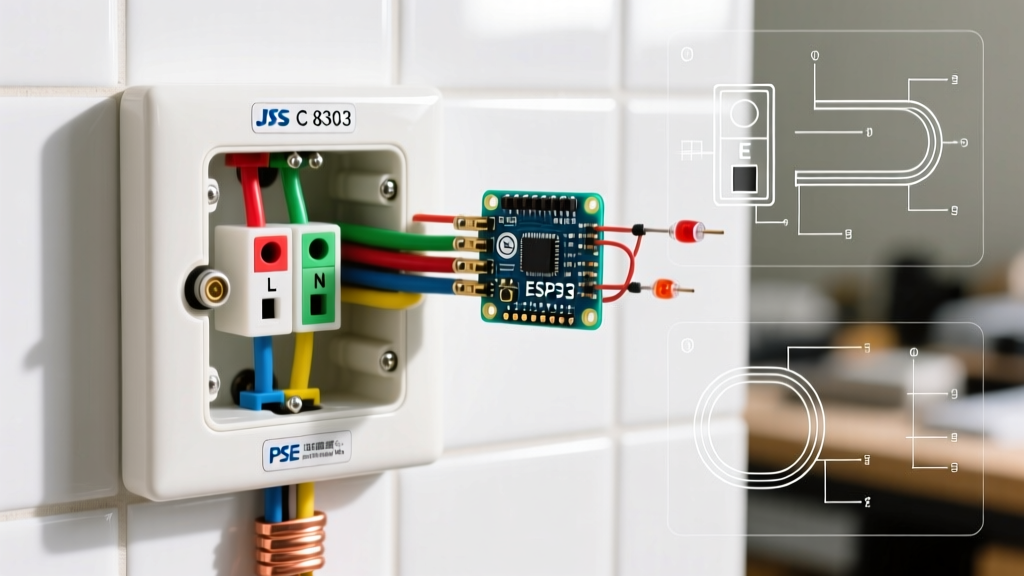
If utilizing a side-mount or corbel-mount strategy on the cabinet face, install a Leviton 8300-IGF or equivalent 20-Amp Tamper-Resistant (TR) GFCI receptacle. Ensure the orientation prevents cords from dangling across a cooktop or sink area. If the island contains a built-in downdraft vent or cooktop, ensure the island receptacle is not placed directly adjacent to the heat source, adhering to clearance requirements outlined by the appliance manufacturer and OSHA general electrical safety standards regarding workspace clearances.
Summary: Passing Your 2026 Inspection
Troubleshooting the kitchen island electrical outlet code requires abandoning outdated habits. The days of dropping a standard 15A outlet into the side of a cabinet or drilling a hole in the granite for a cheap pop-up are over. To ensure compliance, safety, and a passed inspection:
- Acknowledge that island outlets are supplemental, not mandatory.
- Demand UL 962A listing for any face-up countertop installation.
- Ensure 12 AWG wiring on a dedicated 20A SABC.
- Apply GFCI protection without exception.