
Understanding the Aruba Electrical Grid and Outlet Standards
When inspecting, maintaining, or troubleshooting an Aruba electric outlet, it is critical to understand the local power infrastructure. Aruba operates on a 120V, 60Hz electrical grid, managed primarily by the local utility provider, ELMAR. Because Aruba's infrastructure closely mirrors North American standards, the island utilizes Type A and Type B sockets (NEMA 1-15 and NEMA 5-15 receptacles). While this makes it convenient for North American expats, tourists, and imported appliances, the unique tropical and coastal environment of Aruba introduces severe environmental stressors that standard mainland inspection protocols often overlook.
For property managers, villa owners, and DIY enthusiasts, a standard visual check is insufficient. The combination of high humidity, intense UV exposure, and pervasive salt air accelerates galvanic corrosion and degrades thermoplastic outlet housings. This comprehensive inspection and testing guide provides a 2026-updated, professional-grade protocol for verifying the safety, polarity, and structural integrity of Aruban electrical receptacles.
Essential Diagnostic Tools for Outlet Inspection
To properly test an Aruba electric outlet, you must move beyond basic neon-light testers. Modern troubleshooting requires precision instruments capable of detecting high-resistance faults caused by coastal corrosion. Assemble the following toolkit before beginning your inspection:
- True-RMS Digital Multimeter (DMM): The Fluke 117 True-RMS Multimeter (approx. $210) is the industry standard. True-RMS is essential for accurately reading voltage on circuits that may have harmonic distortion from nearby solar inverters or variable-frequency drives (VFDs) used in modern HVAC systems.
- Advanced Receptacle Tester: The Klein Tools RT250 GFCI Receptacle Tester (approx. $35) provides clear LCD readouts for wiring faults and includes a solenoid to trip GFCI circuits without relying on the outlet's internal test button, which may be seized by salt corrosion.
- Non-Contact Voltage (NCV) Tester: The Fluke 2AC VoltAlert (approx. $35) for initial live-circuit verification before removing faceplates.
- Thermal Imaging Camera: A FLIR C5 or similar compact thermal imager is highly recommended for detecting micro-arcing and high-resistance connections hidden behind the outlet yoke.
Phase 1: Visual and Environmental Inspection
Before inserting any testing probes, perform a rigorous physical inspection. The harsh Caribbean climate creates specific failure modes that mainland electricians rarely encounter.
Identifying Salt Creep and Galvanic Corrosion
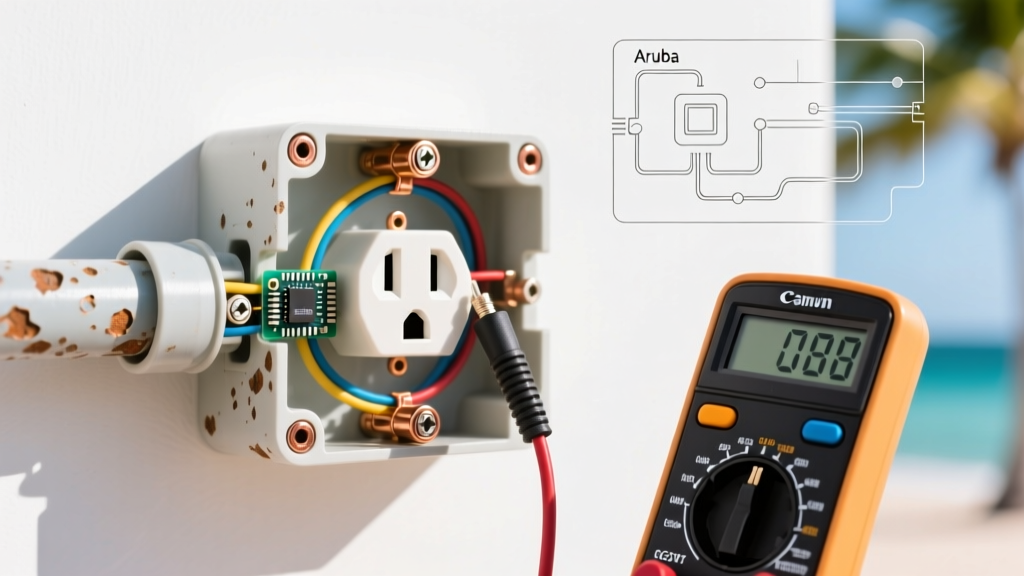
Aruba's trade winds carry microscopic salt aerosols inland. When these chloride ions settle on an Aruba electric outlet, they penetrate the passivation layer of the brass terminal screws and copper wiring. This leads to dezincification and the formation of copper oxide, which acts as a semiconductor, creating high-resistance junctions that generate excessive heat.
Expert Insight: Look for a pale green or powdery white residue around the terminal screws and grounding pigtails. If you observe this 'salt creep' on a standard NEMA 5-15R receptacle, the internal contact tension is likely compromised. Replace the receptacle immediately with a commercial-grade, corrosion-resistant model (e.g., Leviton 5362-C) and apply a thin layer of MG Chemicals 8463 dielectric grease to the terminal screws to block future moisture ingress.
UV Degradation of Faceplates
Outlets exposed to indirect sunlight through villa windows often suffer from UV degradation. Standard nylon faceplates become brittle and yellow within 3 to 5 years in Aruba's climate. Brittle plastics can shatter upon impact, exposing live 120V bus bars. Swap degraded covers for UV-stabilized polycarbonate alternatives.
Phase 2: Step-by-Step Electrical Testing Protocol
Once the physical integrity is verified, proceed with live electrical testing. Ensure you are wearing appropriate PPE, including insulated gloves and safety glasses, in accordance with OSHA Electrical Safety Standards.
Step 1: Receptacle Polarity and Ground Verification
- Insert the Klein Tools RT250 into the top NEMA 5-15 socket.
- Verify the LCD indicates 'CORRECT'. If it displays 'OPEN GROUND', the equipment grounding conductor (EGC) is disconnected—a common issue in older Aruban properties where grounding rods were improperly bonded to the main panel.
- Test the GFCI trip mechanism (if applicable). The RT250 will inject a 6mA fault current. The outlet must trip within 25 milliseconds. If it fails, the internal solenoid is corroded and the GFCI must be replaced.
Step 2: True-RMS Voltage and Voltage Drop Analysis
Set your Fluke 117 multimeter to V AC (True-RMS mode). Insert the black probe into the neutral slot (left, wider) and the red probe into the hot slot (right, narrower).
- Line-to-Neutral (Hot-Neutral): Should read between 115V and 125V. ELMAR's grid is generally stable, but remote villas at the end of long distribution lines may experience sags.
- Line-to-Ground (Hot-Ground): Should read identically to Line-to-Neutral (within 1V).
- Neutral-to-Ground: This is the critical test. It should read less than 2.0V. A reading above 2.0V indicates a voltage drop on the neutral wire, pointing to a loose neutral connection at the panel or a shared-neutral overload. This can cause sensitive electronics to malfunction or overheat.
Step 3: Load Testing and Thermal Scan
Plug in a known 1500W resistive load (such as a high-end hair dryer or space heater). Allow it to run for 10 minutes. While under load, use your thermal imaging camera to scan the outlet face. A temperature rise exceeding 15°F (8°C) above ambient room temperature at the terminal yoke indicates a failing internal brass contact wiper or a loose back-stabbed wire connection. Never use back-stabbed push-in connections in Aruba; always use the side terminal screws with a torque screwdriver set to 12 in-lbs.
Troubleshooting Matrix: Common Aruba Outlet Faults
Use the following diagnostic matrix to quickly identify and resolve the most frequent issues found when testing an Aruba electric outlet.
| Tester Indication | Multimeter Readings (L-N / L-G / N-G) | Probable Root Cause | Required Corrective Action |
|---|---|---|---|
| Open Ground | 120V / 0V / 120V | Corroded ground wire or disconnected panel bond. | Trace EGC to panel; clean grounding bus bar; re-terminate. |
| Hot/Neutral Reversed | 120V / 120V / 0V (but polarity tester flags reverse) | Improper wiring by unlicensed handyman. | Swap hot (black) and neutral (white) wires on terminal screws. |
| High Neutral Voltage | 118V / 118V / 4.5V | Loose neutral at panel or shared neutral overload. | Tighten neutral bus bar lug; verify circuit is not multi-wire branch circuit (MWBC) with imbalanced loads. |
| Low Voltage Under Load | 105V (under 15A load) | Undersized wire gauge for run length; severe corrosion. | Upgrade 14 AWG to 12 AWG copper; clean all splices in junction boxes. |
GFCI and AFCI Code Compliance in Coastal Zones
While Aruba has its own local building codes, modern high-end residential builds and commercial renovations generally adopt the NFPA 70 National Electrical Code (NEC) as the baseline for safety. For 2026 compliance, any Aruba electric outlet installed in wet or damp locations (outdoors, near pools, or in open-air kitchens) must be protected by a Class A GFCI.
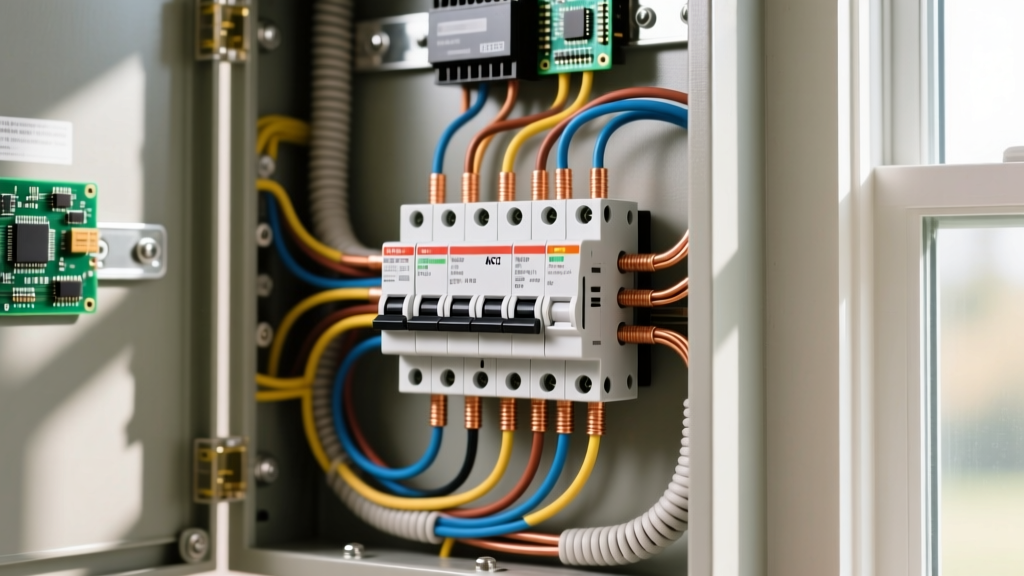
Furthermore, due to the prevalence of salt-air corrosion causing micro-arcing inside wall cavities, installing Arc Fault Circuit Interrupter (AFCI) breakers in the main distribution panel is highly recommended for all 15A and 20A bedroom and living area circuits. Corroded wire nuts and degraded outlet internals are prime ignition sources for electrical fires; AFCI technology detects the unique high-frequency signature of an arc and cuts power before a fire can start.
Frequently Asked Questions (FAQ)
Can I use US-purchased outlets in Aruba?
Yes, standard US NEMA 5-15 and 5-20 receptacles are physically and electrically compatible with Aruba's 120V/60Hz grid. However, it is highly advised to purchase 'Commercial Grade' or 'Hospital Grade' receptacles (identified by a green dot) rather than standard residential builder-grade outlets. Commercial grades feature thicker brass contact wipers and heavier steel yokes that better resist the mechanical wear and environmental corrosion typical of island environments.
Why does my outlet tester show 'Correct' but my appliances still surge?
Standard plug-in testers only verify basic polarity and continuity; they do not measure voltage stability or harmonic distortion. If your appliances are surging, use a True-RMS multimeter to log the voltage over a 24-hour period. You may be experiencing grid sags from ELMAR's distribution network, requiring the installation of a whole-house surge protective device (SPD) or an online double-conversion UPS for sensitive electronics.
How often should Aruba electric outlets be inspected?
For coastal properties within 500 meters of the ocean, a full electrical inspection, including thermal scanning and terminal torque verification, should be performed every 24 months. For inland properties, a 5-year inspection cycle is generally sufficient to ensure ongoing safety and code compliance.