
Understanding the Greek Electrical Infrastructure
If you are renovating a property in Athens, restoring a stone house in the Cyclades, or simply replacing a damaged receptacle, installing an electrical outlet in Greece requires a firm grasp of local standards. Greece operates on a 230V supply voltage and 50Hz frequency, fully harmonized with the broader European Union grid. However, local installation practices, wall box dimensions, and historical wiring quirks demand specific attention from any DIYer or junior electrician.
Greek Grid Standard: According to the Hellenic Electricity Distribution Network Operator (HEDNO), the standard residential socket circuit must be protected by a 30mA Residual Current Device (RCD) and a C16 or C20 Miniature Circuit Breaker (MCB). Never bypass these safety devices when working on Greek electrical panels (known locally as the Pinakas).
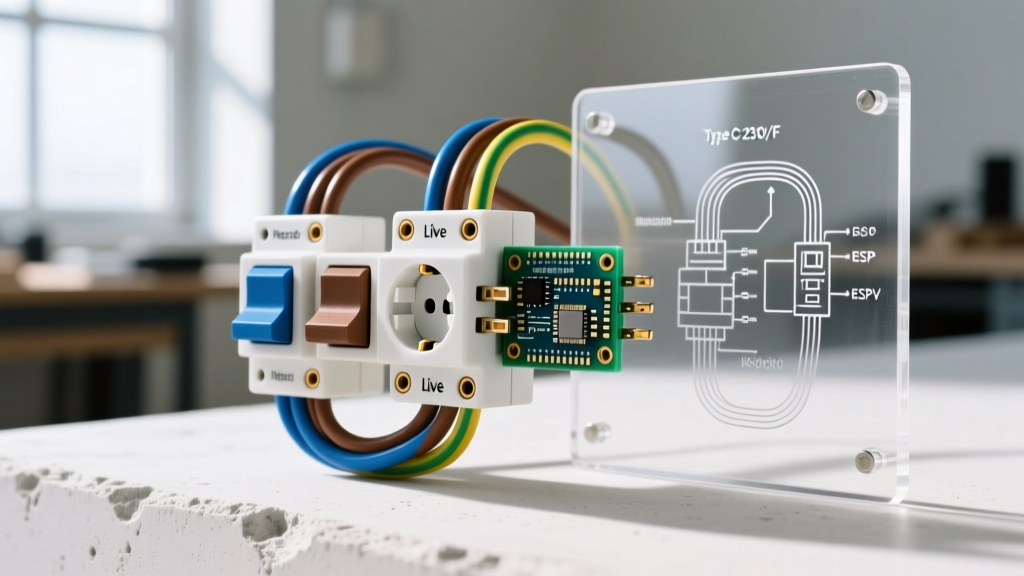
The standard receptacle used throughout Greece is the Type F Schuko (CEE 7/3). Unlike the flat-faced Type A/B outlets found in North America, the Schuko outlet features a recessed circular design with two earthing clips on the top and bottom edges. This design ensures that the earth connection is made before the live pins engage, a critical safety feature mandated by the International Electrotechnical Commission (IEC).
Essential Tools & Materials for Greek Homes
Before you begin, ensure you have the correct VDE-certified (insulated to 1000V) tools. Using standard hardware store tools on a 230V European grid is a severe safety hazard.
- Schuko Receptacle: Opt for reputable European brands widely available in Greek electrical supply stores (ilektrologika), such as Legrand Valena Life, Schneider Electric Odace, or Simon. Expect to pay between €4.50 and €12.00 per unit.
- Wire Strippers: Knipex MultiStrip 10 or similar precision strippers to avoid nicking the 1.5mm² or 2.5mm² solid copper conductors.
- Voltage Tester: A CAT III or CAT IV non-contact voltage detector (e.g., Fluke 1AC-II) and a standard two-pole phase tester screwdriver.
- Connectors: WAGO 221 series lever nuts (ideal for extending short wires in tight Greek masonry boxes).
- Torque Screwdriver: Calibrated to 0.8 Nm - 1.2 Nm for terminal screws to prevent loose connections and subsequent arcing.
Greek Wiring Color Codes (HD 308 S2 Standard)
Greece strictly follows the European CENELEC HD 308 S2 color code standard for fixed wiring. Misidentifying these wires can result in catastrophic equipment failure or fatal electric shock.
| Insulation Color | Function | Schuko Terminal Marking | Wire Gauge (Typical) |
|---|---|---|---|
| Brown | Phase (Live) | L | 1.5mm² or 2.5mm² |
| Blue | Neutral | N | 1.5mm² or 2.5mm² |
| Green/Yellow | Protective Earth (PE) | PE (Side Clips) | 1.5mm² or 2.5mm² |
Step-by-Step Installation Guide
Step 1: Isolate the Pinakas (Distribution Board)
Locate your main electrical panel. Identify the MCB controlling the specific room or zone you are working on. Switch it to the OFF (0) position. Crucially, verify the absence of voltage at the outlet location using your non-contact tester and a two-pole voltage tester. Never rely solely on a single-pole screwdriver tester, as induced voltages in Greek multi-core cables can cause false readings.
Step 2: Prepare the Wall Box
Greek homes primarily use two types of wall boxes:
- Masonry Boxes: Embedded directly into brick or concrete using plaster or gypsum. These can be messy and often have excess debris inside.
- Drywall (Gypsum Board) Boxes: Extremely common in modern Greek renovations (gypsan constructions). These are standard Ø68mm European flush-mounted boxes secured by adjustable butterfly clips.
Clean the box thoroughly. If the wires are too short (less than 8cm protruding from the wall), use WAGO 221 connectors to extend them using matching gauge solid copper wire. Do not use electrical tape for splices inside a wall box; it violates Greek electrical safety codes.
Step 3: Strip and Connect the Wires
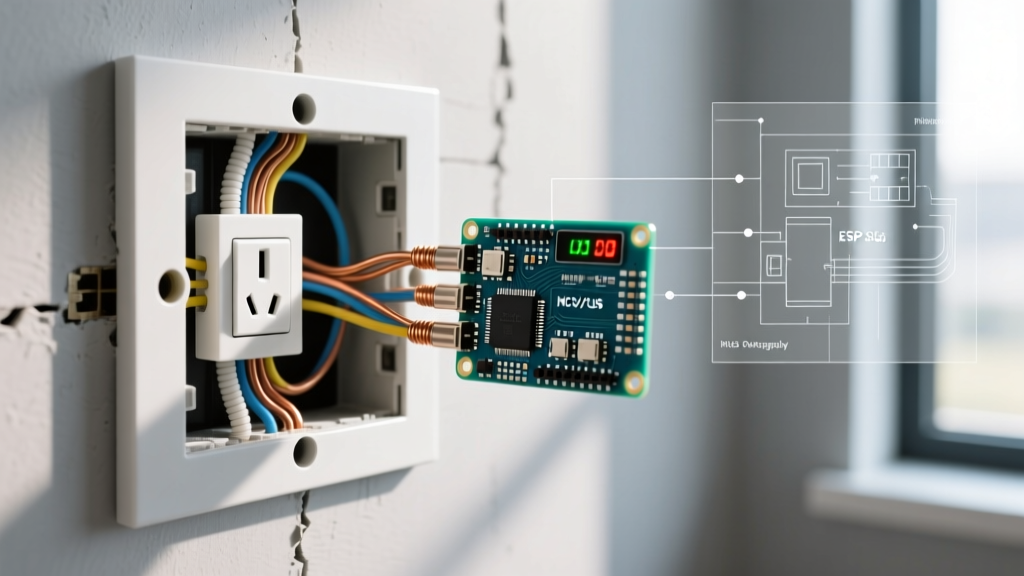
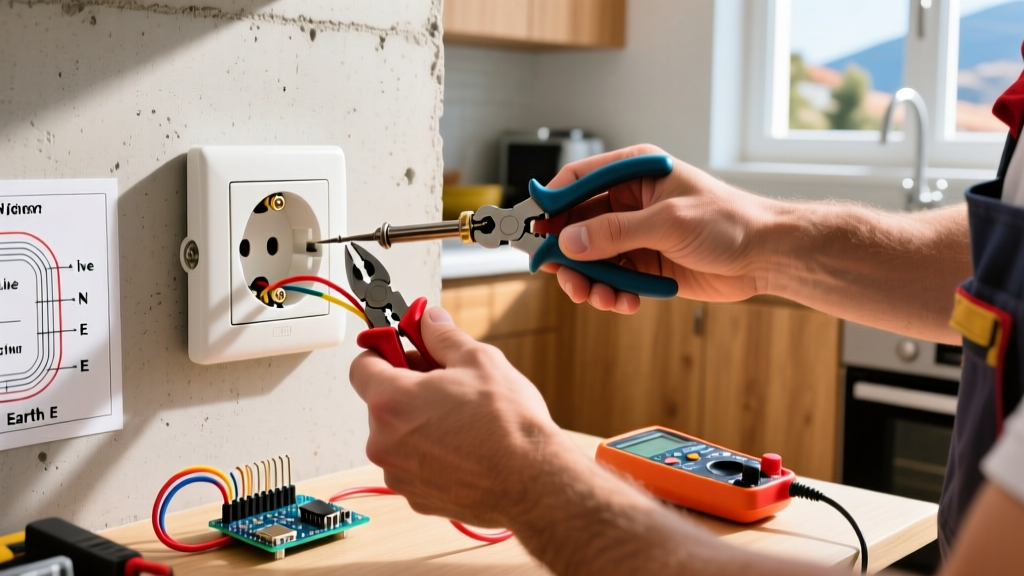
Strip exactly 12mm of insulation from the ends of the Brown, Blue, and Green/Yellow wires. The Schuko outlet will have three main connection points:
- Earth (PE): Connect the Green/Yellow wire to the central earth terminal. This terminal is physically linked to the two metal earthing clips on the top and bottom exterior of the socket face.
- Phase (L): Insert the Brown wire into the terminal marked 'L'. While Schuko plugs are unpolarized (meaning they can be inserted upside down), Greek electrical best practices dictate that if the socket is wired as a single unit, the Phase should ideally be on the right-hand side when facing the socket, though consistency across the room is the most critical factor.
- Neutral (N): Insert the Blue wire into the terminal marked 'N'.
Tighten the terminal screws using your torque screwdriver set to 1.0 Nm. Give each wire a firm tug to ensure it is mechanically secure. A loose neutral wire on a 230V circuit will cause arcing, melting the socket faceplate and creating a severe fire hazard.
Step 4: Mount and Align the Receptacle
Carefully fold the wires into the back of the Ø68mm box. Use the 'accordion' folding method to prevent pinching the insulation against the sharp edges of the metal mounting bracket. Insert the outlet into the box and drive the two M3.5 mounting screws into the box's threaded lugs. Use a spirit level to ensure the faceplate is perfectly horizontal. Finally, snap on the decorative cover plate.
Edge Case: Dealing with Legacy Greek Wiring (Pre-1990)
If you are working in an older Greek home, particularly those built before the 1990s, you will likely encounter outdated wiring colors and missing earth grounds. This is a common shock for expats and foreign DIYers.
- Missing Earth Wire: Many older properties only have two wires (Phase and Neutral) pulled through the conduits. You must not install a Type F Schuko outlet without an earth connection. If no PE wire is present, you must either pull a new earth wire back to the distribution board or, if the circuit is protected by a modern 30mA RCD, install a specialized ungrounded socket (Type C style, though rare for wall mounting) or consult a licensed Greek electrician (ilektrologos) to upgrade the circuit.
- Outdated Colors: Pre-1980s Greek installations often used Black or Grey for Phase, Red for Neutral, and sometimes bare copper or Green for Earth. Always use a multimeter to verify the live conductor before touching any wires in an older property.
Frequently Asked Questions
Can I use a North American 120V outlet in Greece?
No. The physical dimensions, voltage requirements, and safety certifications are entirely incompatible. Plugging a 120V device into a 230V Greek Schuko outlet without a step-down transformer will instantly destroy the appliance and may cause a fire. Always use CE-marked 230V appliances and Schuko receptacles.
What is the standard height for outlets in Greece?
For general living areas and bedrooms, the standard mounting height is 30cm from the finished floor level to the center of the wall box. In kitchens, outlets are typically mounted 110cm to 120cm from the floor to sit above the countertop backsplash, while bathroom outlets (which must be IP44 rated and located outside of Zone 1 and Zone 2) are usually placed at 110cm near the mirror.
Do I need a permit to replace an outlet?
Replacing an existing, damaged Schuko outlet with a new one of the same specification does not require a permit or a new DEDDIE (HEDNO) inspection certificate. However, adding new circuits, upgrading the main distribution panel, or installing new outdoor wiring requires a licensed electrician to issue a formal Ypefthini Dilosi (Sworn Statement of Compliance).