
The Shift to Hidden Power: Why Upgrade Cabinet Outlets?
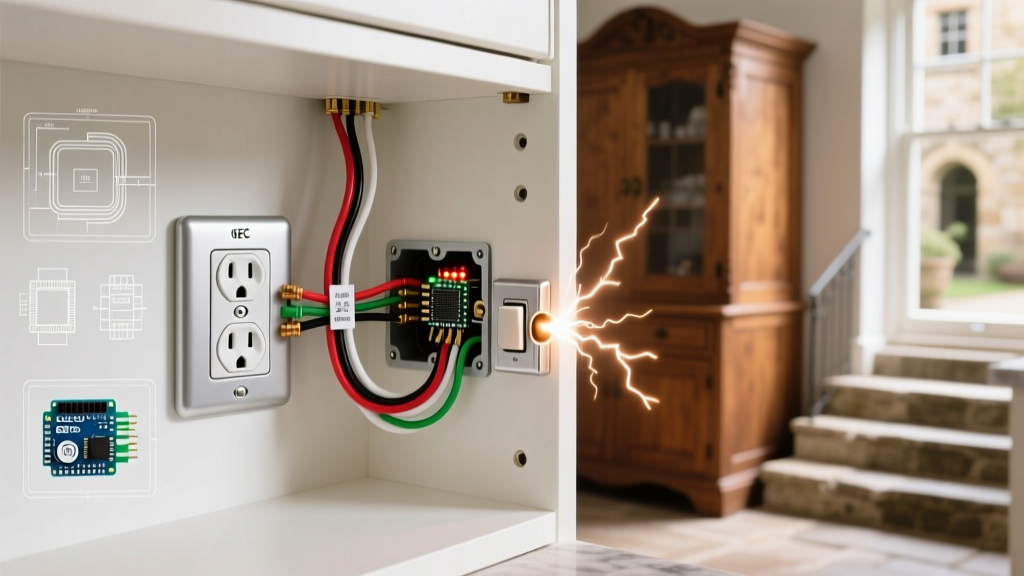
In modern kitchen, bathroom, and workshop designs, the trend of concealing appliances and charging stations has transformed how we approach electrical infrastructure. Installing an electrical outlet in cabinet spaces—often referred to as 'appliance garages' or 'hidden charging drawers'—keeps countertops pristine while providing dedicated power for coffee makers, Dyson vacuums, and lithium-ion power tool chargers. However, upgrading or retrofitting these hidden receptacles requires strict adherence to fire safety clearances, ventilation requirements, and the latest National Electrical Code (NEC) mandates.
Whether you are replacing an outdated, ungrounded 2-prong receptacle hidden behind a microwave cabinet or installing a brand-new in-drawer docking station, this 2026 upgrade guide provides the exact specifications, hardware models, and wiring methodologies required for a safe, code-compliant installation.
Common Failure Modes in Legacy Cabinet Wiring
Before tearing into your cabinetry, it is crucial to understand why older in-cabinet outlets fail or pose severe hazards. Legacy installations often suffer from three primary issues:
- Thermal Runaway & Heat Buildup: Older cabinets were not designed to house modern high-draw appliances or lithium-ion chargers. Plugging a 1200W coffee maker into an unventilated, enclosed cabinet outlet can cause ambient temperatures to exceed 140°F (60°C), degrading the thermoplastic faceplate and wire insulation over time.
- Improper Cable Protection: Many DIYers run standard NM-B (Romex) cable across the back interior of a cabinet. Under NEC Article 334.15, NM-B cable must be protected from physical damage. In a storage cabinet where heavy pots, tools, or cleaning supplies are shifted, exposed NM-B is a severe crush and puncture hazard.
- Missing GFCI Protection: Outlets located inside kitchen or bathroom cabinets are frequently within 6 feet of a sink edge. Legacy wiring often bypasses Ground Fault Circuit Interrupter (GFCI) protection, creating a lethal shock hazard in damp environments.
NEC Compliance for In-Cabinet Receptacles
When upgrading your electrical outlet in cabinet spaces, you must align with the latest NEC cycles (2023/2026). The National Fire Protection Association (NFPA 70) outlines several non-negotiable rules for these installations:
Critical Safety Note: According to the Consumer Product Safety Commission (CPSC), GFCI receptacles prevent thousands of electrocutions annually. Any cabinet outlet serving a kitchen countertop area, bathroom vanity, or within 6 feet of a wet bar sink MUST be GFCI protected and Tamper-Resistant (TR).
Key Code Sections to Remember:
- NEC 210.8(A): Mandates GFCI protection for all 125V, 15A and 20A receptacles in kitchens, including those inside appliance garages and pantry cabinets.
- NEC 406.12: Requires all receptacles in dwelling units to be Tamper-Resistant (TR) to prevent children from inserting objects into hidden, low-level cabinet outlets.
- NEC 300.22: If your cabinet wiring penetrates a fire-rated top plate or runs through a plenum space above the cabinet, you must use firestop putty or plenum-rated cable.
Top Hardware Solutions for In-Cabinet Power
Standard duplex receptacles are rarely the best choice for hidden spaces. Below is a comparison matrix of the top-tier hardware solutions for 2026 cabinet upgrades, categorized by use case.
| Product / Model | Type | Est. Price | Cutout Required | Best Application |
|---|---|---|---|---|
| Leviton R02-GFNT1-0W0 | Slim GFCI TR | $28 - $35 | Standard 1-Gang Box | Under-sink, pantry shelves |
| Docking Drawer 1501-011 | In-Drawer Station | $185 - $210 | Custom Drawer Back | Tool batteries, hair tools |
| Legrand adorne Pop-Out | Push-Pop Receptacle | $115 - $130 | 3-inch Hole Saw | Kitchen appliance garages |
| Leviton DW15R | Smart Wi-Fi TR | $45 - $55 | Standard 1-Gang Box | Slow cookers, automated lighting |
Step-by-Step Upgrade: Wiring an In-Cabinet GFCI Receptacle
Upgrading to a slim-profile GFCI like the Leviton R02-GFNT1-0W0 is the most common and cost-effective method for bringing hidden kitchen and bathroom cabinet outlets up to code. Follow this precise workflow to ensure a professional-grade installation.
Phase 1: Preparation and Cutout
- Kill the Power: Turn off the 20A breaker at the main panel. Verify with a non-contact voltage tester (NCVT) and a multimeter at the existing receptacle.
- Select the Box: If replacing an existing box, ensure it has adequate cubic inch capacity. For a new 12 AWG GFCI installation, use a Carlon B120R (20 cubic inch) PVC nail-on box or a steel 4-square box with a 1-gang plaster ring to accommodate the bulk of the GFCI mechanism and wire nuts.
- Cut the Cabinet Back: If cutting a new hole through 3/4-inch melamine or plywood cabinet backing, score the cut line with a utility knife before using a jigsaw. This prevents catastrophic chip-out on the visible interior side of the cabinet.
Phase 2: Cable Routing and Termination
- Run the Correct Cable: If the cable will be exposed inside the cabinet cavity (e.g., surface mounted to the back panel), you must use 12/2 MC (Metal-Clad) cable rather than NM-B to satisfy NEC physical protection requirements. If running entirely behind the drywall/cabinet back, 12/2 NM-B is acceptable.
- Strip and Terminate: Strip the wire insulation to exactly 5/8 inch. For commercial-grade GFCIs, do not use the back-stab push-in connectors. Use the side terminal screws.
- Apply Exact Torque: Use an inch-pound torque screwdriver set to 14 in-lbs (verify on the device spec sheet) to tighten the terminal screws. Under-torqued connections cause arcing and heat buildup, which is especially dangerous in enclosed wooden cabinets.
- Secure the Box: Mount the box securely to the cabinet framing. If the cabinet back is thin (1/4 inch plywood), use a specialized cut-in bracket like the Carlon SC100 to clamp the box firmly to the panel without cracking the wood.
Troubleshooting Edge Cases: Nuisance Tripping and Heat
Even with perfect wiring, in-cabinet outlets present unique environmental challenges. Here is how to solve the two most common edge cases encountered by master electricians:
1. Nuisance GFCI Tripping from Appliance Motors
If your hidden coffee maker or blender trips the new GFCI outlet upon startup, it is likely due to the high inrush current of the motor or heating element creating a momentary capacitive leakage to ground. The Fix: Do not remove the GFCI (this violates code). Instead, upgrade the circuit wiring to a dedicated 20A line, or use a GFCI breaker at the panel with a higher threshold tolerance, ensuring the branch circuit wiring is completely isolated from other shared neutral loads that cause harmonic leakage.
2. Heat Buildup from Lithium-Ion Chargers
Charging power tool batteries or cordless vacuums inside a closed drawer or cabinet restricts airflow. The Occupational Safety and Health Administration (OSHA) warns against the fire risks of unmonitored lithium-ion charging in confined spaces. The Fix: Install a passive ventilation grille at the bottom and top of the cabinet to create a chimney effect, or integrate a smart outlet (like the Leviton DW15R) configured via its app to automatically cut power after a 2-hour charging cycle, preventing overcharging and thermal runaway.
Expert FAQ
Can I install an electrical outlet inside a kitchen drawer?
Yes, but it requires specialized hardware. Standard receptacles will fail due to the mechanical stress of drawer movement and cord pulling. You must use an interlocking in-drawer docking station (like Docking Drawer) that features an automatic shut-off switch that kills power when the drawer is closed or if the cord is pulled taut.
Do cabinet appliance garages require their own dedicated circuit?
Under NEC 210.23, small appliance branch circuits (SABCs) in kitchens must serve only countertop and pantry receptacles. A dedicated 20A circuit is highly recommended for an appliance garage housing a high-draw microwave or espresso machine to prevent voltage drop and breaker fatigue.
Is it safe to use a power strip inside a cabinet instead of hardwiring an outlet?
Absolutely not. Plugging a power strip into a distant wall outlet and routing the cord through a drilled hole in a cabinet violates NEC Article 400.8, which prohibits using flexible cords as a substitute for the fixed wiring of a structure. Always hardwire a proper receptacle box.