
Navigating the Complexity of European Electrical Outlet Standards
When electricians, DIYers, or international builders encounter a european electrical outlet, the first mistake is assuming a single, unified standard exists across the continent. In reality, Europe features a fragmented landscape of receptacle types, governed by a complex hierarchy of international (IEC), regional (CENELEC), and national codes. Whether you are retrofitting a historic property in Berlin, wiring a new build in London, or troubleshooting a mixed-standard industrial panel in Milan, understanding the precise code requirements is non-negotiable for safety and compliance.
This guide breaks down the exact wiring codes, safety mandates, and installation specifications for the most common European receptacles as of 2026, providing actionable data for professionals and advanced DIYers.
The Regulatory Hierarchy: IEC, CENELEC, and National Codes
European electrical codes do not operate in a vacuum. They are built on a three-tiered regulatory framework:
- IEC (International Electrotechnical Commission): Provides the foundational global standards, such as IEC 60898 for circuit breakers and IEC 61009 for RCBOs (Residual Current Breaker with Overcurrent protection).
- CENELEC (European Committee for Electrotechnical Standardization): Adopts and harmonizes IEC standards for Europe. The critical standard for wiring colors is CENELEC HD 308 S2, which mandates the modern brown/blue/green-yellow color code across all member states.
- National Standards: Countries enforce their own specific wiring regulations based on CENELEC frameworks. In the UK, this is BS 7671 (IET Wiring Regulations); in Germany, it is the DIN VDE 0100 series.
Breakdown of Major European Electrical Outlet Types
While over a dozen plug types exist globally, four primary receptacle types dominate the European landscape. Below is a technical comparison matrix detailing their specifications and code requirements.
| Type | Common Name | Primary Regions | Standard / Code | Rating | Grounding Method | Shutter Mandate |
|---|---|---|---|---|---|---|
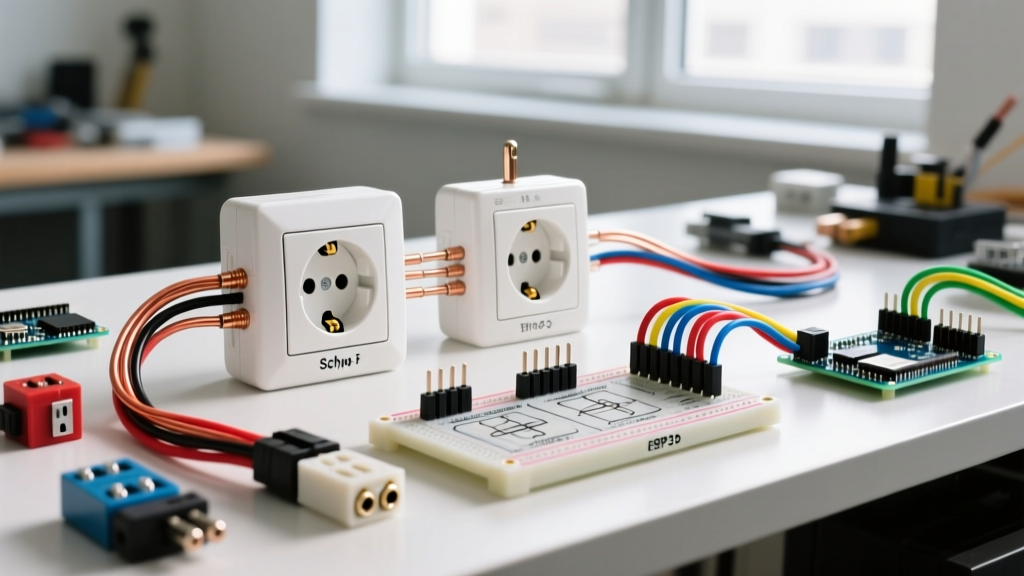
| Type F | Schuko | Germany, Spain, Nordics, Eastern EU | CEE 7/4 (DIN VDE 0620) | 230V / 16A | Side grounding clips | Required in new builds (e.g., Germany) |
| Type E | French | France, Belgium, Poland, Czechia | CEE 7/5 (NF C 61-314) | 230V / 16A | Protruding male earth pin | Required |
| Type G | BS 1363 | UK, Ireland, Malta, Cyprus | BS 1363 / BS 7671 | 230V / 13A | Rectangular top pin | Strictly mandated by law |
| Type L | Italian | Italy, Chile, Uruguay | CEI 23-50 | 230V / 10A or 16A | Inline central pin | Required in modern installations |
To bridge the gap between Type E (French) and Type F (Schuko) outlets, the CEE 7/7 plug was developed. It features both side grounding contacts (for Type F) and a female receptacle for the male earth pin (for Type E). However, hardwiring receptacles must strictly adhere to the national standard of the specific country; you cannot legally install a German Schuko socket in a new French residential build.
Critical Wiring & Code Requirements (2026 Update)
Wiring a european electrical outlet requires strict adherence to harmonized color codes and fault protection standards. The days of region-specific wire colors are over; CENELEC HD 308 S2 is universally enforced.
1. Harmonized Conductor Identification
- Phase (Line): Brown (L1), Black (L2), Grey (L3) for three-phase systems. Never use blue or green/yellow for switched live conductors.
- Neutral: Blue. Must be uniquely identified and never used as a phase conductor.
- Protective Earth (PE): Green-and-Yellow bi-color. This is strictly reserved for grounding. Using it for any other purpose is a severe code violation across all EU and UK jurisdictions.
2. RCD and RCBO Mandates
According to the latest amendments of BS 7671 and DIN VDE 0100, all standard 230V socket outlets intended for general use by ordinary persons must be protected by a Residual Current Device (RCD) with a maximum tripping current of 30mA.
2026 Technology Shift: With the proliferation of residential EV chargers and solar inverters, standard Type AC RCDs are no longer sufficient. Codes now increasingly mandate Type A (for pulsating DC faults) or Type B (for smooth DC faults, common in EV charging circuits) RCDs. For general european electrical outlet circuits in modern smart homes, upgrading to 30mA Type F or Type A RCBOs is the current best practice to prevent nuisance tripping from modern switch-mode power supplies.
Step-by-Step: Installing a Type F (Schuko) Receptacle
Installing a flush-mounted Schuko outlet (e.g., Gira System 55 or Schneider Electric Odace) requires precision to meet DIN VDE 0100 standards. Improper torque or wire preparation is a leading cause of thermal failure in 16A circuits.
- Isolate and Verify: Turn off the MCB/RCBO at the consumer unit. Use a CAT III or CAT IV voltage tester to confirm 0V between Phase, Neutral, and Earth.
- Prepare the Conductors: Strip exactly 12mm of insulation from the solid copper conductors (1.5mm² or 2.5mm² cross-section). Do not nick the copper; a compromised conductor will snap under the terminal screw torque.
- Connect the Terminals: Insert the Brown (Phase) into L, Blue (Neutral) into N, and Green/Yellow into the Earth (⏚) symbol. Note: In Schuko, L and N can technically be reversed due to the unpolarized nature of the plug, but maintaining consistent polarity (L on the right when facing the socket) is a mark of professional workmanship and aids in troubleshooting.
- Apply Correct Torque: Tighten the terminal screws to the manufacturer's specification. For most premium European brands (Jung, Berker, Legrand), the required torque is between 1.2 Nm and 2.0 Nm. Use a calibrated torque screwdriver. Under-tightening causes arcing; over-tightening strips the brass threads or crushes the wire.
- Mounting and Claws: Secure the outlet to the flush-mounted box (Unterputzdose) using the M3.5 device screws. If using the spreading claws (Krallen), ensure they do not damage the cables inside the backbox. Code dictates that device screws are the primary, preferred method of fixation.
Real-World Edge Cases & Troubleshooting
When working with older European properties, you will inevitably encounter legacy wiring that conflicts with modern codes. Here is how to handle the most common edge cases:
Edge Case 1: The "Missing Earth" in Pre-1970s Buildings
In many older German (Klassische Nullung) or UK properties, outlets were wired without a dedicated earth wire, relying instead on a neutral-to-earth bond at the socket (TN-C system). This is illegal in modern renovations. If you are replacing an old ungrounded socket, you must either run a new dedicated PE conductor back to the distribution board or, if structurally impossible, install the socket without an earth pin and protect it with a highly sensitive 10mA or 30mA RCD, clearly labeling it as ungrounded per local derogations.
Edge Case 2: UK Ring Final Circuits (Type G)
The UK uniquely utilizes Ring Final Circuits for standard 13A sockets, wired with 2.5mm² cable and protected by a 32A MCB. When adding a new UK Type G outlet, you must ensure the total floor area served by the ring does not exceed 100m², and you must test the Earth Loop Impedance (Zs) at the furthest point to ensure it falls below the maximum threshold specified in Electrical Safety First guidelines and BS 7671 (typically < 1.44 ohms for a 32A Type B breaker).
Sourcing and Cost Guide (2026 Pricing)
Sourcing compliant, high-quality receptacles is critical. Avoid uncertified imports that lack proper child safety shutters or use substandard brass alloys. Below is a pricing and brand guide for professional-grade components:
- Schneider Electric (Odace / Altira ranges): Excellent for Type F and Type E. Features robust cage-clamp terminals. Cost: $8.00 - $14.00 USD per unit.
- Gira / Jung (System 55 standard): The gold standard for German Schuko installations. Premium thermoplastic, highly precise mounting frames. Cost: $12.00 - $22.00 USD per unit.
- MK Electric (Logic Plus): The preferred choice for UK Type G BS 1363 sockets. Features superior neon indicators and heavy-duty switching contacts. Cost: $10.00 - $18.00 USD per unit.
- Legrand (Mosaic / Galion): Highly versatile, widely used in French Type E and commercial modular setups across the EU. Cost: $9.00 - $16.00 USD per unit.
Frequently Asked Questions
Can I install a US NEMA 5-15 outlet in a European home?
Technically, you can wire it using a step-down transformer, but hardwiring a 120V US receptacle directly to a 230V European circuit will instantly destroy connected appliances and create a severe fire hazard. If you need to power US equipment, use a high-quality, CE-marked step-down transformer or install a dedicated 120V circuit fed by an appropriately rated isolation transformer.
What is the required IP rating for outdoor European outlets?
According to Health and Safety Executive (HSE) and IEC 60364 standards, outdoor receptacles must have a minimum rating of IP44 (protected against splashing water from all directions) if mounted under a covered eave, or IP66 (protected against powerful water jets) if fully exposed. Furthermore, outdoor sockets must feature a spring-loaded flap cover that automatically closes when the plug is removed.
Do European outlets require arc fault protection (AFCI)?
Unlike the US NEC, which heavily mandates AFCI protection for bedroom and living area receptacles, European codes (IEC/BS 7671) have historically focused on RCDs for shock protection and thermal-magnetic breakers for overcurrent. However, as of the mid-2020s, AFDDs (Arc Fault Detection Devices per IEC 62606) are increasingly recommended and, in some specific national amendments, mandated for final circuits in high-risk areas like sleeping quarters and wooden-framed buildings.