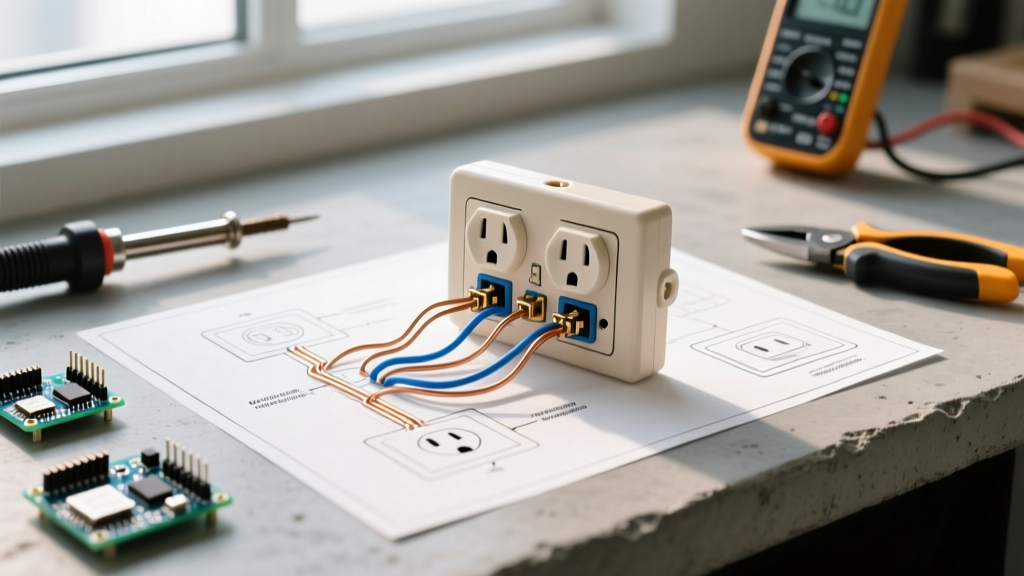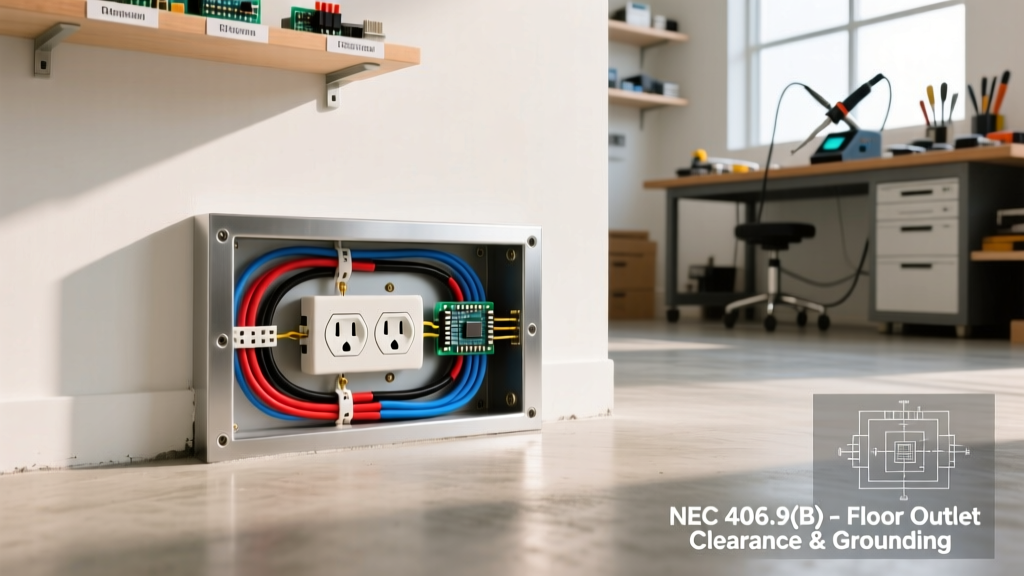

The Reality of Floor Receptacles: Why Standard Wall Boxes Fail
Designing a modern living room or open-concept office often involves floating furniture away from the walls. To power lamps, laptops, and home theater equipment without stretching hazardous extension cords across walkways, many homeowners consider installing an electrical outlet on the floor. While aesthetically pleasing and highly functional, placing a receptacle in a walking surface introduces severe mechanical and environmental hazards that standard wall boxes simply cannot withstand.
Standard single-gang or double-gang wall boxes are engineered for vertical mounting. When laid flat on a floor, they are immediately vulnerable to crushing forces from foot traffic, furniture legs, and vacuum cleaner beater bars. Furthermore, standard faceplates lack water ingress protection. A routine wet-mopping session can force conductive, mineral-laden water directly into the terminal screws, creating an immediate arc-fault or electrocution hazard. To mitigate these risks, the National Electrical Code (NEC) enforces strict hardware and installation mandates for floor-mounted receptacles.
NEC Code Compliance for an Electrical Outlet on the Floor
As of the 2026 enforcement cycle of the NEC, the rules governing floor receptacles are primarily found in Article 406.9(E) and Article 314.27(B). The National Fire Protection Association (NFPA) explicitly states that receptacles installed in floors must be listed specifically as a floor receptacle.
NEC 406.9(E) Receptacles in Floors: "Receptacles installed in floors shall be listed as a floor receptacle. Floor receptacles shall be installed in floor boxes that are listed for the purpose."
This means you cannot legally or safely take a standard $1.50 blue PVC wall box, embed it in your concrete slab or wood subfloor, and slap a standard faceplate on it. The entire assembly—the box, the internal device, and the cover plate—must be tested and listed by a Nationally Recognized Testing Laboratory (NRTL) like UL (Underwriters Laboratories) for floor use. These assemblies are engineered with heavy-duty brass or die-cast zinc covers, integrated gaskets, and angled internal wiring chambers to prevent cable pinching.
Approved Floor Box Assemblies: Market Leaders & Pricing
Selecting the correct box depends entirely on your subfloor material. Below is a comparison of industry-standard floor boxes available in 2026:
| Brand / Model | Application | Material | Est. Price (2026) | Key Feature |
|---|---|---|---|---|
| Carlon E971F-UP | New Construction (Wood/Poured) | Non-Metallic PVC | $35 - $45 | Angled knockouts to prevent wire kinking |
| Hubbell SystemOne | Concrete On-Grade (Commercial) | Die-Cast Zinc / Steel | $140 - $220 | Adjustable depth for leveling with concrete |
| Pass & Seymour 6230 | Retrofit (Wood Subfloor) | Die-Cast Aluminum | $85 - $110 | Brass cover with integrated gasket seal |
For residential DIYers working with wood joists, the Carlon E971F-UP is the most cost-effective and code-compliant choice. For concrete slab penetrations, metallic boxes like those from Hubbell Wiring Systems are mandatory to maintain the structural integrity of the slab and provide proper grounding.
Moisture, Mopping, and GFCI Requirements
The most frequent point of failure for an electrical outlet on the floor is moisture ingress. Even in dry residential living rooms, wet mopping introduces water that can pool around the receptacle cover.
- Dry Locations: If the floor box is installed in a carpeted area or a room where wet mopping is strictly prohibited, a standard NEMA 1-rated floor cover with a basic gasket is sufficient.
- Damp Locations: For hard-surface floors (tile, hardwood, polished concrete) subject to routine damp or wet mopping, the cover assembly must be rated for damp locations and feature a watertight seal when the cover is closed.
- Wet Locations: Outdoor patios or indoor commercial kitchens require NEMA 3R or NEMA 4X rated floor boxes with heavy-duty spring-loaded flip covers and deep O-ring seals.
Does a floor outlet require GFCI protection? The NEC does not universally mandate GFCI protection for floor receptacles simply because they are on the floor. However, if the outlet is installed within 6 feet of a sink (such as in a kitchen island or wet bar), or if local commercial codes dictate GFCI for areas subject to wet mopping, a 20-Amp GFCI receptacle must be used inside the floor box. Note that standard GFCI devices are deeper than standard receptacles; you must verify that your chosen floor box has the internal cubic-inch capacity (usually at least 22.5 cu. in.) to accommodate the bulky GFCI electronics.
Step-by-Step Installation: Wood Joist vs. Concrete Slab
The installation methodology drastically changes based on your structural framing. Improper support leads to box deflection, which eventually cracks the faceplate or loosens wire terminations.
Scenario A: Wood Subfloor (New Construction or Retrofit)
- Locate and Cut: Use a stud finder to ensure you are not cutting through a floor joist. Cut the subfloor using a 4-inch hole saw (verify exact dimensions on the manufacturer's template).
- Run the Feeder: Run 12/2 or 14/2 NM-B (Romex) cable to the location. Leave at least 8 inches of slack inside the box.
- Secure the Box: Non-metallic floor boxes like the Carlon E971F feature integral mounting brackets. Insert the box into the hole and tighten the mounting screws, which draw the flange tight against the subfloor. Do not rely solely on the drywall or subfloor friction; the mechanical brackets must bear the load.
- Seal the Edges: Apply a bead of silicone caulk between the box flange and the subfloor to prevent dust and minor spills from entering the joist bay below.
Scenario B: Concrete On-Grade Slab
Installing an electrical outlet on the floor of a concrete slab requires pre-planning before the pour, or expensive core-drilling for retrofits.
- Pre-Pour: Secure the metallic floor box to the rebar grid or wire mesh using heavy-duty zip ties or steel tie wire. Ensure the top of the box cover flange is set exactly to the finished floor elevation (FFE). If the concrete pour buries the flange, the box is ruined.
- Concrete Encasement: The NEC requires metallic boxes in concrete to be encased by at least 1.5 inches of concrete to prevent corrosion and cracking. Use a high-slump concrete mix around the box to eliminate air voids, which can cause the slab to crack under foot traffic.
- Retrofit Core Drilling: If cutting into an existing slab, you must use a diamond core drill. Once the trench is dug to the main feed, the box is set in a rapid-hardening hydraulic cement (like Quikrete Water-Stop). Ensure the box is bonded to the equipment grounding conductor, as concrete-encased electrodes (Ufer grounds) interact differently with metallic floor boxes.
Critical Safety Detail: Terminal Torque and Vibration
An often-overlooked failure mode for floor receptacles is terminal screw loosening due to micro-vibrations from foot traffic and heavy appliances. In 2026, NEC 110.14(D) strictly requires the use of calibrated torque tools for all electrical terminations where the manufacturer specifies a torque value.
When wiring the receptacle inside the floor box:
- Strip the wires to the exact length indicated by the manufacturer's strip gauge (usually 5/8 inch).
- Use a calibrated torque screwdriver (e.g., Klein Tools or CDI). For standard 12 AWG copper wire on a 20-Amp commercial-grade receptacle, the typical torque requirement is 16 inch-pounds. For 14 AWG on a 15-Amp device, it is typically 12 to 14 inch-pounds.
- Never use the "push-in" backstab connectors for floor outlets. The constant mechanical vibration of a walking surface will eventually cause backstabbed connections to arc and fail. Always use the side-terminal screws or a high-quality screwless clamp termination.
Summary and Final Inspections
Installing an electrical outlet on the floor is a highly effective way to manage power distribution in modern, open-concept spaces, provided you respect the mechanical and environmental realities of the floor plane. By strictly adhering to NEC 406.9(E), utilizing only NRTL-listed floor box assemblies, applying correct torque to terminal screws, and evaluating the moisture risks of your specific room, you can achieve a safe, code-compliant, and durable installation. Always consult your local Authority Having Jurisdiction (AHJ), as local amendments may impose stricter GFCI or metallic-box requirements than the baseline national code.