
Decoding Electrical Outlet Names: The NEMA Standard
When planning a subpanel upgrade, installing a new appliance, or troubleshooting a tripped breaker, understanding electrical outlet names is the difference between a safe, code-compliant installation and a severe fire hazard. In North America, receptacles and plugs are not simply categorized by 'shape' or 'size'; they are strictly classified by the National Electrical Manufacturers Association (NEMA).
Every standard electrical outlet name follows a specific alphanumeric code that dictates its voltage, amperage, grounding status, and physical configuration. For DIYers and professional electricians alike, misidentifying a NEMA 10-30R as a 14-30R can result in missing equipment grounding paths, violating the National Electrical Code (NEC) and creating lethal shock risks.
The Anatomy of a NEMA Designation
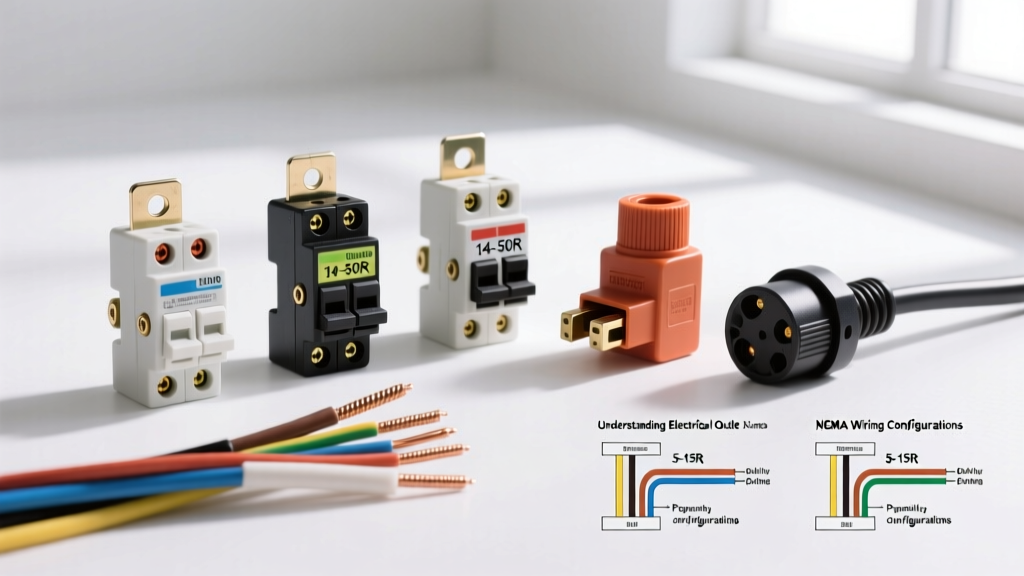
To master common wiring scenarios, you must first learn how to read the code. A standard electrical outlet name like NEMA 5-15R breaks down as follows:
- NEMA: The governing standard body.
- 5: The configuration code (indicates 125V, 2-pole, 3-wire with ground).
- 15: The amperage rating (15 Amps).
- R: Receptacle (female outlet). If it were a plug (male), it would end in 'P'.
Expert Insight: Never use a 'cheater plug' or adapter to force a plug into a mismatched receptacle. The physical blade differences exist specifically to prevent overloading circuits and bypassing safety grounds.
Standard Residential Receptacles (120V Scenarios)
The vast majority of residential wiring scenarios involve 120V circuits. However, the physical differences between the two most common outlet names dictate entirely different wire gauges and breaker sizes.
NEMA 5-15R (Standard 15A Duplex)
This is the ubiquitous household outlet found in living rooms and bedrooms. It features two vertical slots (one slightly longer for the neutral) and a U-shaped ground pin.
- Wiring Scenario: Requires 14 AWG copper wire minimum, protected by a 15A breaker.
- Code Requirement: As of recent NEC updates, all 15A 125V receptacles in dwelling units must be Tamper-Resistant (TR). Look for the 'TR' stamp on the yoke.
- Cost Expectation: A high-quality commercial-grade TR receptacle (e.g., Leviton T5252) costs between $1.50 and $2.50 in 2026. Avoid the $0.60 residential-grade backstab models; use the side-terminal screws torqued to 12-14 in-lbs.
NEMA 5-20R (20A Kitchen and Bath)
Visually similar to the 5-15R, the NEMA 5-20R features a distinct 'T' shaped neutral slot. This allows 20A plugs to be inserted, while still accepting standard 15A plugs.
- Wiring Scenario: Mandates 12 AWG copper wire and a 20A breaker. Commonly wired in kitchen small-appliance circuits and bathroom vanity circuits.
- Common Mistake: Installing a 5-20R receptacle on a 15A breaker/14 AWG wire circuit. While the NEC permits 15A receptacles on 20A circuits (if there are multiple receptacles), it strictly forbids 20A receptacles on 15A circuits.
High-Power & Appliance Outlets (240V Scenarios)
Heavy appliances and modern electric vehicles (EVs) require 240V circuits. The electrical outlet names in this category dictate high-amperage wiring scenarios that demand precise torque specifications and continuous-load calculations.
NEMA 14-50R (EV Chargers, Ranges, and RV Hookups)
The NEMA 14-50R is a 4-wire receptacle (two hots, one neutral, one ground) rated for 125/250V and 50 Amps. In 2026, this is the most heavily debated outlet in residential wiring due to the explosion of Level 2 home EV charging.
- Wiring Scenario: Requires 6 AWG copper wire (or 4 AWG aluminum) and a 50A double-pole breaker.
- The Continuous Load Trap: According to NEC Article 210.20, a continuous load (running for 3+ hours, like an EV charger) can only utilize 80% of a breaker's capacity. Therefore, a 40A EV charger requires a 50A breaker and a 14-50R receptacle.
- Hardware Warning: Standard $12 residential-grade 14-50R receptacles are known to melt under continuous 40A EV loads. The U.S. Department of Energy and fire investigators heavily recommend installing industrial-grade receptacles (like the Hubbell HBL9450A or Bryant 9450FR, costing $75-$95) which feature massive brass contacts designed to dissipate heat during continuous duty cycles.
NEMA 10-30R vs. NEMA 14-30R (Electric Dryers)
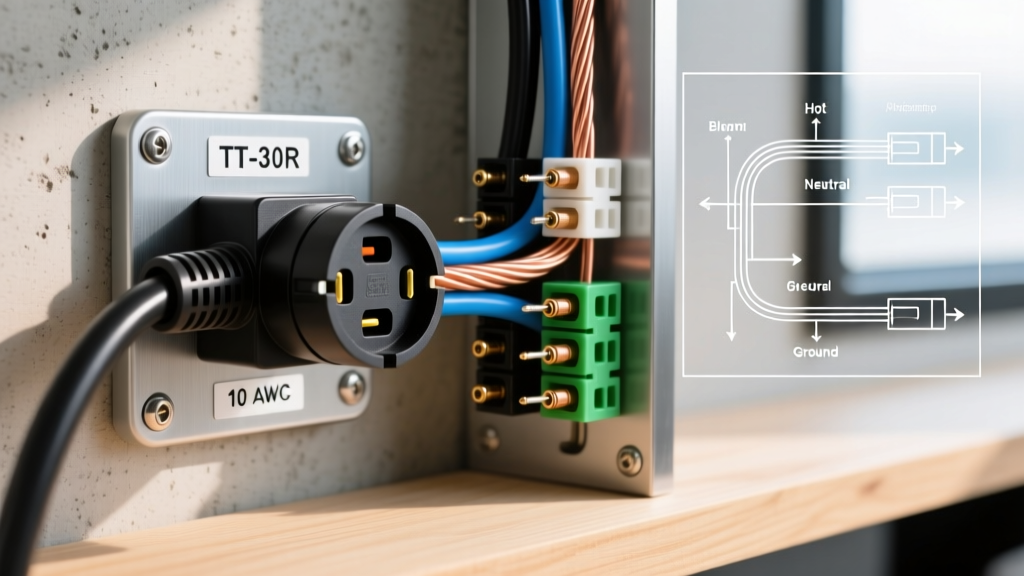
If you are wiring a new laundry room, you will encounter the NEMA 14-30R. This is a 4-wire, 30A, 125/250V receptacle.
- Wiring Scenario: 10 AWG copper wire on a 30A double-pole breaker.
- The Legacy 10-30R: Older homes may feature a NEMA 10-30R (3-prong, no dedicated ground). The NEC banned the installation of new 10-30R receptacles in 1996. If you are upgrading a panel, you must run a new 4-wire cable and install a 14-30R. Never rely on the neutral wire as a ground path in new installations.
Quick Reference: Common Electrical Outlet Names
| NEMA Name | Voltage | Amps | Wire Gauge (Cu) | Breaker Size | Common Application |
|---|---|---|---|---|---|
| 5-15R | 125V | 15A | 14 AWG | 15A | General Living Spaces |
| 5-20R | 125V | 20A | 12 AWG | 20A | Kitchens, Bathrooms |
| 6-15R | 250V | 15A | 14 AWG | 15A | Small Window AC Units |
| 10-30R | 125/250V | 30A | 10 AWG | 30A | Legacy Dryers (Pre-1996) |
| 14-30R | 125/250V | 30A | 10 AWG | 30A | Modern Electric Dryers |
| 14-50R | 125/250V | 50A | 6 AWG | 50A | EV Chargers, Ranges, RVs |
| 14-60R | 125/250V | 60A | 4 AWG | 60A | Heavy Duty EV / Shop Tools |
| L14-30R | 125/250V | 30A | 10 AWG | 30A | Portable Generators |
Specialty & Safety Receptacle Configurations
Beyond standard NEMA shapes, electrical outlet names often include prefixes or suffixes that denote critical safety mechanisms required by modern building codes.
GFCI and AFCI Receptacles
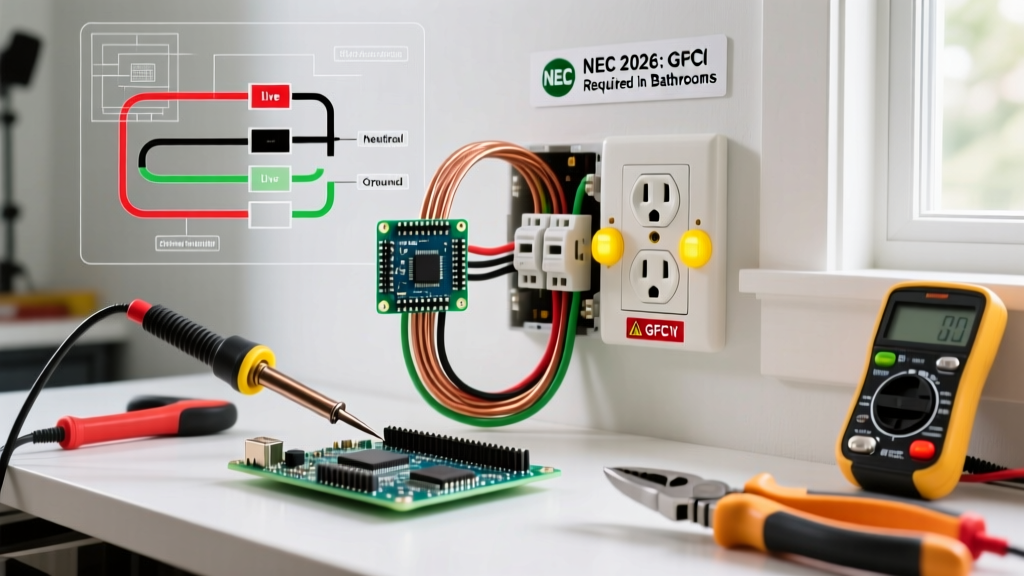
While they retain the standard NEMA 5-15R or 5-20R blade configuration, Ground Fault Circuit Interrupter (GFCI) and Arc Fault Circuit Interrupter (AFCI) receptacles contain internal microprocessors.
- GFCI (Ground Fault): Monitors current imbalance between hot and neutral. Trips at a 4mA to 6mA variance to prevent electrocution. Required in wet locations (kitchens, baths, exteriors, garages).
- AFCI (Arc Fault): Detects dangerous electrical arcing (sparking) that causes fires. Usually handled at the breaker panel, but dual-function AFCI/GFCI receptacles exist for retrofits where panel space is limited.
Twist-Lock Outlets (L-Series)
If an electrical outlet name begins with an 'L' (e.g., L14-30R), it is a twist-lock receptacle. The blades are curved; you insert the plug and twist it 15 degrees to lock it in place.
- Wiring Scenario: Predominantly used for portable generators and transfer switches. The locking mechanism prevents the plug from vibrating loose or being accidentally pulled out while under heavy load, which could cause a fatal arc flash.
- Installation Note: When wiring a generator inlet box with an L14-30R, ensure the neutral-to-ground bonding screw is removed inside your main panel if you are using a transfer switch, to prevent backfeeding and creating a parallel neutral path.
Critical Wiring Mistakes to Avoid
Knowing the electrical outlet names is only half the battle; executing the wiring correctly is where most DIY failures occur. According to OSHA wiring standards and NEC guidelines, avoid these catastrophic errors:
- Ignoring Torque Specifications: Since NEC 110.14(D) was enforced, electricians must use a calibrated torque screwdriver. Under-tightening a 14-50R terminal screw causes high resistance, leading to thermal expansion, arcing, and melted receptacles. Over-tightening strips the brass threads.
- Backstabbing High-Current Outlets: Push-in backwire holes are acceptable for 15A lighting circuits using 14 AWG solid wire. They are entirely unacceptable for 20A kitchen circuits or 240V appliance receptacles. Always use side-terminal screws or the screw-down backwire clamp plates.
- Bootleg Grounds: When replacing an ungrounded NEMA 1-15R (2-prong) with a 3-prong 5-15R, never use a jumper wire between the neutral and ground screws. This creates a 'bootleg ground' that will energize the appliance chassis if the neutral wire ever breaks. Instead, install a GFCI receptacle and label it 'No Equipment Ground' as permitted by the NEC.
Summary
Mastering electrical outlet names and their corresponding NEMA configurations ensures that your wiring scenarios are safe, efficient, and fully compliant with the latest electrical codes. Whether you are wiring a simple NEMA 5-15R bedroom outlet or sizing 6 AWG wire for a NEMA 14-50R EV charger, always verify the amperage, voltage, and grounding requirements before terminating your first wire.