
Determining the Correct Electrical Outlet Height in Garage Environments
Wiring a garage is fundamentally different from wiring the interior living spaces of a home. While a bedroom outlet simply needs to accommodate a lamp or a phone charger, a garage serves as a dynamic workshop, a storage facility, and increasingly, a residential fueling station for electric vehicles. Determining the correct electrical outlet height in garage environments requires balancing strict National Electrical Code (NEC) mandates with practical, real-world ergonomics.
If you mount every receptacle at the standard residential height of 16 inches, you will inevitably deal with power cords draping dangerously across workbenches, EV charging cables dragging through winter road salt, and constant bending to plug in heavy power tools. This guide breaks down the optimal mounting heights for every garage scenario, backed by current NEC regulations and professional workshop design principles.
The Baseline: General Perimeter Outlets and NEC Spacing
Before customizing heights for specific zones, you must satisfy the baseline code requirements for general garage receptacles. According to the National Fire Protection Association (NFPA 70), NEC Article 210.52(G) dictates that at least one 120-volt, 20-ampere receptacle outlet must be installed in each garage bay. Furthermore, NEC 210.8(A)(2) mandates that all 125V through 250V receptacles rated 150 amps or less in garages must have Ground-Fault Circuit Interrupter (GFCI) protection.
The 18-Inch Standard
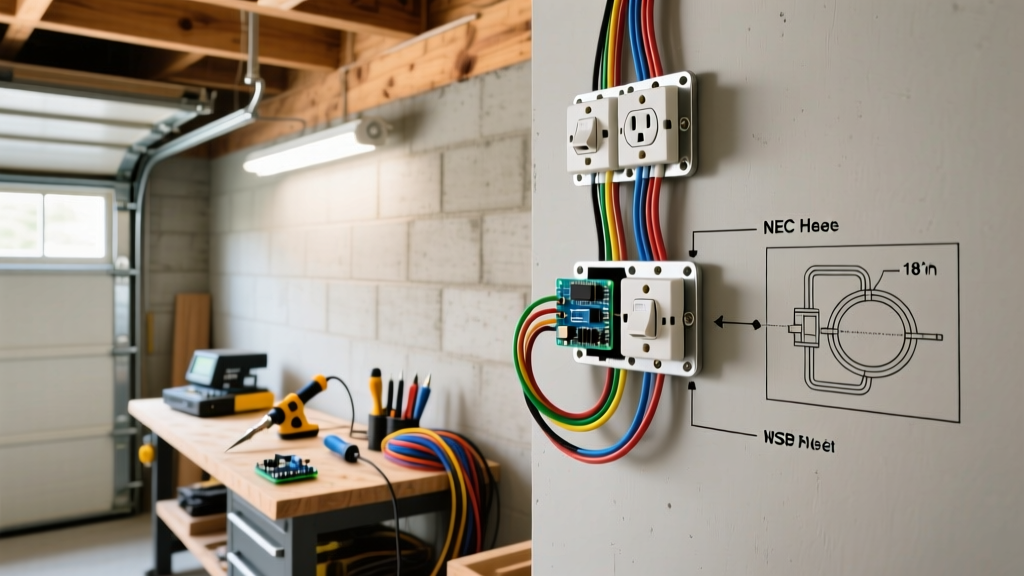
For general perimeter walls where no specific workbench or appliance is planned, the standard electrical outlet height in garage spaces is 18 inches from the finished floor to the center of the electrical box.
- Framing Logic: This height allows electricians to easily run NM-B (Romex) cable through the studs and drill a single hole without interfering with standard 2x4 bottom plates.
- Drywall Logic: When hanging 4x8 drywall sheets horizontally, an 18-inch height places the outlet box neatly on the lower sheet, avoiding the tapered horizontal seam.
- Use Case: Plugging in a shop vac, a battery charging station, or seasonal holiday lighting.
Workbench Zones: The 44-Inch Ergonomic Sweet Spot
The most critical mistake DIYers make is installing standard 18-inch outlets behind a workbench. A standard workshop bench is 34 to 36 inches high. If your outlet is at 18 inches, your power tool cords must drape down over the back edge of the bench, creating a severe snag hazard that can pull a running router or circular saw onto the floor.
Optimal Height and Rough-In Strategy
For dedicated workbench walls, the ideal electrical outlet height in garage setups is 44 to 48 inches from the floor to the center of the box. This places the receptacle 8 to 12 inches above the bench surface, allowing cords to plug in horizontally and trail neatly along the back of the work area.
Pro-Tip for Framers and Electricians: During the rough-in phase, install horizontal 2x4 blocking between the wall studs at exactly 43 inches (to accommodate a 2.5-inch deep box and land the center at 44 inches). This provides a rock-solid mounting surface for the electrical box, which is crucial when you are repeatedly pushing and pulling stiff plugs from heavy-duty receptacles.
Product Selection for Workbenches
Avoid standard 15-amp builder-grade receptacles. Workbenches demand 20-amp, Tamper-Resistant (TR), commercial-grade duplex receptacles. The Leviton 5362-W (20A Commercial Duplex) retails for roughly $8 to $12 in 2026 and features heavy-gauge brass contacts that will not loosen over years of vibration from power tools. Always wire these on a dedicated 20A circuit using 12 AWG copper wire.
EV Charging Stations: Mounting the NEMA 14-50 Receptacle
With EV adoption accelerating, the garage is now a primary fueling location. Most Level 2 home chargers utilize a NEMA 14-50R receptacle (50 Amp, 240 Volt). The mounting height for this specific receptacle is a subject of intense debate, but physics and cable management dictate the correct answer.
The 48 to 52-Inch Rule for EV Outlets
According to best practices outlined by the U.S. Department of Energy for home EV infrastructure, the optimal height for a NEMA 14-50 receptacle is 48 to 52 inches from the floor.
- Cable Drape Physics: EV charging cords are heavy, thick, and often 18 to 24 feet long. The charge port on most modern EVs (like the Tesla Model Y or Ford F-150 Lightning) sits between 30 and 40 inches off the ground. Mounting the receptacle at 48 inches allows the heavy 6 AWG or 4 AWG cable to loop gently downward without resting on the garage floor.
- Moisture and Corrosion Prevention: Garage floors collect melting snow, rainwater, and road salt. If an EV receptacle is mounted at 18 inches, the heavy cable drags through this corrosive slush, eventually degrading the cable jacket and introducing moisture to the plug face.
- Clearance: A 48-inch height keeps the plug face well above the splash zone of tires and floor drains.
The Danger of Cheap 50A Receptacles
Do not buy a $15 generic NEMA 14-50 receptacle from a big-box store for EV charging. Continuous EV charging draws 40 amps for 8+ hours. Cheap receptacles use thin aluminum internal busbars that overheat, melt, and cause fires. Always specify the Hubbell 9450FR (roughly $65 in 2026) or the Bryant 9450FR. These feature massive solid brass busbars and heavy-duty phenolic faces designed specifically for continuous high-amperage EV loads.
Matrix: Garage Outlet Heights by Scenario
| Garage Zone / Scenario | Ideal Height (Center of Box) | Recommended Receptacle Type | NEC / Code Considerations |
|---|---|---|---|
| General Perimeter Walls | 18 inches | 15A or 20A GFCI Duplex | NEC 210.8(A)(2) GFCI required |
| Workbench / Assembly Area | 44 to 48 inches | 20A Commercial Duplex (TR) | Dedicated 20A circuit recommended |
| EV Charging Station (Level 2) | 48 to 52 inches | 50A NEMA 14-50R (Hubbell 9450FR) | NEC 625.40; 50A breaker for 40A load |
| Air Compressor / Dust Collector | 72 to 84 inches | 20A/30A Twist-Lock (L6-30) | Prevents accidental unplugging |
| Ceiling Hoist / Motorized Storage | Ceiling Mount / Drop Cord | 15A/20A Twist-Lock or Hardwired | Strain relief and physical protection |
Rough-In Realities: Exposed Wiring and Plywood Walls
Many garage owners opt to line their walls with 3/4-inch plywood or OSB instead of drywall to allow for easy tool mounting. This drastically changes your rough-in strategy and interacts directly with NEC Article 334.15 regarding exposed work.
The Physical Damage Clause
NEC 334.15 states that NM-B (Romex) cable must be protected from physical damage where exposed. Running bare Romex down the face of a plywood wall where cars, bicycles, and lumber are constantly moving is a direct code violation. If your plywood wall is already up, or if you plan to leave the stud bays exposed, you must run your wiring through EMT (Electrical Metallic Tubing) or rigid PVC conduit.
Box Depth Calculations for Plywood
When mounting electrical boxes to 3/4-inch plywood, standard shallow boxes will result in the receptacle face sitting too far back, creating a gap where debris can enter. Use deep boxes. The Carlon B618R-UPC (Single Gang, 22.5 cubic inches) or the Raco 8200 (Steel, 21 cubic inches) provide ample depth. This extra depth is crucial in 2026, as many modern smart plugs, energy monitors, and bulky GFCI bodies require significant space behind the yoke to prevent wire crushing and overheating.
GFCI Nuisance Tripping: Breakers vs. Receptacles
While the NEC mandates GFCI protection for garage outlets, the method of protection matters immensely for workshop functionality. Older induction motors (found in vintage table saws, air compressors, and bench grinders) can generate harmonic feedback or inrush currents that cause point-of-use GFCI receptacles to nuisance trip.
Furthermore, if you mount a GFCI receptacle behind a heavy, stationary tool like a bandsaw, resetting it requires moving the machine. The superior approach is to install a standard 20A duplex receptacle at your desired ergonomic height and use a GFCI Circuit Breaker in the main panel. This protects the entire circuit while keeping the reset mechanism easily accessible at the breaker box. For maximum safety and compliance with modern arc-fault requirements, utilize a Dual Function (DF) breaker that provides both AFCI and GFCI protection in one unit.
Frequently Asked Questions
Does the ADA apply to residential garage outlet heights?
The Americans with Disabilities Act (ADA) generally applies to commercial and public spaces, not private single-family residences. However, if you are designing an accessible in-law suite or an aging-in-place workshop, the ADA Standards for Accessible Design recommend that operable parts (like receptacles) be mounted between 15 and 48 inches above the floor to accommodate wheelchair reach ranges. The 44-inch workbench height perfectly aligns with accessible forward-reach limits.
Can I install an outlet directly on the garage floor?
No. Floor receptacles in a garage are highly discouraged and often rejected by local inspectors. Garages are subject to water intrusion, snowmelt, and chemical spills. Even with a waterproof floor box cover, the risk of liquid ingress into a 120V/240V connection is too high. Always mount receptacles on vertical walls or suspend them from the ceiling.
How many outlets should a 2-car garage have?
While the NEC only strictly requires one per car bay, the Electrical Safety Foundation International (ESFI) strongly advises against relying on extension cords and power strips. A modern 2-car garage should have a minimum of 8 to 12 receptacles, distributed across at least three separate 20A circuits (e.g., one for general lighting/vacuum, one dedicated to the workbench, and one dedicated to EV charging or heavy appliances).
Final Thoughts on Garage Wiring
Planning your electrical outlet height in garage spaces is a one-time decision that will dictate your workflow and safety for decades. By elevating workbench outlets to 44 inches, positioning EV receptacles at 48 inches to keep heavy cables off wet floors, and utilizing commercial-grade hardware like the Hubbell 9450FR, you transform a basic code-compliant garage into a professional-grade, future-proofed facility. Always consult with a licensed electrician and your local building department, as local amendments can occasionally supersede baseline NEC guidelines.