
Why Outlet Box Dimensions Dictate Electrical Safety
When planning a residential or commercial wiring project, selecting the correct enclosure is not merely a matter of physical fit; it is a critical life-safety requirement. The dimensions of electrical outlet box enclosures directly impact heat dissipation, wire bending radius, and the prevention of insulation damage. According to the National Fire Protection Association (NFPA 70), specifically NEC Article 314, outlet boxes must provide adequate cubic-inch volume to accommodate all conductors, devices, and fittings without overcrowding.
As electrical loads increase and smart home technology becomes ubiquitous in 2026, the physical footprint of devices like GFCIs, USB-integrated receptacles, and smart dimmers has expanded. Using undersized boxes leads to pinched wires, compromised connections, and an elevated risk of arc faults or electrical fires. This guide breaks down standard sizing matrices, NEC box fill calculations, and depth requirements to ensure your installation passes inspection on the first attempt.
Standard Dimensions of Electrical Outlet Box: A Sizing Matrix
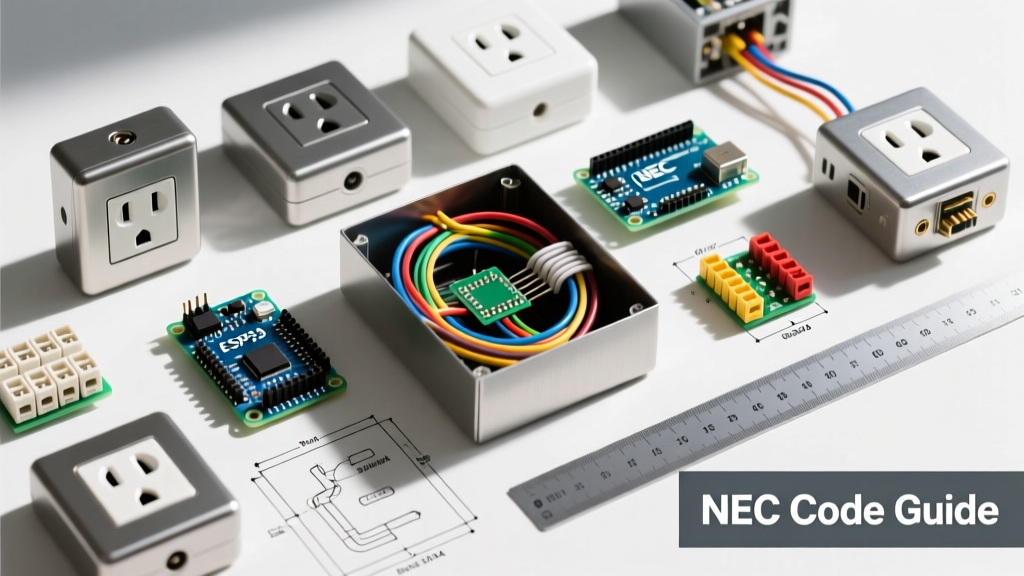
Electrical boxes are categorized by their gang count (number of device openings) and their depth. While the face dimensions are relatively standardized to fit standard wall plates, the depth and resulting cubic-inch capacity vary wildly. Below is the standard dimensional matrix for non-metallic (PVC/fiberglass) and metallic new-work boxes.
| Box Type | Standard Face Dimensions | Common Depths | Typical Cubic Inch Capacity | Best Application |
|---|---|---|---|---|
| 1-Gang (Standard) | 2.125" x 3.5" | 1.5", 2.0", 2.5" | 18.0 to 22.5 cu. in. | Standard single switches or duplex receptacles |
| 1-Gang (Deep/Switch) | 2.125" x 3.5" | 3.0", 3.5" | 24.0 to 32.0 cu. in. | Smart switches, GFCIs, USB outlets |
| 2-Gang | 4.0" x 3.5" | 1.5", 2.0", 2.5" | 34.0 to 42.0 cu. in. | Two adjacent switches or receptacles |
| 3-Gang | 5.5" x 3.5" | 2.0", 2.5" | 50.0 to 60.0 cu. in. | Multi-switch lighting control banks |
| 4-Inch Square (Metallic) | 4.0" x 4.0" | 1.5", 2.125" | 25.5 to 30.3 cu. in. | Exposed conduit, junctions, 1-2 devices with plaster ring |
| Octagonal / Round | 4.0" Diameter | 1.5", 2.125" | 12.5 to 16.5 cu. in. | Ceiling fan supports, light fixture canopies |
NEC Article 314: Box Fill Calculations Explained
Knowing the physical dimensions is only half the battle. The NEC mandates a strict mathematical formula to determine if a box's cubic-inch capacity is sufficient for the specific wires and devices entering it. This is known as the Box Fill Calculation. Inspectors use NEC Table 314.16(B) to assign a 'volume allowance' to every component inside the box.
Inspector Insight: The most common reason for failed rough-in inspections in 2026 is failing to account for the doubled volume allowance required by modern smart switches and GFCI receptacles, which have bulky internal electronics and heat sinks.
NEC Volume Allowance Multipliers (Table 314.16(B))
Each conductor, device, or fitting is assigned a multiplier based on the American Wire Gauge (AWG) of the largest wire entering the box. You multiply this base number by the cubic-inch value per wire size.
| Component Type | Volume Allowance Multiplier |
|---|---|
| Each Current-Carrying Conductor (Hot/Neutral) | 1 |
| All Equipment Grounding Conductors (Combined) | 1 |
| Internal Cable Clamps (Combined) | 1 |
| Each Device (Switch, Receptacle, GFCI) | 2 |
| Isolated Ground Wires (if present) | 1 |
Base Cubic-Inch Values by Wire Gauge
- 14 AWG: 2.0 cubic inches per allowance
- 12 AWG: 2.25 cubic inches per allowance
- 10 AWG: 2.5 cubic inches per allowance
- 8 AWG: 3.0 cubic inches per allowance
Step-by-Step Box Fill Calculation Example
Let us calculate the required box volume for a standard 12 AWG, 20-amp bathroom circuit featuring a Leviton T5280 GFCI receptacle. Two 12/2 NM-B cables enter a plastic box with internal clamps.
- Current-Carrying Conductors: 2 cables x 2 wires (hot/neutral) = 4 wires. (4 x 2.25 cu in = 9.0 cu in)
- Equipment Grounds: 2 bare ground wires count as a single allowance. (1 x 2.25 cu in = 2.25 cu in)
- Internal Clamps: Plastic boxes with molded clamps count as 1 allowance. (1 x 2.25 cu in = 2.25 cu in)
- The Device (GFCI): A GFCI counts as 2 allowances. (2 x 2.25 cu in = 4.5 cu in)
Total Required Volume: 9.0 + 2.25 + 2.25 + 4.5 = 18.0 cubic inches.
In this scenario, a standard 18 cu. in. 1-gang box (like the Carlon B118A) is technically code-compliant. However, because GFCI bodies are exceptionally deep, physically cramming the 12 AWG wires behind the device will be difficult. Best practice dictates upgrading to a 22.5 cu. in. deep box (2.5" depth) to facilitate safe wire folding and prevent stress on the terminal screws.
Depth Requirements for Modern Smart & GFCI Devices
The shift toward connected homes has fundamentally changed how electricians select box dimensions. Standard 1.5-inch deep boxes are now considered obsolete for anything other than simple single-pole toggle switches. When installing modern equipment, adhere to these minimum depth guidelines:
- Standard Duplex Receptacles & Toggles: Minimum 1.5" depth (18 cu. in.).
- GFCI & AFCI Receptacles: Minimum 2.5" depth (22.5 cu. in. or greater). The bulky internal trip mechanisms require significant rear clearance.
- Smart Switches (e.g., Lutron Caseta, Leviton Decora Smart): Minimum 2.5" to 3.0" depth. These devices contain Wi-Fi/Zigbee radios, relays, and heat-dissipating fins that easily measure 1.75" deep, leaving almost no room for wire nuts in a shallow box.
- USB-C Integrated Outlets: Minimum 2.0" depth. The internal step-down transformers generate heat and require physical space for airflow.
Common Code Violations Inspectors Flag
According to data from the Occupational Safety and Health Administration (OSHA) and local electrical inspectors, box fill and dimension violations remain a top citation. Avoid these frequent pitfalls:
1. The 'Plaster Ring' Miscalculation
When using a 4-inch square metallic box with a single-gang plaster ring (mud ring) for a drywall application, many electricians mistakenly calculate the box fill based only on the 4x4 box volume. NEC Section 314.22 requires you to add the volume of the plaster ring to the base box volume. If the ring adds 4.5 cu. in., and your 4x4 box is 25.5 cu. in., your total allowable volume is 30.0 cu. in.
2. Ignoring Pigtails and Wire Connectors
While wire nuts and Wago connectors themselves do not require a separate volume allowance, the pigtails used to connect devices do. However, conductors that originate and terminate entirely within the box (like a simple grounding pigtail) do not count toward the box fill. Misunderstanding this nuance often leads to either overcrowded boxes or unnecessarily oversized ones.
3. Using Shallow Boxes for Multi-Gang Smart Switches
Installing three smart dimmers in a 3-gang, 2.0" deep box is a guaranteed inspection failure and a thermal hazard. Smart dimmers derate their maximum wattage capacity if they are ganged together without adequate heat dissipation space. Always use 2.5" or 3.0" deep multi-gang boxes for clustered solid-state devices.
Frequently Asked Questions (FAQ)
Can I use a box extension ring to increase dimensions?
Yes. NEC Article 314.22 permits the use of extension rings to increase the cubic-inch capacity of an existing metallic box. However, you cannot use a standard extension ring to fix an overcrowded non-metallic (PVC) box; you must replace the PVC box entirely or use a manufacturer-approved, listed PVC box extender designed for old-work retrofits.
Do low-voltage wires count toward box fill?
No. According to the Copper Development Association and NEC guidelines, Class 2 and Class 3 low-voltage conductors (like thermostat wire, Ethernet, or doorbell wire) do not require a volume allowance in a standard line-voltage box, provided they are separated by a permanent barrier or the box is specifically listed for mixed-voltage use.
What is the minimum box depth for a ceiling fan?
Standard octagonal boxes (1.5" deep) are insufficient for the weight and vibration of ceiling fans. You must use a fan-rated box (typically 2.125" deep or more) that is securely braced to the building structure, capable of supporting at least 35 pounds, or up to 70 pounds if specifically marked.