
Understanding Standard Electrical Outlet Box Dimensions
When planning a residential or commercial wiring project, selecting the correct electrical outlet box dimensions is not merely a matter of physical fit—it is a strict legal requirement governed by the National Electrical Code (NEC). Under NEC Article 314, the internal volume of an outlet box must be sufficient to prevent overcrowding, which can lead to damaged wire insulation, overheating, and catastrophic electrical fires. According to the National Fire Protection Association (NFPA), improper box fill is consistently cited as one of the most common residential electrical code violations during rough-in inspections.
While the face dimensions of a standard single-gang box are universally 2 inches wide by 3 inches high, the depth and resulting cubic inch capacity vary drastically. Choosing the wrong depth is a frequent error made by DIYers who purchase the cheapest, shallowest boxes available without calculating the required wire fill.
⚠️ Code Warning: Never force wires into a shallow box. If the drywall is already installed and you realize your 1.5-inch deep box is overfilled, you must cut it out and install an approved deep retrofit box. Overstuffed boxes violate OSHA and NEC safety standards, as noted in OSHA Standard 1926.405 regarding wiring methods and component safety.Standard Outlet Box Dimensions and Volumes
The table below outlines the most common electrical outlet box dimensions found in North American hardware stores, along with their nominal cubic inch capacities. These capacities dictate exactly how many wires and devices you can legally install inside them.
| Box Type | Face Dimensions (W x H) | Depth | Cubic Inch Capacity | Best Use Case |
|---|---|---|---|---|
| Single-Gang Shallow | 2" x 3" | 1.5" | 8.0 cu in | Single toggle switch, 14 AWG only |
| Single-Gang Standard | 2" x 3" | 2.5" | 14.0 cu in | Standard duplex receptacles, 12/14 AWG |
| Single-Gang Deep | 2" x 3" | 3.5" | 22.0 cu in | GFCI, smart switches, dimmers |
| 4-Inch Square Shallow | 4" x 4" | 1.5" | 21.0 cu in | Junction boxes, ceiling fans, multi-wire |
| 4-Inch Square Deep | 4" x 4" | 2.125" | 30.3 cu in | Heavy feed-throughs, large smart hubs |
NEC Article 314: Calculating Box Fill Capacity
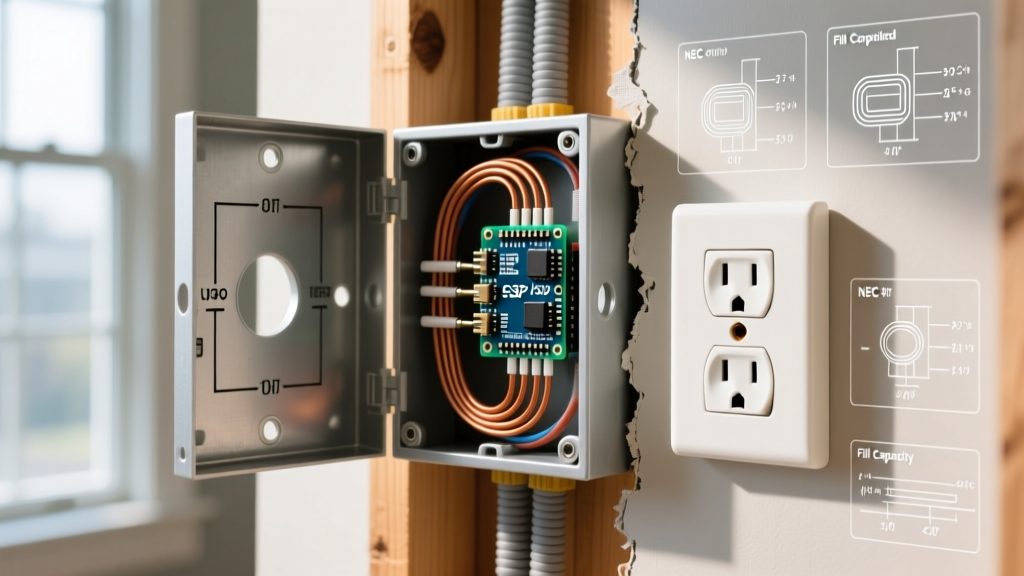
To determine if your chosen electrical outlet box dimensions are legally compliant, you must perform a 'box fill calculation' as mandated by NEC 314.16(B). This calculation assigns a specific volume allowance to every wire, device, and clamp inside the box. The total required volume must not exceed the stamped cubic inch capacity of the box.
Step 1: Determine the Volume Allowance per Conductor
The NEC assigns a cubic inch multiplier based on the American Wire Gauge (AWG) size of the largest wire in the box. Even if you only have one 10 AWG wire and five 14 AWG wires, the 10 AWG multiplier applies to the entire calculation.
| Wire Size (AWG) | Volume Allowance per Wire |
|---|---|
| 14 AWG | 2.0 cubic inches |
| 12 AWG | 2.25 cubic inches |
| 10 AWG | 2.50 cubic inches |
| 8 AWG | 3.00 cubic inches |
| 6 AWG | 5.00 cubic inches |
Step 2: Count the Fill Items
Use the following NEC rules to count the number of 'allowances' in your box:
- Current-Carrying Conductors: Count 1 for each hot (black/red) and neutral (white) wire that originates or terminates in the box. (Note: A wire that passes completely through the box without being spliced or terminated counts as 1, not 2).
- Equipment Grounding Conductors: Count 1 total for all bare copper or green ground wires combined, regardless of how many enter the box.
- Internal Cable Clamps: Count 1 total if the box has built-in metal or plastic clamps. (External Romex connectors do not count).
- Devices (Switches/Receptacles): Count 2 for every single device yoke installed in the box, based on the largest wire connected to that specific device.
Step 3: Real-World Calculation Example
Imagine you are installing a standard 12 AWG duplex receptacle on a 20-amp kitchen circuit. You are feeding power in from one 12/2 Romex cable and feeding out to another 12/2 Romex cable. The plastic nail-on box has internal clamps.
- Hots: 2 wires (1 in, 1 out) = 2 allowances
- Neutrals: 2 wires (1 in, 1 out) = 2 allowances
- Grounds: 2 bare wires combined = 1 allowance
- Internal Clamps: Built-in plastic clamps = 1 allowance
- Receptacle Device: 1 duplex receptacle = 2 allowances
Total Allowances: 2 + 2 + 1 + 1 + 2 = 8 allowances.
Because you are using 12 AWG wire, you multiply 8 allowances by 2.25 cubic inches.
Total Required Volume: 8 x 2.25 = 18.0 cubic inches.
The Smart Switch and GFCI Depth Crisis
One of the most critical shifts in modern electrical installations involves the physical depth of advanced devices. Standard toggle switches and basic duplex receptacles are relatively shallow, typically protruding only about 1.25 inches into the box. However, modern electronics require massive heatsinks, relays, and circuit boards.
Minimum Box Depths for Specific Devices
- Standard Toggle Switch (e.g., Leviton 1451): Requires minimum 1.5" depth (8 cu in box).
- Standard Duplex Receptacle (e.g., Leviton R52-05320-WMP): Requires minimum 2.0" depth (12.5 cu in box).
- GFCI Receptacle (e.g., Leviton 8599-W): The internal fault-circuit board is extremely bulky. Requires minimum 2.5" depth, but 3.0" is highly recommended to prevent pinching the ground wire against the back of the device.
- Smart Dimmers (e.g., Lutron Caseta PD-6WCL): Features a large aluminum heatsink on the rear. Requires a minimum of 18 cubic inches of free space. A 2x3x3.5" deep box (22 cu in) is the absolute minimum requirement for safe heat dissipation.
- Smart Switches with Neutral (e.g., Enbrighten Z-Wave 52256): Because these require a neutral wire pigtail inside the box, the wire count increases. You must use a 4x4x2.125" deep box (30.3 cu in) with a single-gang plaster ring to accommodate both the device depth and the extra wire fill.
Cost vs. Compliance: Why Shallow Boxes Are a False Economy
Many contractors and DIYers attempt to save money by purchasing shallow 1.5-inch deep plastic boxes. At a big-box hardware store, a shallow 8-cubic-inch plastic nail-on box costs approximately $1.10, while a 3.5-inch deep 22-cubic-inch box costs around $2.80. On a 50-box rough-in, the savings appear to be roughly $85.
However, this is a false economy. If an electrical inspector flags overfilled boxes, the cost to remediate is staggering. You will need to purchase deep retrofit boxes (like the Carlon B618R, which costs about $4.50 each), cut out the existing drywall or plaster, extract the shallow box, re-route the stiff Romex cables into the new deep box, and pay a drywaller to patch the enlarged holes. The remediation cost per box easily exceeds $45 in labor and materials. As highlighted by industry experts at the International Association of Electrical Inspectors (IAEI), failing to calculate box fill during the initial rough-in phase is the leading cause of failed residential electrical inspections.
"Always default to the deepest single-gang box your stud cavity will allow. The $1.50 premium per box for a 3.5-inch deep enclosure buys you the flexibility to upgrade to smart home technology, GFCI protection, or USB receptacles in the future without tearing open your walls."
Summary Checklist for Outlet Box Selection
Before purchasing your electrical boxes, run through this quick compliance checklist to ensure your electrical outlet box dimensions meet all 2026 NEC standards:
- Identify the largest wire gauge entering the box (usually 12 AWG or 14 AWG).
- Count all hots, neutrals, grounds, clamps, and devices to determine your total fill allowances.
- Multiply the allowances by the cubic inch volume for your specific wire gauge.
- Check the device specifications. If installing a GFCI, dimmer, or smart switch, verify the manufacturer's minimum cubic inch requirement (often printed on the device packaging).
- Select a box whose stamped internal volume exceeds both your calculated wire fill and the device manufacturer's minimum depth requirement.
By strictly adhering to these dimensional requirements and box fill calculations, you ensure a safe, cool-running, and fully code-compliant electrical system that will easily pass inspection and support future technological upgrades.