
The Diagnostic Mindset: Why You Can't Just Swap the Receptacle
If you live in a home built before 1962, you are likely staring at a two-prong ungrounded receptacle and wondering how to upgrade it. The most dangerous mistake a DIYer can make is simply snipping off the ground pin on a three-prong plug or installing a standard three-prong receptacle without a true ground wire. This creates a 'fake ground' scenario, leaving your appliances unprotected and introducing a severe shock hazard.
Before you buy any hardware, you must approach this project from a troubleshooting and diagnostic perspective. You need to determine exactly what kind of wiring is hiding behind the wall plate, whether a hidden ground path exists, and which National Electrical Code (NEC) compliance pathway applies to your specific situation. In this guide, we will diagnose your wiring, test for lethal 'bootleg' grounds, and outline the exact steps to safely change two prong electrical outlet to three prong configurations.
⚠️ Critical Safety Warning: Never rely on a cheap plug-in receptacle tester alone. These devices can be fooled by 'bootleg grounds' (an illegal jumper wire connecting the neutral terminal to the ground screw), showing a false 'Correct' reading while leaving the chassis of your appliances energized if a neutral fault occurs.
Diagnosing Your Existing Wiring Architecture
To troubleshoot the upgrade path, first identify the cable type feeding the outlet. Turn off the breaker, remove the two-prong receptacle, and inspect the wires entering the electrical box.
- Knob-and-Tube (K&T): Identifiable by individual black and white cloth-covered wires entering the box through porcelain tubes. Diagnosis: Absolutely no ground path exists. The insulation is often degraded in 2026, requiring careful handling.
- Early Non-Metallic (NM) Cable: Rubber or early plastic sheathing containing only a black (hot) and white (neutral) wire. Diagnosis: No equipment grounding conductor (EGC) is present.
- Armored Cable (AC/BX): A flexible metal spiral casing. Diagnosis: Older BX lacks an internal bonding strip, meaning the metal jacket cannot be trusted as a ground. Modern AC cable contains a thin aluminum bonding strip; if present, the metal box may be grounded.
The Multimeter Test: Verifying Ground and Catching Bootlegs
Before proceeding, use a digital multimeter (such as the Klein Tools MM400 or Fluke 117) to diagnose the actual electrical state of the box. Leave the breaker ON and exercise extreme caution.
- Test Hot to Neutral: Place probes on the brass (hot) and silver (neutral) screws. You should read 115V–125V.
- Test Hot to Metal Box: Place one probe on the brass screw and the other on the bare metal of the electrical box (scratch the paint if necessary).
- If 120V: The metal box is grounded (likely via metallic conduit or properly bonded AC cable).
- If 0V: The box is ungrounded.
- The Bootleg Ground Diagnostic: If you are replacing an existing three-prong outlet that was previously 'upgraded' by a past owner, test Hot to Ground. If you read 120V, but the Hot to Metal Box reads 0V, the previous installer illegally jumpered the neutral to the ground screw. Troubleshooting action: You must remove this jumper immediately, as an open neutral downstream will electrify the ground pin of anything you plug in.
NEC-Compliant Solutions Matrix
Once diagnosed, you must choose a compliant method to change two prong electrical outlet to three prong. The NFPA 70 (National Electrical Code) provides specific pathways for existing ungrounded systems.
| Method | NEC Reference | Est. Cost (2026) | Provides Surge Protection? | Skill Level |
|---|---|---|---|---|
| GFCI Receptacle (No Ground) | 406.4(D)(2) | $18 - $30 | No | Beginner |
| Pigtail to Grounded Metal Box | 406.4(D)(2)(a) | $5 - $10 | Yes | Intermediate |
| Retrofit New EGC Wire | 250.130(C) | $40 - $120 | Yes | Advanced |
Method 1: The GFCI Workaround (NEC 406.4(D)(2))
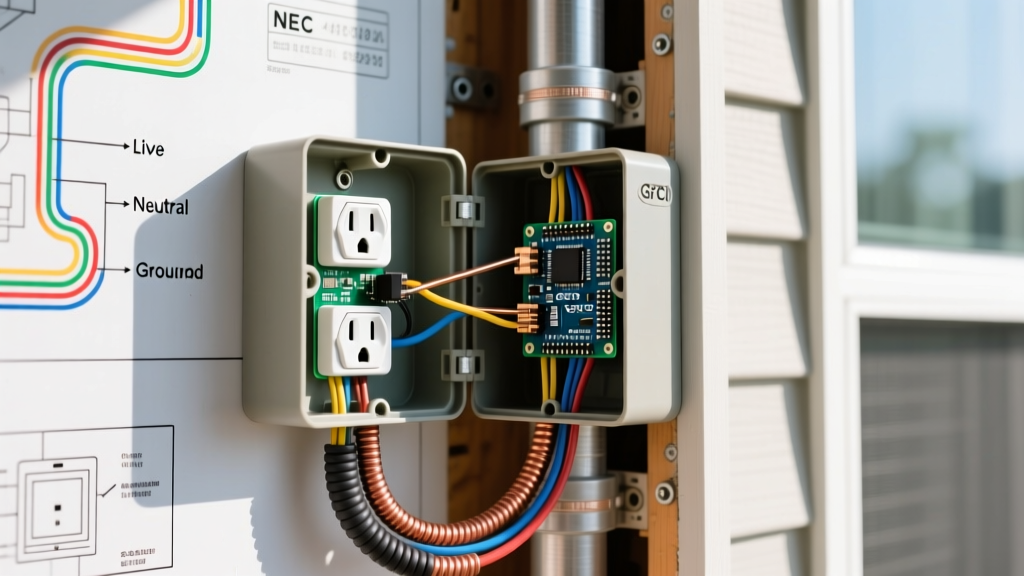
If you have ungrounded NM cable or Knob-and-Tube, the safest and most code-compliant method is installing a Ground Fault Circuit Interrupter (GFCI). A GFCI does not create a ground; instead, it monitors the current balance between the hot and neutral wires. If it detects a leakage of 4 to 6 milliamps (indicating current is flowing through a person to ground), it trips in milliseconds, preventing lethal electrocution.
Product Recommendation: The Leviton 16252-W or Eaton GFNL15 (approx. $18–$25).
Installation & Code Requirements:
- Connect the incoming hot and neutral to the LINE terminals only. Leave the LOAD terminals empty unless you intend to protect downstream outlets.
- The green ground screw on the GFCI must be left completely empty. Do not connect it to the metal box or a fake ground.
- Mandatory Labeling: You must apply the UL-required 'No Equipment Ground' sticker to the faceplate. Furthermore, if protecting downstream standard three-prong outlets, they must be labeled 'GFCI Protected' and 'No Equipment Ground'.
Expert Insight: While a GFCI protects human life from shock, it does not provide an equipment ground. Sensitive electronics (like desktop PCs or home theater receivers) plugged into a GFCI-protected ungrounded outlet will not have a path for surge protectors to dump excess voltage. For expensive electronics, Method 3 is required.
Method 2: Pigtailing to a Valid Ground Source
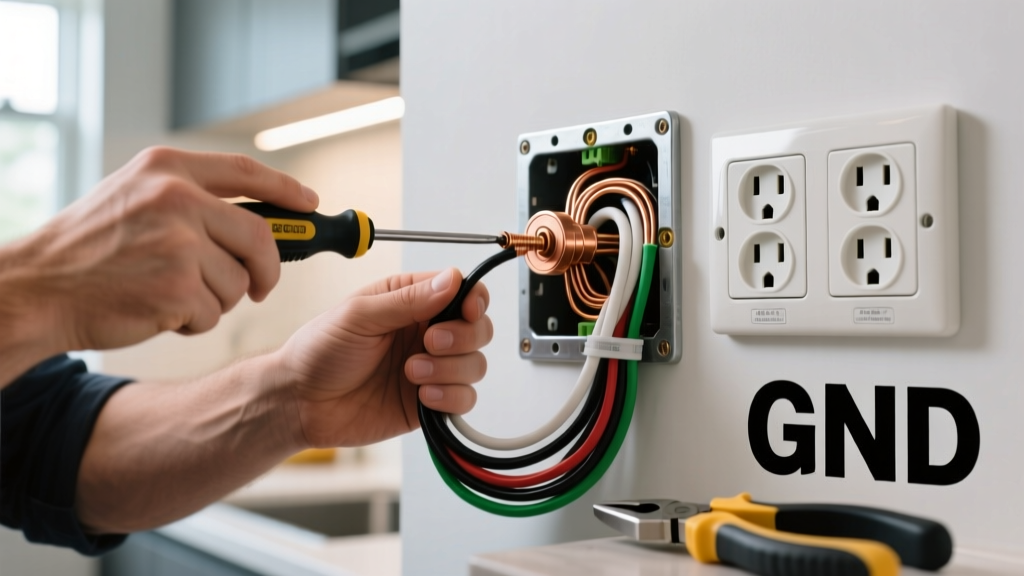
If your multimeter diagnostic confirmed 120V between the hot wire and the metal electrical box, you are in luck. You can install a standard three-prong receptacle (like the Leviton 5320-W) by pigtailing a 14 AWG or 12 AWG bare copper wire from the receptacle's green ground screw directly to the metal box using a 10-32 green grounding screw or a grounding clip.
Troubleshooting Edge Case: Ensure the metal box is actually bonded to the panel's ground bus bar. In some old conduit systems, rust or loose fittings at the panel can interrupt the ground path. Verify continuity from the box to the panel ground bar with the power OFF before trusting this method.
Method 3: Retrofitting an Equipment Grounding Conductor (EGC)
Under NEC 250.130(C), you are legally permitted to retrofit a bare copper ground wire to an existing ungrounded circuit without tearing open the walls to replace the entire cable.
- Run a bare copper wire (14 AWG for 15A circuits, 12 AWG for 20A circuits) from the outlet's metal box to any accessible point on the home's grounding electrode system or the main panel's ground bus bar.
- The wire does not need to follow the exact path of the existing hot/neutral cables; it can be fished through walls, attics, or basements directly back to the panel.
- Use wire staples every 4.5 feet and protect the wire with nail plates where it passes through framing studs.
Troubleshooting Post-Installation Failures
Even with correct wiring, you may encounter issues after upgrading. Here is how to diagnose them:
- GFCI Will Not Reset: If the GFCI trips immediately or won't reset, you likely wired the incoming power to the LOAD terminals instead of the LINE terminals. Use a non-contact voltage tester to identify the live feed wire and move it to the LINE brass screw.
- Downstream Outlets Dead After GFCI Install: If you wired downstream outlets to the LOAD terminals, but the downstream circuit relies on a shared neutral (common in older multi-wire branch circuits or switch loops), the GFCI will detect an imbalance and trip. Fix: Separate the circuits or use individual GFCIs at each location.
- Phantom Voltage Readings: When testing a newly installed ungrounded GFCI with a high-impedance digital multimeter, you may read 40V–60V between the hot slot and the empty ground slot of the faceplate. This is capacitive coupling (phantom voltage) and is harmless. A low-impedance solenoid tester (like a Wiggy) will correctly read 0V.
Frequently Asked Questions (FAQ)
Is it legal to use a cheater plug (3-prong to 2-prong adapter)?
No. While widely sold, the U.S. Consumer Product Safety Commission (CPSC) and the NEC strongly advise against them. The small pigtail on these adapters must be screwed into the faceplate cover screw, which rarely provides a true ground in older homes, rendering the safety feature useless.
Can I just connect the ground screw to the water pipe behind the wall?
Absolutely not. Modern plumbing often uses PEX or PVC, which do not conduct electricity. Even with copper pipes, dielectric unions or localized repairs can break the continuous ground path. Furthermore, if a fault occurs, it could electrify the plumbing fixtures in a bathroom or kitchen, creating a massive shock hazard.
Do I need an AFCI breaker when upgrading these outlets?
Under the latest NEC adoptions, if you are replacing an existing ungrounded receptacle in a bedroom, living room, or hallway, you are not strictly required to upgrade the breaker to an Arc Fault Circuit Interrupter (AFCI) unless you are running a brand new circuit. However, replacing the standard breaker with a Dual Function (AFCI/GFCI) breaker is a highly recommended safety upgrade for aging Knob-and-Tube or early NM wiring in 2026.