
Understanding the GB 1002 / GB 2099.1 Standard
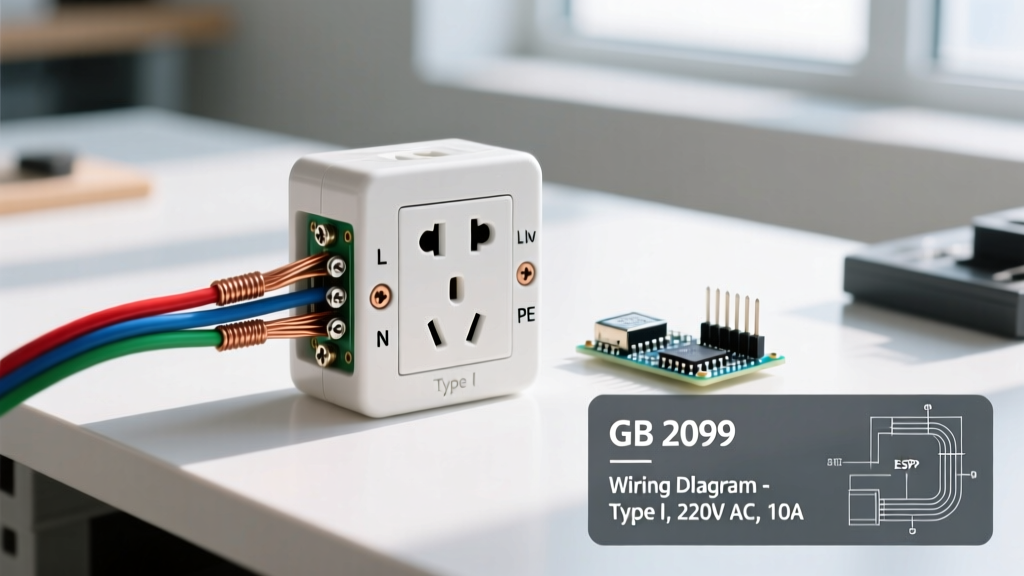
When importing heavy-duty machinery, CNC routers, or high-wattage server racks from Chinese manufacturers, you will frequently encounter the need to install a dedicated receptacle to match the equipment's power cord. The standard China electrical outlet plug configuration is governed by the GB 1002 (plug) and GB 2099.1 (socket) national standards. Visually, this is recognized globally as the 'Type I' plug, featuring three flat, rectangular pins arranged in a triangular pattern, or two flat pins for ungrounded variants.
According to the International Electrotechnical Commission (IEC), Type I is primarily used in China, Australia, New Zealand, and Argentina. However, assuming that all Type I sockets are wired identically across these regions is a catastrophic mistake that can lead to severe electrical shock hazards and equipment failure. This guide details the exact wiring scenario for installing a Chinese-standard 220V/50Hz receptacle in a workshop environment, focusing on the critical nuances that generic wiring diagrams often miss.
The Fatal Trap: China vs. Australia Type I Wiring
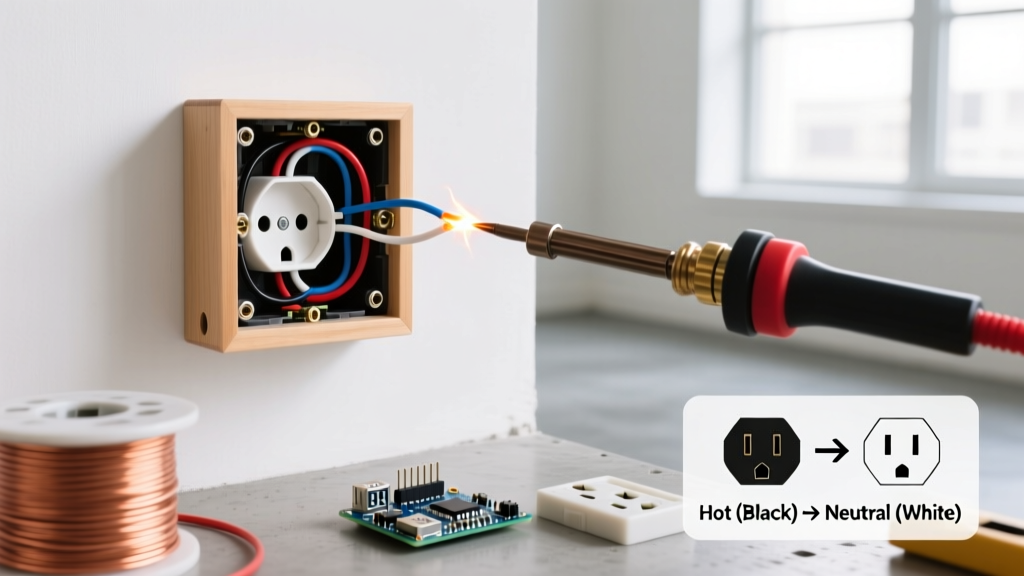
The most common and dangerous error DIYers and even licensed electricians make when installing a China electrical outlet plug is relying on Australian wiring standards for a Chinese socket. While the physical pins are nearly identical, the internal wiring topology for Line (Active) and Neutral is completely reversed.
Critical Safety Warning: Never assume Line and Neutral placement based solely on the physical shape of a Type I socket. Always verify the terminal markings on the back of the specific receptacle you are installing.
Pin Configuration Comparison (Facing the Socket)
- Top Pin: Earth / Ground (PE) - Identical in both standards.
- Bottom Left Pin: In China (GB 1002), this is Neutral (N). In Australia (AS/NZS 3112), this is Active/Line (L).
- Bottom Right Pin: In China (GB 1002), this is Line / Active (L). In Australia, this is Neutral (N).
Why does this matter? If you wire a Chinese socket using the Australian standard, you reverse the polarity. While many modern switch-mode power supplies will still turn on, any single-pole internal switches or fuses on the imported Chinese machinery will now interrupt the Neutral wire instead of the Line wire. This means that even when the machine is switched 'off', the internal chassis, heating elements, and motor windings remain fully energized at 220V, presenting a lethal shock hazard during maintenance. For deeper physical specifications, refer to the World Standards Type I database.
Common Scenario: Powering a 3kW Imported Laser Cutter
Let us examine a real-world 2026 workshop scenario: You have imported a 3kW CO2 laser engraver from Shenzhen. The machine draws approximately 14A at peak load and requires a dedicated 16A or 20A China electrical outlet plug. You are wiring this in a North American or European workshop that already has 240V/230V single-phase split or line-to-neutral power available.
Required Materials & Sizing
- Receptacle: Bull G07 Series or Chint 16A/250V Type I Flush Socket (Approx. $6 - $12 USD).
- Wire Gauge: 2.5mm² (Metric) or 12 AWG (US) stranded copper wire. Do not use 14 AWG, as continuous 16A loads will cause voltage drop and thermal degradation over time.
- Breaker: 20A Double-Pole MCB (Miniature Circuit Breaker) with a 30mA RCD/GFCI module for personnel protection.
- Terminals: Ferrule crimps for stranded wire to prevent splaying in the socket's screw terminals.
Step-by-Step Installation Guide
Follow these steps to ensure a code-compliant and safe installation. Always adhere to NFPA Electrical Safety guidelines regarding lockout/tagout procedures before beginning work.
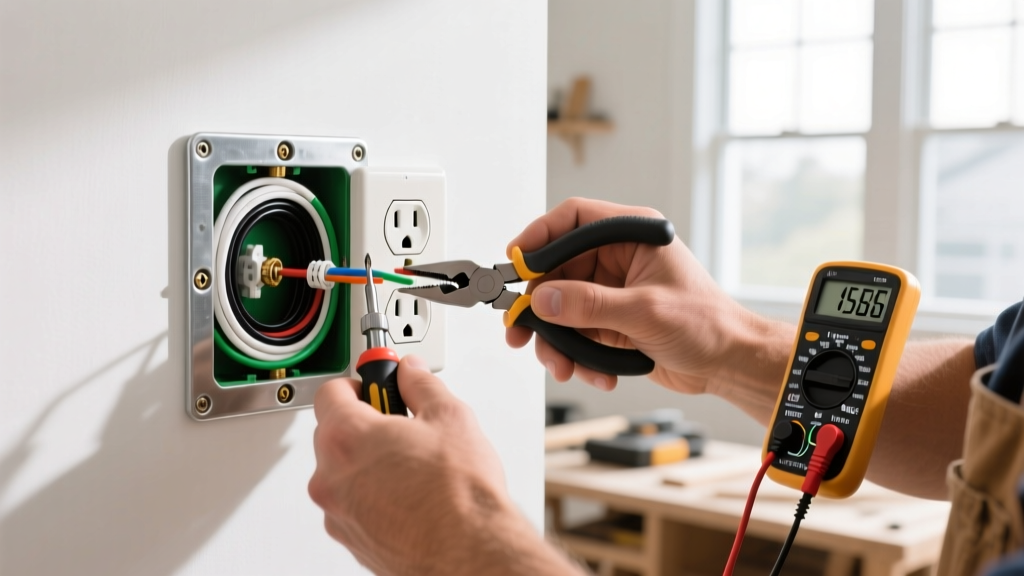
- Isolate and Verify: Turn off the main breaker for the circuit. Use a non-contact voltage tester (like the Klein Tools NCVT-3) and a digital multimeter to confirm 0V between Line, Neutral, and Ground.
- Prepare the Conductors: Strip exactly 12mm of insulation from the 2.5mm² wires. Crimp insulated ferrule ends onto the stranded copper to ensure a solid, gas-tight connection under the socket's terminal screws.
- Connect the Earth (PE): Attach the Green/Yellow (or bare/green) ground wire to the top terminal marked with the Earth symbol. Torque the screw to 0.5 Nm. This pin is physically longer on the plug to ensure ground makes contact first.
- Connect the Neutral (N): Attach the Blue (or White) neutral wire to the Bottom Left terminal. Verify the terminal is stamped with an 'N'. If the socket lacks markings, do not use it; substandard sockets without terminal markings are a major fire risk.
- Connect the Line (L): Attach the Brown (or Black) hot wire to the Bottom Right terminal. Verify the terminal is stamped with an 'L'.
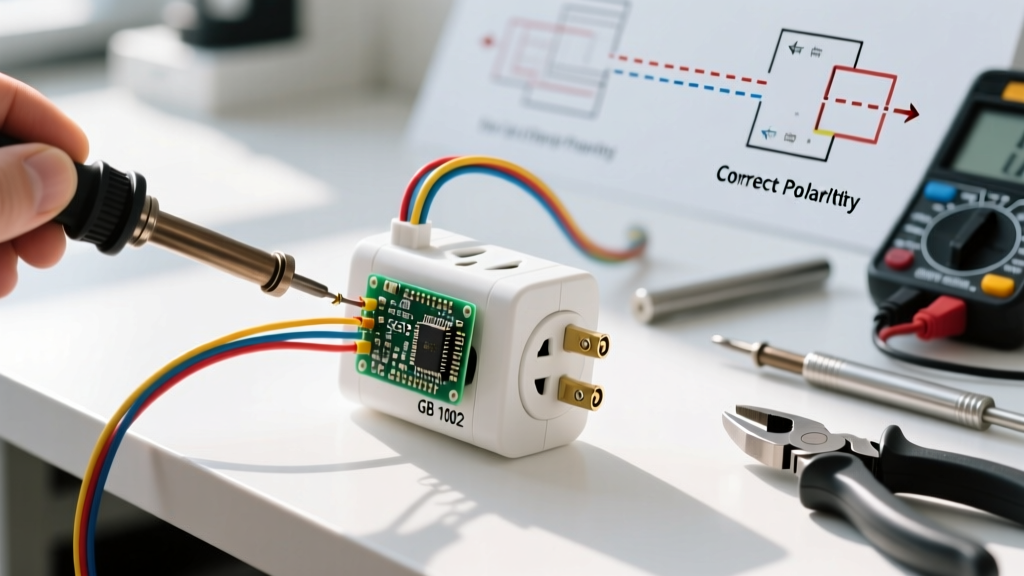
- Secure and Test: Mount the socket into the wall box, ensuring no bare copper is exposed outside the terminal block. Restore power and test the receptacle using a custom Type I polarity tester or a multimeter to verify 220-240V between L and N, and 0V between N and PE.
Power Quality: 50Hz vs 60Hz and Voltage Variance
Wiring the physical China electrical outlet plug is only half the battle. You must also account for the difference in grid frequency and voltage tolerances.
Voltage Tolerance: China's nominal voltage is 220V, though it frequently fluctuates between 210V and 235V. North American split-phase provides 240V, and Europe provides 230V. Most imported industrial equipment utilizes Switch-Mode Power Supplies (SMPS) rated for 100-240V AC, which will handle these variances without issue.
The Frequency Mismatch (50Hz vs 60Hz): This is where imported machinery often fails prematurely. If your local grid operates at 60Hz (North America) and the Chinese machine relies on AC induction motors (such as water chillers, exhaust blowers, or spindle motors), the motors will run 20% faster than designed. This leads to excessive bearing wear, increased acoustic noise, and eventual thermal overload. Solution: Install a Variable Frequency Drive (VFD) between the socket and the machine's motor circuits, or utilize a dedicated rotary frequency converter to step the 60Hz supply down to a true 50Hz sine wave.
Troubleshooting Matrix for Imported Equipment
Even with a perfectly wired China electrical outlet plug, imported machinery can exhibit strange behaviors due to grid differences. Use this diagnostic table to identify common edge cases.
| Symptom | Probable Cause | Actionable Fix |
|---|---|---|
| Machine trips RCD/GFCI breaker immediately upon plugging in. | High capacitive leakage current from industrial SMPS units exceeding the 30mA RCD threshold. | Upgrade to a 100mA Type-F or Type-B RCD breaker designed for high-leakage IT/industrial equipment. |
| Machine powers on, but internal control panel is dead. | Reversed Line/Neutral causing an internal varistor or surge protector to short and blow the machine's internal glass fuse. | Verify socket polarity with a multimeter. Replace the machine's internal fuse and correct the wall wiring if reversed. |
| Water chiller pump vibrates loudly and overheats after 30 mins. | 50Hz AC motor running on 60Hz grid power, causing cavitation and thermal overload. | Install a step-down frequency converter or replace the pump motor with a locally sourced 60Hz equivalent. |
| Plug feels warm to the touch after 1 hour of operation. | Terminal screws on the socket were not torqued correctly, or 14 AWG wire was used instead of 12 AWG / 2.5mm². | De-energize, trim wire, apply ferrules, and re-torque terminal screws to 0.5 Nm. |
Final Safety Considerations
Installing a China electrical outlet plug requires strict adherence to polarity and an understanding of the imported load's electrical characteristics. By respecting the GB 1002 Line/Neutral configuration and addressing the 50Hz/60Hz frequency gap, you ensure both the longevity of your expensive imported machinery and the safety of your workshop environment. Always document your wiring topology on the inside of the breaker panel door to prevent future confusion by maintenance personnel.