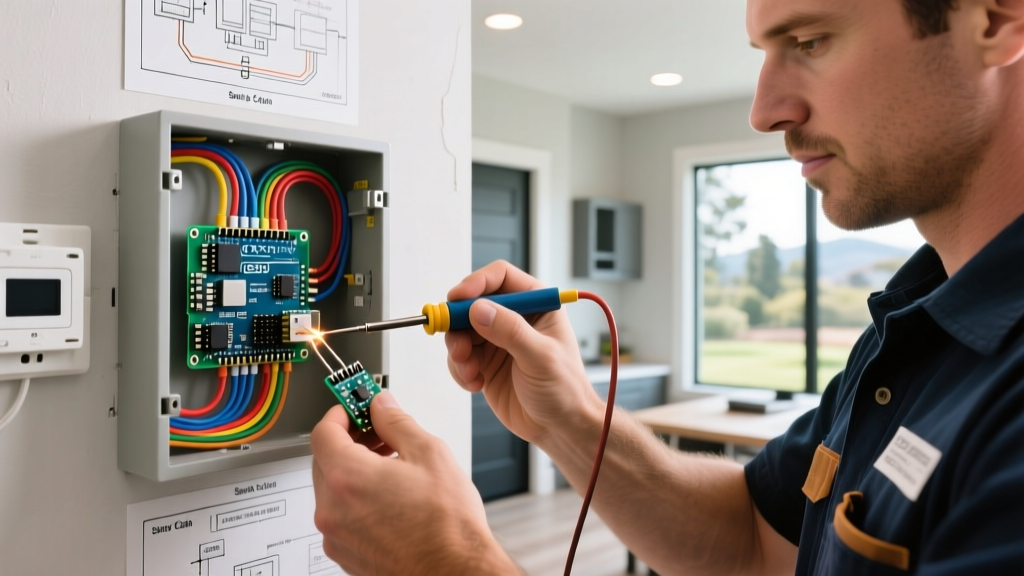

Silicon Valley Standards: Why Santa Clara Inspections Are Unique
When executing smart home electrical wiring Santa Clara contractors and advanced DIYers face a rigorous regulatory environment. Sitting at the heart of Silicon Valley, Santa Clara boasts one of the highest concentrations of automated, high-tech residential retrofits in the country. However, local Authority Having Jurisdiction (AHJ) inspectors do not grant leniency for cutting-edge technology. Every smart switch, motorized shade, and hardwired sensor must strictly adhere to the California Electrical Code (CEC) and the state's stringent Title 24 Energy Efficiency Standards.
Failing an electrical inspection in Santa Clara County doesn't just delay your project; it can result in costly tear-outs, especially when low-voltage data cables are improperly routed alongside line-voltage feeds. This guide breaks down the exact compliance hurdles, specific product limitations, and inspection frameworks required to pass a smart home wiring inspection in Santa Clara.
California Title 24 and Smart Lighting Mandates
Unlike standard NEC guidelines, California's Title 24 Part 6 heavily dictates how smart lighting controls must be wired and configured. The California Energy Commission mandates that automated lighting systems cannot merely be 'convenient'—they must actively reduce energy consumption. Inspectors will verify that your smart wiring design includes specific control topologies.
Title 24 Smart Lighting Compliance Matrix
| Control Requirement | Standard Wiring (Non-Compliant) | Smart Wiring (Title 24 Compliant) | Inspector Checkpoint |
|---|---|---|---|
| Multi-Level Control | Single-pole toggle switch | Smart dimmer (e.g., Lutron PD-10NXD) with 0-10V or phase-cut dimming | Verification of dimming range down to 20% or lower |
| Vacancy Sensing | Standard manual switch | Smart switch with integrated PIR/Vacancy sensor or hub-linked occupancy logic | Auto-off functionality tested within 15-30 minutes of vacancy |
| Daylight Integration | No daylight harvesting | Smart fixtures with integrated photocells or hub-linked window sensors | Fixtures within 15 feet of a window must auto-dim |
| Central Shutoff | Individual room switches only | Smart hub (e.g., Control4, Savant) with a single 'Away' relay cutting non-essential loads | Single switch at primary entry must kill all non-essential lighting |
The Neutral Wire Requirement: CEC Article 404.2(C)
One of the most common reasons smart home wiring fails inspection in Santa Clara is the omission of a grounded (neutral) conductor at the switch box. Under CEC Article 404.2(C), a neutral wire is mandatory at nearly all lighting switch locations. This is because smart switches (like the Leviton DZ6HD or Enbrighten Z-Wave models) require continuous standby power to maintain their Wi-Fi, Zigbee, or Z-Wave radio connections.
The Retrofit Reality: In older Santa Clara ranch homes built in the 1960s and 70s, switch loops were often run with only a 14/2 or 12/2 NM-B cable, utilizing the white wire as a re-identified hot, leaving no true neutral. Do not attempt to bypass this by using 'no-neutral' smart switches as a permanent loophole. While devices like the Lutron Caseta PD-6WCL can operate without a neutral by leaking current through the load, Title 24 inspectors frequently flag these in new construction or major gut-remodels because they limit the types of LED bulbs you can use and often fail the strict multi-level dimming requirements. Expect to pay between $350 and $600 per drop to have an electrician fish a new 14/3 NM-B cable to existing switch boxes to bring them up to code.
Line-Voltage vs. Low-Voltage Routing Violations
Smart homes require massive amounts of low-voltage wiring: Cat6A for Power over Ethernet (PoE) cameras and access points, 18/2 Class 2 wire for smart thermostats, and shielded cables for DALI or 0-10V smart lighting control. The National Fire Protection Association (NFPA 70 / NEC) is exceptionally strict about separating these systems.
Code Reference: NEC 725.136(A) strictly prohibits Class 2 (low-voltage) conductors from being placed in any cable, cable tray, compartment, enclosure, manhole, outlet box, device box, raceway, or similar fitting with conductors of electric light, power, and Class 1 circuits, unless separated by a physical barrier.
How Santa Clara Inspectors Check Separation
- The Gang Box Violation: You cannot run a 24V smart thermostat C-wire into the same double-gang box as a 120V smart receptacle unless the box features a listed, physical UL-rated divider. Inspectors will pull the faceplate and look for the divider.
- The Ceiling Joist Bay Issue: Running Cat6 parallel to 120V Romex in the same bored joist hole is an automatic red tag. Maintain a minimum 2-inch separation when running parallel, or cross them at 90-degree angles.
- The Smart Relay Exception: Devices like the Shelly 1PM or Shelly Plus 1 are specifically designed and UL-listed to sit inside a standard junction box alongside 120V line voltage. Because the low-voltage antenna is entirely encapsulated and the device is rated for the environment, inspectors will approve this specific mixed-voltage setup, provided the box fill calculations (NEC 314.16) are not exceeded.
Common Inspection Failure Modes in Smart Retrofits
Based on recent field reports and California Building Standards Commission guidelines, here are the most frequent edge cases that cause smart wiring inspections to fail:
- AFCI/GFCI Nuisance Tripping: Installing smart switches with internal power supplies on circuits protected by older AFCI breakers can cause harmonic interference and nuisance tripping. Inspectors will test the circuit; if the smart switch causes the AFCI to trip upon switching, it fails. Solution: Use smart breakers (like the Leviton Smart Load Center) or ensure the smart switch has built-in EMI filtering.
- Improper Box Fill: Smart switches are physically deeper than standard toggles. A standard 18-cubic-inch plastic nail box is often insufficient when you add 12/2 line, load, neutral, ground, AND the smart switch's internal volume. Inspectors use a box fill calculator. Solution: Upgrade to 22-cubic-inch or 24-cubic-inch 'deep smart boxes' during the rough-in phase.
- Missing Grounding Pigtails: Many DIYers assume the metal yoke of a smart switch grounds the box. If you are using plastic boxes and metal faceplates, or if the switch requires an explicit equipment grounding conductor (EGC) for its internal logic board, failing to pigtail the bare copper ground to the switch's green screw is an immediate violation of CEC 250.148.
Navigating the Santa Clara Building Division Permit Process
Before pulling a single wire, you must understand the local permitting thresholds. The Santa Clara Building Division requires electrical permits for any line-voltage modifications. This includes hardwiring smart hubs into a dedicated 120V circuit, installing smart breakers in the main service panel, or adding new 120V smart receptacles.
What about low-voltage? Purely low-voltage wiring (Cat6, 18/2 thermostat wire, speaker wire) generally does not require an electrical permit in Santa Clara if it operates under 50 volts and is not integrated into a fire alarm system. However, if your smart home wiring includes hardwired PoE smoke/CO detectors or low-voltage relays that interface directly with the HVAC high-voltage control boards, an inspector may require a low-voltage electrical permit or a mechanical permit for the HVAC integration. Always submit your smart home single-line diagram (SLD) to the plan checker during the initial permit application to avoid stop-work orders during the rough-in inspection.
Frequently Asked Questions (FAQ)
Can I use a smart plug instead of hardwiring a smart receptacle to avoid permits?
Yes. Plug-in smart modules (like the Wemo Smart Plug or TP-Link Kasa) do not require electrical permits because they do not alter the permanent branch circuit wiring. However, they do not satisfy Title 24 requirements for hardwired multi-level lighting controls or central shutoff mandates in new construction.
Do motorized smart shades require a dedicated circuit?
Not usually, but they do require proper wiring. Most hardwired motorized shades (like Lutron Sivoia QS) operate on 24V DC or 48V DC provided by a central power panel. The 120V feed to the shading power panel must be on a dedicated breaker, and the low-voltage wiring to the shades must be routed separately from line-voltage lighting feeds to pass inspection.