
Decoding the Yellow Wire: The Core Functions
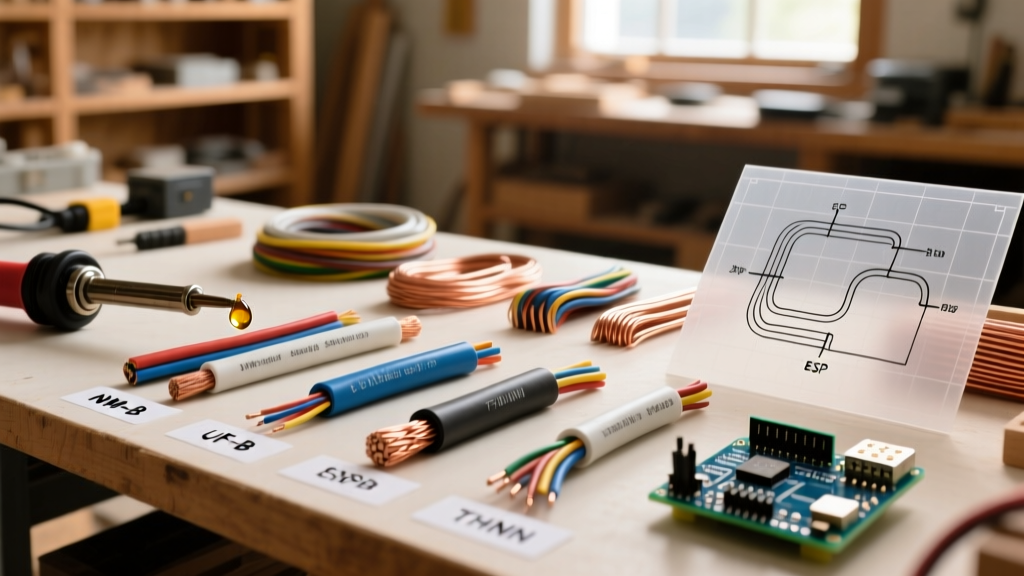
When homeowners and novice DIYers ask what is a yellow wire for in electrical wiring, the answer almost always points to its role as a secondary current-carrying conductor in multi-wire cables. In standard residential wiring, you will rarely find a standalone yellow wire pulled through conduit. Instead, the yellow wire is typically the third insulated conductor found inside 14/3 or 12/3 NM-B (Non-Metallic Sheathed) cables, commonly known by the brand name Romex.
While the National Electrical Code (NEC) strictly mandates white or gray for grounded neutral conductors and green or bare copper for equipment grounding conductors, the color yellow is not rigidly assigned to a single function in standard 120V branch circuits. However, industry conventions have established specific use cases. Understanding how a weekend DIYer interprets these conventions versus how a licensed master electrician applies them is critical for safety, code compliance, and long-term system maintainability.
1. Three-Way and Four-Way Switch Travelers
The most common application for a yellow wire in residential wiring is as a 'traveler' in 3-way and 4-way switch configurations. When controlling a single light fixture from two different locations, a 14/3 or 12/3 cable is run between the switches. The black, red, and yellow (or white re-identified) conductors carry the alternating hot current depending on the toggle positions. Professionals almost universally use the red and yellow wires as the traveler pair, reserving the black wire for the common (line or load) terminal.
2. Switch Legs and Line-Load Routing
In complex lighting circuits, such as ceiling fans with separate light kits or multi-gang switch boxes, the yellow wire is frequently utilized as a dedicated switch leg. This allows the electrician to send a constant hot (black) down to the switch box and return two separate switched hots (red and yellow) to the fixture, enabling independent control of the fan motor and the light array.
3. Smoke Detector Interconnects
Hardwired smoke and carbon monoxide detectors require a 3-wire setup to comply with modern building codes. The black wire provides 120V power, the white wire serves as the neutral, and the yellow (or red) wire acts as the interconnect signal line. When one detector senses smoke, it sends a 9V to 12V DC signal down this yellow wire to trigger all other interconnected alarms in the home simultaneously.
The DIY Perspective: Common Practices and Critical Pitfalls
For the ambitious DIYer, the yellow wire is often viewed simply as 'another hot wire.' While this is technically true, treating it as a generic conductor leads to several dangerous and code-violating pitfalls.
- The Neutral Substitution Error: A frequent and severe DIY mistake is using the yellow wire in a 14/3 cable as a neutral return because the white wire was already used or damaged. According to the NFPA 70 (National Electrical Code), specifically Section 200.6, neutral conductors must be white or gray. Using yellow for a neutral creates a massive shock hazard for future electricians who assume the yellow wire is hot.
- Backstabbing Terminals: DIYers often terminate 14 AWG yellow wires using the push-in 'backstab' connectors on the rear of cheap $1.50 builder-grade switches. Under heavy loads, these friction-fit connections degrade, causing arcing, melting, and eventual circuit failure.
- Failing to Re-Identify: If a DIYer uses a 14/2 cable and a separate 14/3 cable in a complex run, they sometimes fail to wrap the white wire in black or yellow electrical tape when it is used as a hot traveler, violating NEC 200.7(C)(1).
The Professional Standard: Code Compliance and Mental Mapping
Licensed electricians approach the yellow wire not just as a conductor, but as a tool for 'mental mapping'—a systematic color-coding strategy that ensures anyone working on the panel or junction box in the future can instantly understand the circuit's logic.
'In professional rough-ins, color consistency is just as important as torque specifications. If black is always the constant hot, red is the first traveler or switched leg, and yellow is the second traveler or secondary switched leg, troubleshooting a fault five years later takes minutes instead of hours.' — Master Electrician Field Standard
Pros also adhere strictly to the Electrical Safety Foundation International (ESFI) guidelines regarding wire gauge and termination. When using a yellow wire from a 12/3 NM-B cable for a 20-ampere circuit, professionals will never terminate it on a standard 15-amp receptacle or switch, even if the device accepts 12 AWG wire, to maintain overcurrent protection integrity.
Head-to-Head: DIY vs. Professional Yellow Wire Execution
| Execution Phase | Typical DIY Approach | Professional Electrician Standard |
|---|---|---|
| Wire Selection | Uses whatever 3-wire scrap is available in the garage, often mixing 14 AWG and 12 AWG. | Pulls fresh 250ft coils of Southwire SIMpull 12/3 or 14/3 NM-B, matching gauge to the breaker size. |
| Traveler Assignment | Uses black and white as travelers, leaving yellow capped or confusingly spliced. | Strictly uses Red and Yellow as travelers; Black is reserved for the Common terminal. |
| Termination | Strips 1 inch of insulation, leaves exposed copper, and uses backstab push-in holes. | Strips exactly 3/4 inch, loops clockwise around the brass screw terminal, and torques to manufacturer specs. |
| Testing | Flips the breaker and sees if the light turns on; uses a $5 neon screwdriver tester. | Uses a low-impedance digital multimeter or solenoid tester to verify absence of phantom voltage before touching. |
Real-World Troubleshooting: Phantom Voltages and Miswired Travelers
One of the most common edge cases professionals face when troubleshooting a yellow traveler wire is 'phantom voltage.' Because the yellow and red traveler wires run parallel to each other inside the tight sheathing of a 14/3 cable for dozens of feet, capacitive coupling occurs.
If you test a disconnected yellow traveler with a high-impedance Non-Contact Voltage Tester (NCVT) or a standard digital multimeter, it may read anywhere from 40V to 90V, leading a DIYer to believe the wire is dangerously energized. A professional knows to use a low-impedance tool, like the Fluke 117 True-RMS Multimeter with its built-in LoZ (Low Impedance) mode, or a traditional solenoid 'Wiggy' tester. These tools draw a micro-load that instantly collapses the phantom capacitive voltage, revealing the wire is actually dead. Misinterpreting this phenomenon causes DIYers to unnecessarily tear open drywall hunting for a 'leaking' switch.
Tooling and Materials: What the Pros Use in 2026
Working with 3-wire cables requires precision. To handle yellow wires cleanly without nicking the copper—which creates a high-resistance hot spot that can melt the insulation over time—professionals rely on specific, calibrated tools.
- Wire Strippers: The Klein Tools 11054-4E Wire Stripper/Cutter is the 2026 industry standard for 14 and 12 AWG solid copper. It features precision-machined stripping holes that remove the PVC jacket without scoring the yellow insulation underneath.
- Cable Sheathing Removal: Instead of using a utility knife (which risks slicing the yellow wire's insulation), pros use the Jonard Tools JIC-4170 Romex Splitter or a specialized cable ripper to slit the outer NM-B jacket cleanly.
- Cost Expectations: As of early 2026, a 250-foot coil of Southwire 14/3 SIMpull NM-B cable averages between $125 and $145 at major suppliers, reflecting recent stabilization in copper commodities. A professional-grade 3-way switch, like the Leviton Decora 5603-W, costs around $6.50 per unit, featuring heavy-duty brass terminal screws designed to clamp the yellow traveler securely.
Frequently Asked Questions (FAQ)
Can I use a yellow wire as a ground?
Absolutely not. According to the U.S. Consumer Product Safety Commission (CPSC) and NEC Section 250.119, equipment grounding conductors must be bare, covered green, or covered green with yellow stripes. Using a solid yellow insulated wire for a ground is a severe code violation that will fail any municipal inspection and compromises the entire safety path of the circuit.
Why does my yellow wire have a white stripe on it?
If you are working with THHN/THWN wires pulled through commercial conduit rather than residential Romex, a yellow wire with a white stripe is often used to identify a specific phase in a 3-phase commercial panel, or it may denote a specific control circuit in industrial HVAC wiring harnesses. In residential NM-B cable, you will not see striped yellow wires; they are solid yellow.
Is it safe to cap off an unused yellow wire in a junction box?
Yes, if the yellow wire is part of a 14/3 cable where only the black and white are needed for a simple single-pole switch leg, the unused yellow wire must be capped at both ends with a properly sized wire nut (such as an Ideal 341 Blue Wing-Nut for 14 AWG). Never leave a capped wire buried inside drywall without an accessible, code-compliant junction box cover.