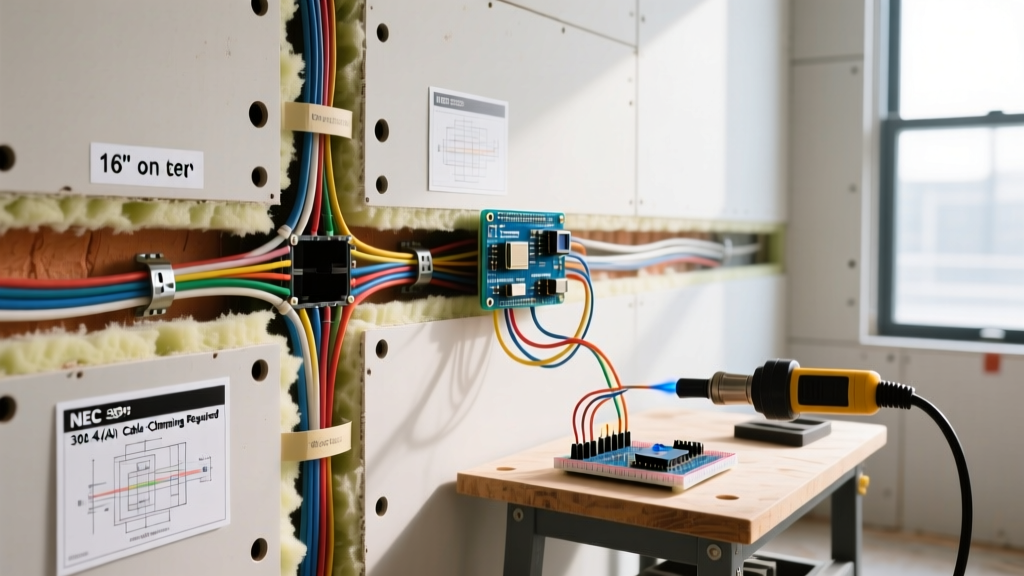

The High Stakes of Rough-In Compliance
When executing stud wall electrical wiring, the rough-in inspection is the ultimate gatekeeper. Failing this phase doesn't just mean a bruised ego; it triggers re-inspection fees (typically $150 to $250 per visit), delays drywall installation, and can push a residential or commercial project timeline back by weeks. In 2026, with local jurisdictions widely enforcing the 2023 National Electrical Code (NEC) and newer amendments, inspectors are utilizing laser levels and digital calipers to verify compliance. General contractors and master electricians alike must move beyond "rough approximations" and adhere to exact dimensional tolerances.
This guide bypasses generic advice and dives deep into the precise mathematics, specific hardware, and edge-case code requirements necessary to guarantee a flawless sign-off on your wood-framed stud walls.
The 1-1/4 Inch Rule and the 2x4 Math Problem
NEC Article 300.4(A)(1) mandates that cables running parallel to framing members must maintain a minimum 1-1/4 inch setback from the nearest edge of the stud. This prevents drywall installers and finish carpenters from driving screws or nails directly into your conductors. However, this rule creates a hidden mathematical trap for electricians boring holes in standard 2x4 studs.
The Hidden 2x4 Boring Trap
A standard dimensional 2x4 stud actually measures 1.5 inches deep by 3.5 inches wide. If you must maintain a 1-1/4" (1.25") setback from both edges, the math reveals a strict limitation:
- Total Stud Width: 3.5 inches
- Required Setbacks: 1.25" + 1.25" = 2.5 inches
- Remaining Safe Zone in Center: 1.0 inch
This means the absolute maximum hole diameter you can drill in a 2x4 bearing wall without violating the edge setback rule is 1.0 inch. If you use a standard 1-1/4" or 1-1/2" auger bit to pull multiple NM cables through a single hole, the edges of that hole will inevitably encroach into the 1-1/4" danger zone. When this happens, NEC 300.4(A)(2) is triggered, legally requiring you to install a steel nail plate on the offending edge of the stud.
| Stud Size (Actual) | Max Hole Diameter (No Plate) | Hole Edge Setback | Nail Plate Required? |
|---|---|---|---|
| 2x4 (1.5" x 3.5") | 1.0 inch | 1.25 inches | No (if centered perfectly) |
| 2x4 (1.5" x 3.5") | 1.25 inch or larger | Less than 1.125" | YES |
| 2x6 (1.5" x 5.5") | 2.0 inch | 1.75 inches | No (allows multi-cable pulls) |
Physical Protection: Selecting the Right Nail Plates
When your wiring falls within 1-1/4" of the stud edge, or when you notch a stud to run a cable, you must protect the cable from nail penetration. The NEC requires a steel plate of at least 1/16 inch thickness. Do not attempt to fabricate these from scrap sheet metal; inspectors will flag them immediately.
For professional stud wall electrical wiring, rely on stamped, code-compliant hardware like the Simpson Strong-Tie NP15 (1-1/2 in. x 5 in. Nail Plate) or the Oatey 33511 protector plates. Priced at roughly $0.45 to $0.85 per unit in bulk, these plates feature aggressive prongs that bite into the wood framing.
Pro-Tip for Hardwoods and LVLs: If you are wiring through engineered lumber, LVL headers, or dense Douglas Fir, standard pronged nail plates will bend upon installation. Pre-drill a shallow 1/16" pilot guide or use screw-on protector plates (like the Gardner Bender NP-4S) to ensure flush mounting without compromising the plate's structural integrity.
For comprehensive hardware specifications, electricians should consult manufacturer guides directly from Simpson Strong-Tie Nail Plates to verify gauge thickness and prong depth against local framing lumber densities.
Securing and Supporting NM Cable (NEC 334.30)
Inspectors are notoriously strict about "floating" wires. Nonmetallic-sheathed cable (Romex) must be secured and supported in a manner that prevents strain on the terminals inside the junction box.
The 8-Inch vs. 12-Inch Box Rule
A frequent point of failure during rough-in inspections occurs at the box entry point. The NEC dictates different support distances based on the box type:
- Single-Gang Boxes WITHOUT Internal Cable Clamps: The cable must be stapled within 8 inches of the box. This is common in residential remodels using standard blue Carlon B114R boxes.
- Boxes WITH Internal Cable Clamps: The cable must be secured within 12 inches of the box.
- Subsequent Support Intervals: After the initial box staple, the cable must be secured at regular intervals not exceeding 4.5 feet.
Tool Recommendation: Ditch the hand stapler. For high-volume compliance, use a heavy-duty insulation cable stapler like the Gardner Bender GS-26 or the Ramset DS100. These tools drive 3/8" to 1/2" insulated staples perfectly flush without crushing the NM cable jacket—a common violation that results in an immediate red tag.
Fire-Blocking and Draft-Stopping Penetrations
Stud wall electrical wiring doesn't just deal with electrical safety; it intersects with building and fire codes. When you drill through top plates, bottom plates, or fire-blocks to run cables vertically between floors or into attics, you compromise the wall's fire-resistance rating.
According to the International Residential Code (IRC) and NEC 300.21, you must maintain the fire-resistance rating of the assembly. In 2026, inspectors are heavily scrutinizing unsealed top-plate penetrations.
- The Wrong Way: Leaving a 1-inch gap around a 1/2" NM cable where it passes through the top plate into the attic.
- The Code-Compliant Way: Sealing the penetration with an intumescent fireblock foam, such as Touch 'n Seal Fire Block 400, or tightly packing the void with mineral wool (e.g., Rockwool Safe'n'Sound).
Always reference the National Fire Protection Association (NFPA) for the latest amendments on firestop systems, particularly when penetrating rated assemblies in multi-family dwellings or commercial tenant improvements.
Common Rough-In Inspection Failures (Avoid These Edge Cases)
Even seasoned journeymen occasionally trigger red tags by overlooking nuanced code applications. Review this checklist before calling for your municipal inspection:
- Derating in Stacked Holes: The NEC does not explicitly forbid running multiple NM cables through a single bored hole in a stud. However, if you stack more than three current-carrying conductors through a hole that is fire-blocked (sealed with foam), NEC 310.15(C)(1) requires you to apply ampacity derating factors. A standard 12 AWG THHN wire might lose its 20A rating, forcing you to upsize the wire or drill separate holes.
- Sheathing Inside the Box: The outer jacket of the NM cable must extend into the box by at least 1/4 inch. Stripping the jacket flush with the knockout and leaving bare conductors exposed outside the clamp is an automatic fail.
- Missing Box Supports: Ceiling fan-rated boxes must be independently supported by the framing (using threaded rods or specific fan-rated braces like the Raco 937), not just nailed to the side of a joist where drywall vibration will loosen them over time.
- Exposed NM in Drop Ceilings: Running Romex across the top of a commercial suspended ceiling grid is a violation of NEC 334.10(1). You must transition to MC (Metal Clad) cable or EMT conduit before leaving the stud wall cavity in commercial applications.
Final Sign-Off Strategy
Passing a stud wall electrical wiring inspection is about demonstrating systemic control over your craft. Before the inspector arrives, walk the site with a high-lumen work light and a tape measure. Verify every nail plate is seated flush. Ensure every staple is centered over the cable and driven to the exact depth required. By treating the NEC not as a hurdle, but as a precise engineering blueprint, you eliminate callbacks, protect the building's occupants, and establish a reputation for unimpeachable compliance.


