
The Lethal Intersection: Why Pool Pump Electrical Wiring Demands Respect
Water and electricity form an unforgiving combination. When it comes to pool pump electrical wiring, the margin for error is effectively zero. According to the U.S. Consumer Product Safety Commission (CPSC), faulty pool wiring and inadequate grounding remain leading causes of aquatic electrocution and severe shock injuries. As variable-speed pumps like the Pentair IntelliFlo3 VSF and Hayward TriStar VS dominate the 2026 market, the electrical requirements have evolved from simple 120V/240V power feeds to complex systems requiring precise equipotential bonding and low-voltage communication wiring.
For homeowners weighing a weekend DIY project against hiring a licensed electrical contractor, the decision hinges on three factors: National Electrical Code (NEC) compliance, liability, and the hidden complexities of the equipotential bonding grid. This analysis breaks down the technical realities, real-world costs, and failure modes of pool pump wiring to help you make an informed, safe decision.
NEC Article 680: The Non-Negotiable Code Requirements
Pool wiring is not governed by standard residential wiring rules (Article 300); it falls strictly under NEC Article 680, which dictates specialized installation methods for swimming pools, fountains, and similar installations. The National Fire Protection Association (NFPA) updates these codes regularly to address new failure modes and equipment types.
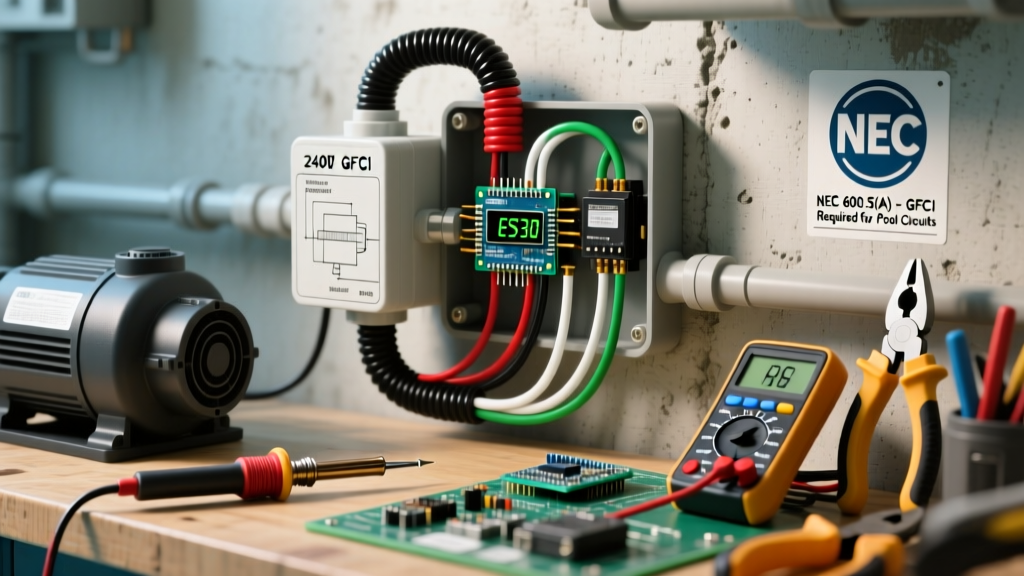
Critical Code Callout: NEC 680.22 requires that all 15- and 20-ampere, single-phase, 125-volt or 250-volt receptacles supplying pool pump motors be protected by a ground-fault circuit interrupter (GFCI). Furthermore, hardwired 240V pool pumps must be protected by a Class A GFCI breaker, which trips at a highly sensitive 4-6mA leakage threshold.
A standard 240V double-pole breaker will not pass inspection. You must install a specialized GFCI breaker, such as the Eaton BR250GFI or Siemens Q250GF, which typically costs between $120 and $160 in 2026. DIYers frequently attempt to bypass GFCI requirements for hardwired 240V pumps by misinterpreting older code cycles, resulting in failed inspections and severe safety hazards.
DIY vs. Professional Installation: A 2026 Comparative Analysis
Below is a realistic breakdown of what a DIY installation entails versus hiring a licensed professional for a standard 240V, 3HP variable-speed pool pump setup.
| Metric | DIY Installation | Licensed Professional (2026 Rates) |
|---|---|---|
| Total Estimated Cost | $280 - $450 (Materials only) | $950 - $1,800 (Labor + Materials) |
| Time to Complete | 8 - 14 hours (over 2-3 weekends) | 3 - 5 hours (single day) |
| Code Compliance | Low (High risk of missing 680.26 bonding) | High (Guaranteed to pass AHJ inspection) |
| Equipment Warranty | Voided if not installed by licensed pro | Fully validated by manufacturer |
| Liability / Insurance | Homeowner assumes all liability | Covered by contractor's liability insurance |
Note: Major manufacturers like Pentair and Hayward explicitly state in their 2026 installation manuals that warranties are void if the equipment is not installed by a licensed electrician. A $1,500 pump replacement due to a fried control board from improper grounding will not be covered.
The #1 DIY Failure Point: The Equipotential Bonding Grid
If there is a single aspect of pool pump electrical wiring that separates professionals from amateurs, it is the equipotential bonding grid. Grounding and bonding are not the same thing. Grounding provides a path for fault current to trip the breaker. Bonding connects all conductive metal parts together so they share the same electrical potential, preventing a voltage gradient from forming between the water, the deck, and the pump.
The Bonding Specifications (NEC 680.26)
- Wire Type: 8 AWG solid bare copper wire. (Stranded wire is a code violation for the bonding grid).
- Components to Bond: The pump motor housing, the pump volute, all metal piping within 3 feet, metal deck reinforcement, and the pool water itself.
- Water Bonding: If you have PVC plumbing, you must install a water bonding device, such as the Perma-Cast PB-1 or the Pool Tool 100UB, directly into the plumbing line to bond the water.
- Connections: Must use listed, direct-burial bonding clamps, such as the King Innovation 888 or 889 series. Standard brass hose clamps or indoor wire lugs will corrode within months when exposed to pool chemicals and soil moisture.
The DIY Edge Case: Many DIYers run the 8 AWG bonding wire to the pump but fail to connect it to the pool's structural rebar or the water bond device. This creates a 'floating' potential. If a fault occurs, the water can become energized relative to the deck, leading to fatal shock.
Conduit, Conductors, and the 'Direct Burial' Myth
Another frequent code violation in DIY pool wiring is the use of Underground Feeder (UF-B) direct burial cable. NEC 680.10 strictly prohibits direct burial cables for underground wiring to pool equipment.
Professional electricians use individual THWN (Thermoplastic Heat and Water-resistant Nylon-coated) copper conductors pulled through rigid Schedule 40 or Schedule 80 PVC conduit. For a standard 3HP, 240V pump, this means pulling three 10 AWG THWN wires (two hots, one equipment grounding conductor) and one 8 AWG bare solid copper bonding wire through a minimum 3/4-inch PVC conduit.
Professional Conduit Best Practices
- Sweep Bends: Pros use long-radius sweep bends instead of sharp 90-degree conduit elbows to prevent wire insulation damage during pulling and to allow for future wire replacement.
- Expansion Joints: PVC expands and contracts with temperature changes. Pros install PVC expansion fittings to prevent the conduit from buckling or tearing away from the junction boxes.
- Duct Seal: Conduit ends at the equipment pad must be sealed with duct seal compound to prevent moisture and chlorine vapor from migrating into the underground conduit and corroding the THWN insulation.
Variable Speed Pumps and Automation Wiring
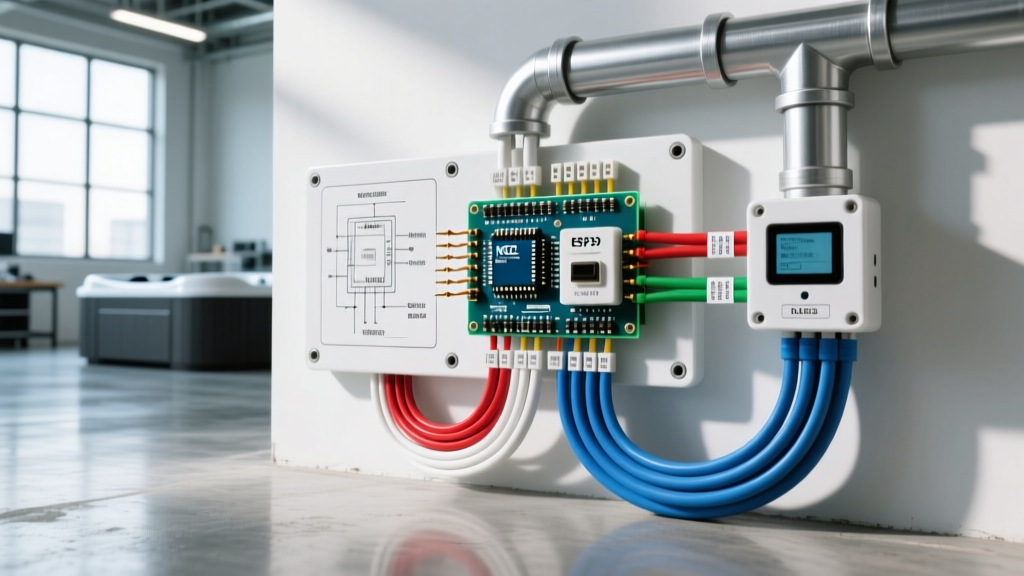
Modern variable speed pumps rarely operate in isolation. They are often integrated into smart home automation systems like the Pentair IntelliConnect or Hayward OmniLogic. This introduces a new layer of complexity: low-voltage communication wiring.
These systems use RS-485 communication protocols. The wiring requires specific 2-conductor or 4-conductor shielded twisted-pair cables. A common DIY failure mode is running this low-voltage communication cable in the same conduit as the 240V high-voltage THWN wires. This causes electromagnetic interference (EMI), resulting in dropped signals, erratic pump speeds, and control board faults. Professionals maintain strict physical separation (at least 6 inches) between high-voltage power conduits and low-voltage communication trenches.
When to Immediately Hire a Licensed Electrician
While a highly experienced DIYer with a deep understanding of NEC Article 680 might successfully pull THWN wire and terminate a GFCI breaker, you must hire a professional if you encounter any of the following red flags:
- Aluminum Branch Wiring: If your home's main panel or sub-panel utilizes aluminum feeders, the termination lugs and torque requirements are highly specific. Improper torque on aluminum leads to thermal expansion, arcing, and panel fires.
- Insufficient Panel Capacity: A 3HP variable speed pump requires a 30A or 40A double-pole breaker. If your main panel is already at 80% capacity (calculated via an NEC Article 220 load calculation), you will need a panel upgrade or a critical loads sub-panel.
- Missing or Corroded Existing Bonding: If you are replacing an old single-speed pump on a 15-year-old pool, the existing 8 AWG bonding wire is likely corroded or severed. A professional will use specialized testing equipment to verify the continuity of the bonding grid before energizing the new pump.
Frequently Asked Questions (FAQ)
Can I use a standard 240V breaker for a hardwired pool pump?
No. Current NEC codes require Class A GFCI protection for all pool pump motors, whether they are plugged into a receptacle or hardwired directly to a timer or automation controller. You must use a GFCI double-pole breaker.
Does the equipment grounding conductor need to be insulated?
Yes. While the equipotential bonding wire must be 8 AWG solid bare copper, the equipment grounding conductor (EGC) pulled inside the conduit with the hot wires must be an insulated 10 AWG or 8 AWG green or bare copper wire, depending on the breaker size and run length to account for voltage drop.
Why did my variable speed pump control board fry after a storm?
Variable speed pumps contain sensitive solid-state drives. If the equipotential bonding grid is incomplete, or if the equipment grounding conductor has high impedance due to corroded connections, a nearby lightning strike or utility surge will seek the path of least resistance—often through the pump's logic board. Installing a specialized pool equipment surge protector (like the Intermatic IG1240RC3) at the sub-panel is highly recommended.
Final Verdict: Is DIY Pool Pump Wiring Worth the Risk?
While the material savings of a DIY pool pump electrical wiring project ($600 to $1,000) are tempting, the stakes are disproportionately high. The strict requirements of NEC Article 680, the absolute necessity of a flawless equipotential bonding grid, and the risk of voiding a $1,500+ pump warranty make this one of the least forgiving DIY electrical projects. For the vast majority of homeowners, hiring a licensed electrical contractor who specializes in aquatic environments is not just a code requirement—it is a critical investment in the safety of your family and the longevity of your pool equipment.