
Understanding the Types of Electrical Wiring in Homes
Whether you are wiring a new addition, upgrading a service panel, or troubleshooting a faulty circuit, selecting the correct cable is the foundation of a safe electrical system. The types of electrical wiring in homes are strictly governed by the National Electrical Code (NEC), and using the wrong material can lead to catastrophic failures, including arc faults and electrical fires. According to the National Fire Protection Association (NFPA), electrical distribution and lighting equipment are consistently among the leading causes of home structure fires.
This material and tool guide breaks down the specific cable types used in modern residential construction, their 2026 market costs, exact NEC article references, and the specialized tools required for proper installation.
1. NM-B (Non-Metallic Sheathed Cable)
Commonly referred to by the brand name Romex, NM-B cable is the undisputed standard for interior, dry-location residential wiring. It consists of two or more insulated conductors wrapped in a bare copper ground wire, all encased in a flexible PVC jacket.
Material Deep Dive: Southwire SIMpull Technology
In 2026, the industry standard for NM-B is Southwire’s SIMpull cable. The jacket features a proprietary NoLube additive that reduces friction by up to 50% when pulling through studs and joists. This drastically reduces the physical strain on the installer and prevents micro-tears in the PVC jacket that could compromise the dielectric strength of the insulation.
- Best Use Case: Interior branch circuits, lighting, and receptacles in dry, climate-controlled environments.
- NEC Reference: Article 334 (Nonmetallic-Sheathed Cable: Types NM, NMC, and NMS).
- 2026 Cost Estimate: $0.45 to $0.65 per linear foot for 12/2 AWG (250ft coil).
- Restriction: Cannot be used in wet locations, embedded in concrete, or exposed in unfinished basements where subject to physical damage (typically below 7 feet).
2. THHN / THWN-2 (Thermoplastic High Heat-Resistant Nylon-Coated)
When NM-B is not permitted—such as inside metallic conduit, underground PVC runs, or exposed basement ceilings—electricians use individual THHN/THWN-2 conductors. These are single wires with a tough nylon outer coating that resists oil, gas, and moisture.
Solid vs. Stranded Conductors
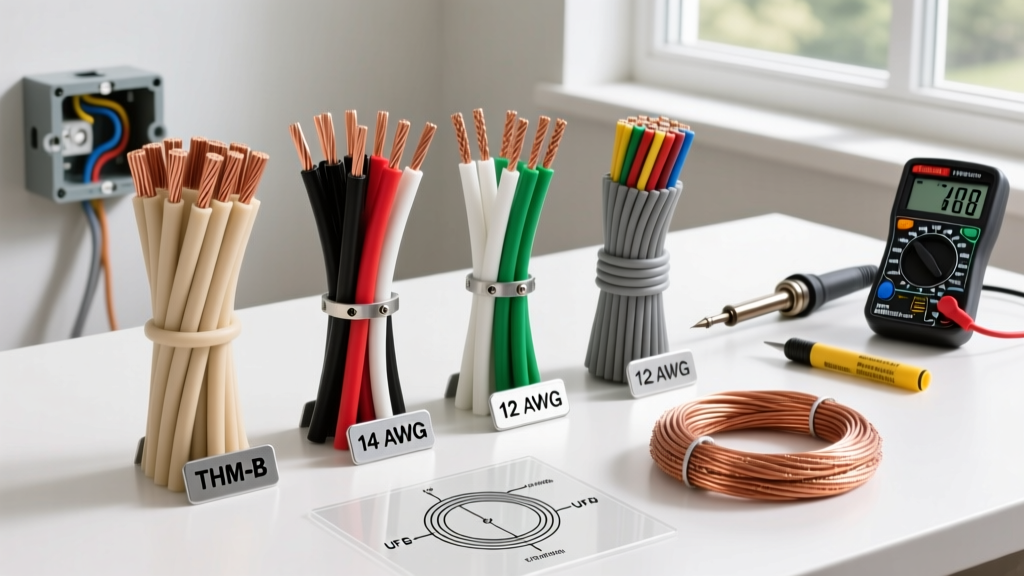
For residential conduit runs, 12 AWG and 10 AWG wires are typically available in both solid and stranded formats. Stranded THHN is significantly easier to pull through conduit with multiple bends, reducing the risk of exceeding the NEC maximum pulling tension. However, solid wire is preferred for terminal connections on standard 15A and 20A receptacles, as stranded wire can fray under screw terminals if not properly ferruled.
- Best Use Case: Conduit runs, service entrance feeders, and wet locations (when rated THWN-2).
- NEC Reference: Article 310 (Conductors for General Wiring).
- 2026 Cost Estimate: $0.18 to $0.30 per foot (varies heavily by copper spot prices).
3. UF-B (Underground Feeder)
UF-B cable looks similar to NM-B but features a solid, moisture-resistant PVC jacket that encapsulates the conductors completely, rather than wrapping them in a sheath. It is designed specifically for direct burial and outdoor applications.
Code Alert: Burial Depths
Under NEC Article 300.5, standard UF-B cable buried without mechanical protection (like PVC conduit) must be installed at a minimum depth of 24 inches. If you install it under a 2-inch thick concrete slab, the minimum depth drops to 18 inches. Always verify local amendments, as some municipalities require deeper trenches in frost-heavy regions.
- Best Use Case: Outdoor lighting, detached garages, well pumps, and landscape irrigation controllers.
- NEC Reference: Article 339 (Underground Feeder and Branch-Circuit Cable: Type UF).
- 2026 Cost Estimate: $0.85 to $1.20 per foot for 12/2 AWG.
4. MC (Metal-Clad) and AC (Armored Cable)
For homes requiring enhanced physical protection or where local codes prohibit NM-B in exposed areas (like certain multi-family dwellings or commercial-grade remodels), Metal-Clad (MC) and Armored Cable (AC) are utilized. MC cable features a continuous corrugated aluminum or steel armor and includes a dedicated green grounding wire. AC cable (often called BX) relies on the armor itself as the ground path via an internal bonding strip.
- Best Use Case: Exposed runs in garages, basements, and surface-mounted retrofit installations.
- 2026 Cost Estimate: $1.10 to $1.60 per foot for 12/2 AWG MC.
Comparison Matrix: Residential Wiring Materials
| Cable Type | Primary Application | Environment | Approx. Cost (12 AWG) | NEC Article |
|---|---|---|---|---|
| NM-B | Standard branch circuits | Indoor / Dry | $0.55 / ft | Art. 334 |
| THHN/THWN-2 | Conduit pulls, panels | Indoor / Wet (in conduit) | $0.25 / ft | Art. 310 |
| UF-B | Direct burial, outdoors | Outdoor / Wet | $1.05 / ft | Art. 339 |
| MC (Metal-Clad) | Exposed runs, retrofits | Indoor / Dry | $1.35 / ft | Art. 330 |
Wire Gauge and Ampacity: The NEC 310.16 Baseline
Understanding the types of electrical wiring in homes is useless if you select the wrong gauge. Ampacity dictates the maximum continuous current a wire can handle before the insulation begins to degrade. The U.S. Consumer Product Safety Commission (CPSC) emphasizes that overloaded circuits are a primary catalyst for residential electrical fires.
Standard Residential Sizing (60°C to 75°C Column)
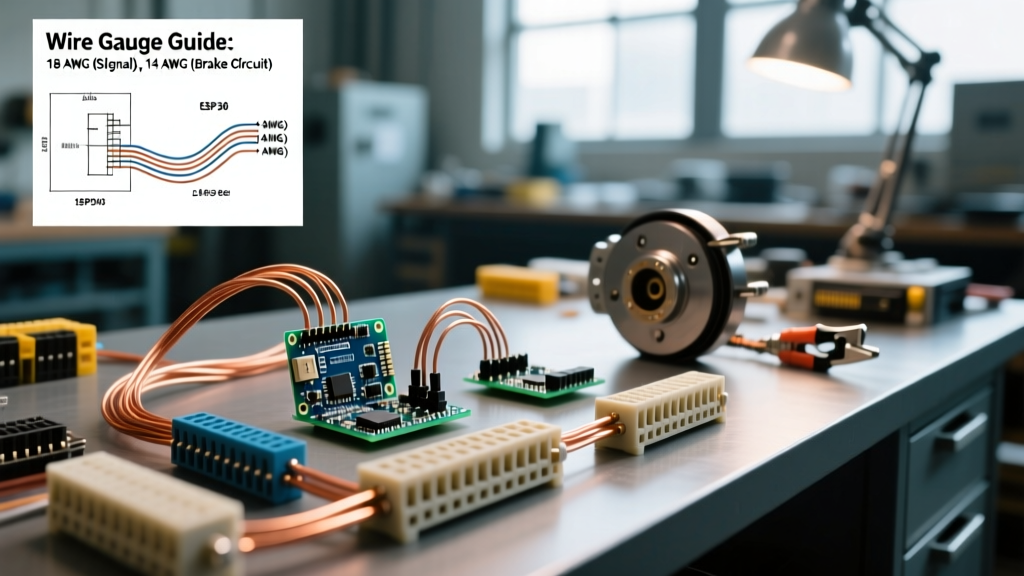
- 14 AWG: 15 Amps (Max breaker: 15A). Used for general lighting and low-draw receptacles.
- 12 AWG: 20 Amps (Max breaker: 20A). The modern standard for kitchen, bathroom, and outdoor receptacles.
- 10 AWG: 30 Amps (Max breaker: 30A). Dedicated circuits for water heaters, dryers (gas), and RV hookups.
- 8 AWG: 40 Amps (Max breaker: 40A). Electric ranges, large HVAC compressors.
- 6 AWG: 55 Amps (Max breaker: 60A). Sub-panels, tankless electric water heaters.
Pro-Tip for 2026: While 14 AWG is legal for 15A circuits, many professional electricians exclusively stock and pull 12 AWG for all standard receptacle circuits. The marginal increase in material cost (~$0.15/ft) is offset by the flexibility to upgrade the breaker to 20A in the future without rewiring the entire branch.
Essential Tools for Cable Preparation
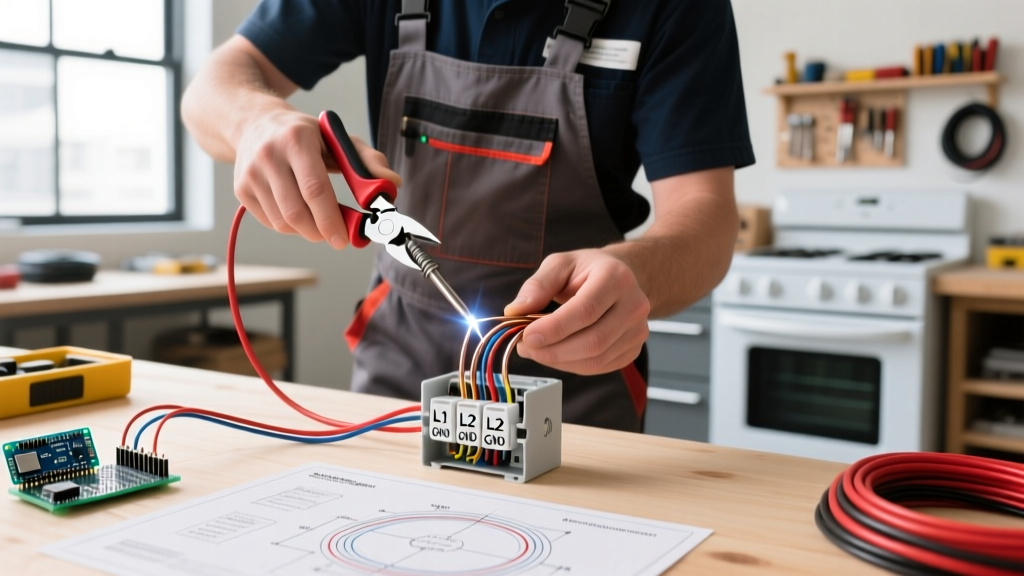
Working with these materials requires precision. Damaging the conductor insulation during stripping compromises the circuit's integrity.
- Klein Tools 11055 Wire Stripper: The industry standard for cleanly stripping 14 to 10 AWG solid and stranded wire without nicking the copper, which creates a hot-spot and a potential failure point.
- Gardner Bender GCR-200 Cable Ripper: A specialized tool that slides under the NM-B jacket and slices it lengthwise without scoring the underlying THHN insulation. Using a standard utility knife for this task is a leading cause of arc-faults in DIY projects.
- Klein Tools 56334 Fish Tape (1/4" Steel, 50ft): Essential for pulling THHN through existing walls and EMT conduit. The flat steel design prevents tangling and provides the rigidity needed to navigate tight joist bays.
Common Failure Modes and Edge Cases
The Bundling Derating Trap
One of the most frequently violated codes in residential wiring is NEC 310.15(C)(1) regarding conductor bundling. If you pull more than three current-carrying conductors through a single hole in a framing member or a single conduit, you must "derate" the ampacity of the wire. For example, if you bundle six 12 AWG THHN wires together, their ampacity drops from 20A to 14A. This means they can no longer safely be used on a 20A breaker, despite being 12 AWG. Always separate circuits or upsize the wire gauge when bundling is unavoidable.
UV Degradation on NM-B
NM-B cable is not rated for UV exposure. If left exposed to direct sunlight in an unfinished attic with open gable vents or on an exterior wall before siding is applied, the PVC jacket will become brittle and crack within 12 to 18 months. This exposes the bare ground and insulated conductors to moisture and physical abrasion. If temporary outdoor exposure is necessary, use UV-rated THWN-2 in Schedule 80 PVC conduit.
Final Thoughts on Material Selection
Mastering the types of electrical wiring in homes requires moving beyond basic color codes and understanding the environmental and mechanical stresses each cable type is engineered to withstand. Always consult the latest edition of the National Electrical Code and your local Authority Having Jurisdiction (AHJ) before beginning any rough-in work, as local amendments frequently supersede national baselines regarding permitted materials and installation depths.