
The True Cost of Standard Circuit Wiring in 2026
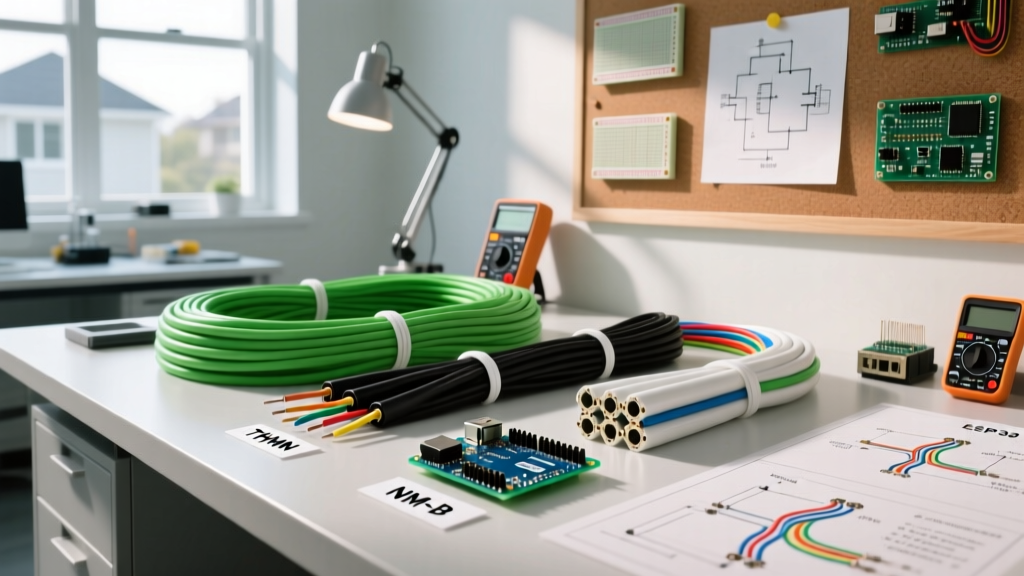
When planning a residential or commercial circuit, understanding the standard electrical wiring colors—green, black, and white—is critical for both safety and budgeting. While many DIYers casually refer to "Romex" when discussing home wiring, the specific color triad of green, black, and white actually points to individual THHN/THWN-2 conductors pulled through a raceway or conduit system. Standard non-metallic (NM-B) cable typically utilizes a bare copper ground, not a green-insulated one.
If your project specifications, local inspector, or commercial blueprint explicitly calls for the electrical wiring colors green, black, and white, you are likely looking at a conduit-based installation. This 2026 cost estimation guide breaks down the exact material expenses, labor multipliers, and edge cases associated with pulling individual colored conductors versus running standard NM-B cable, giving you a precise financial roadmap for your next electrical upgrade.
Decoding the Colors: NEC Compliance and Application
Before estimating costs, it is vital to understand why these specific colors are mandated. The National Electrical Code (NEC / NFPA 70) strictly governs conductor identification to prevent catastrophic cross-wiring and shock hazards.
- Black (Ungrounded / Hot): Carries the live 120V current from the breaker panel to the load. NEC Article 200 dictates that black (or any color other than white, gray, or green) can be used for ungrounded conductors.
- White (Grounded / Neutral): Completes the circuit by returning current to the panel. NEC Article 200.2 strictly reserves white or gray for the grounded neutral conductor.
- Green (Equipment Grounding Conductor): Provides a safe path for fault currents. Per NEC Article 250.119, the equipment ground must be green, green with one or more yellow stripes, or bare copper.
Expert Insight: Never use a green wire as a "switched hot" or a neutral, even if you wrap it in black or white electrical tape. While the NEC allows re-identifying white wires as hot with permanent markers or tape, re-identifying a green wire for any purpose other than grounding is a severe code violation and an immediate fail on any 2026 municipal inspection.
2026 Material Cost Matrix: THHN vs. NM-B
To accurately estimate your budget, we must compare the cost of buying individual spools of THHN wire (to achieve the green, black, and white configuration) against buying pre-assembled 12/2 NM-B cable (which contains black, white, and bare copper). The prices below reflect Q1 2026 national averages from major suppliers like Southwire and Cerro Wire.
| Material Component | THHN in EMT Conduit (Green/Black/White) | Standard 12/2 NM-B Cable (Black/White/Bare) |
|---|---|---|
| Wire Cost (per foot) | $1.35 (3 wires @ $0.45/ft each) | $0.58 (Integrated jacket) |
| Raceway / Jacket | $0.85/ft (1/2" EMT Conduit) | $0.00 (Included in NM-B) |
| Fittings & Couplings | $2.50 per joint/box entry | $0.10 (Cable staples) |
| Pulling Lubricant | $12.00 per bottle (Ideal Industries) | Not Required |
| Total Material (100ft Run) | $245.00 - $275.00 | $75.00 - $90.00 |
Labor Estimation: The Conduit Multiplier
Material costs only tell half the story. According to the U.S. Bureau of Labor Statistics, the mean hourly wage for licensed electricians has climbed in 2026, with fully burdened contractor rates (what you actually pay) averaging between $95 and $145 per hour depending on your metropolitan area.
Scenario A: Pulling THHN (Green, Black, White) in EMT
Installing individual wires requires bending, cutting, and threading EMT (Electrical Metallic Tubing) conduit. The electrician must use a mechanical bender (like a Klein Tools 5/8" ratcheting bender), secure the conduit with straps every 10 feet, and then physically pull the three wires through using a fish tape and wire-pulling compound.
- Time to install 100 feet: 3.5 to 5 hours.
- Estimated Labor Cost: $332 to $725.
- Total Project Cost (Material + Labor): $577 to $1,000
Scenario B: Running 12/2 NM-B Cable
If your local code allows NM-B cable (typically permitted in dry, residential interior walls), the installation is vastly faster. The electrician simply unrolls the cable, drills framing studs, pulls the cable through, and secures it with staples within 8 inches of every box.
- Time to install 100 feet: 1.5 to 2.5 hours.
- Estimated Labor Cost: $142 to $362.
- Total Project Cost (Material + Labor): $217 to $452
When is the Green, Black, and White THHN Method Worth the Cost?
Given that pulling individual green, black, and white wires through conduit costs roughly 2.5 times more than running NM-B cable, why do commercial blueprints and high-end residential specs demand it? Industry experts at Electrical Construction & Maintenance (EC&M) highlight several scenarios where the premium is justified:
- Physical Protection: In exposed basement ceilings, garages, or commercial retail spaces where walls are unfinished, NM-B cable is vulnerable to physical damage. EMT conduit provides a crush-proof steel armor.
- Future-Proofing and Upgrades: If you install 1/2" EMT conduit with THHN wires, you can easily pull the wires out and replace them with thicker 10 AWG wires or add a fourth wire (red) for a 240V circuit in the future without tearing open walls.
- High-Temperature Environments: Standard NM-B is rated for 60°C to 90°C depending on the termination. THHN/THWN-2 wire is rated for 90°C in dry locations, making it mandatory for certain high-heat commercial lighting runs or near industrial equipment.
Hidden Costs and Edge Cases to Watch For
When drafting your final budget, do not overlook these common financial pitfalls associated with conduit and individual wire installations:
1. Voltage Drop and Wire Upsizing
If your 120V circuit run exceeds 100 feet, you may experience a voltage drop greater than the NEC-recommended 3%. To compensate, you must upsize from 12 AWG to 10 AWG wire. In 2026, 10 AWG THHN costs approximately $0.68 per foot per color. This increases your wire material cost by over 50% and may force you to upsize your conduit from 1/2" to 3/4" to meet NEC fill-capacity tables.
2. Conduit Fill Capacity Violations
You cannot simply stuff as many green, black, and white wires as you want into a single pipe. NEC Chapter 9, Table 1 limits conduit fill to 40% for three or more wires. A standard 1/2" EMT conduit can safely hold up to nine 12 AWG THHN wires. If your design calls for multiple circuits in one raceway, you will need to purchase larger 3/4" or 1" conduit, increasing material costs by $0.40 to $0.90 per foot.
3. Specialty Boxes and Fittings
EMT conduit requires specific compression or set-screw fittings, as well as deeper metal junction boxes to accommodate the sweeping bends of the wires entering the box. Standard plastic "old work" boxes used with NM-B cannot be used with metal conduit. Budget an extra $4 to $8 per box location for heavy-duty steel boxes and metallic fittings.
Frequently Asked Questions
Can I use green tape on a white wire to make it a ground?
No. While the NEC allows you to re-identify a white wire as a "hot" conductor using black or colored tape at the terminations, you cannot use a white wire as an equipment grounding conductor. The ground must be bare, green, or green with a yellow stripe.
Is it cheaper to buy pre-assembled green/black/white cable?
There is a product known as MC (Metal Clad) cable, which contains individual THHN wires (black, white, green) wrapped in a flexible aluminum interlocking armor. For long, straight commercial runs, MC cable can reduce labor costs by 30% compared to rigid EMT conduit, though the material cost per foot is roughly 20% higher than buying loose THHN and EMT separately.
Why does my older home have a green wire that isn't a ground?
In some mid-century wiring systems (like older knob-and-tube or early cloth-sheathed cables), color coding was not standardized to modern NEC specifications. You may find green wires used as "hot" conductors. Always test wires with a non-contact voltage tester and a multimeter before touching them, and budget for a full panel and circuit rewiring if legacy colors are discovered.