
The Hidden Costs of Warehouse Electrical Failures
Modern logistics and distribution hubs operate on razor-thin margins, relying heavily on automated sorting systems, high-bay lighting, and heavy-duty HVAC. When warehouse electrical wiring fails, the resulting downtime can cost between $10,000 and $25,000 per hour in lost throughput. Unlike standard commercial spaces, warehouse environments subject electrical infrastructure to extreme mechanical vibration, conductive dust, and massive non-linear loads.
This troubleshooting guide bypasses generic advice to provide facility engineers and master electricians with deep-dive diagnostics for the five most destructive wiring faults found in industrial warehouses today.
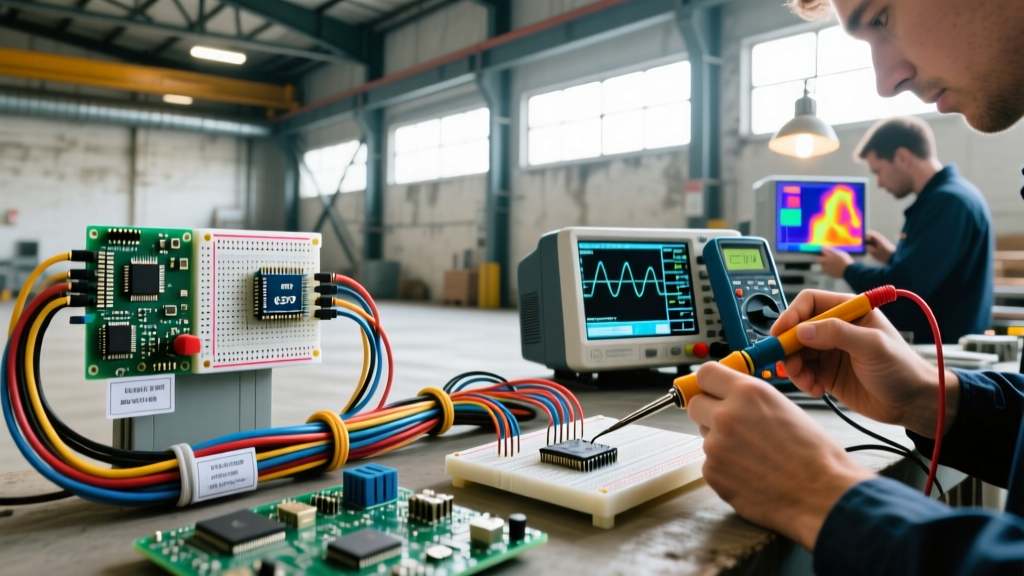
Essential Diagnostic Toolkit for Industrial Environments
Before climbing a scissor lift or opening a 480V distribution panel, ensure you have the correct diagnostic equipment. Standard multimeters are insufficient for capturing transient warehouse faults.
- Fluke 435-II Power Quality Analyzer (~$6,800): Mandatory for logging triplen harmonics and voltage sags over 7-day operational cycles.
- Fluke Ti480 PRO Infrared Camera (~$11,500): Required for identifying thermal anomalies at busway stabs and lug connections under load.
- Megger MIT515/2 Insulation Tester (~$4,200): Outputs up to 5kV DC to detect microscopic insulation breakdowns in long feeder runs.
Fault 1: Severe Voltage Drop at Remote Distribution Panels
Symptoms
Automated Guided Vehicles (AGVs) experience charging faults. Variable Frequency Drives (VFDs), such as the Yaskawa A1000, trip on undervoltage alarms (Uv1) during peak morning startup sequences. Lighting at the far ends of the facility visibly dims when conveyor motors engage.
Root Cause Analysis
While the NFPA 70 National Electrical Code (NEC Article 215.2) recommends a maximum 3% voltage drop for feeders, many older warehouses were wired with bare-minimum 350 kcmil THHN conductors for 400A panels. As facilities add EV fleet chargers and high-draw robotics, the actual load pushes the voltage drop past 5%. At a 480V source, a 5% drop leaves the remote panel with just 456V, which is often below the operational threshold for sensitive 460V motor drives.
The Expert Fix
- Upgrade feeder conductors from 350 kcmil to 500 kcmil or 600 kcmil XHHW-2 copper.
- Verify termination torque. A loose lug on a 500 kcmil conductor creates a high-resistance joint that mimics voltage drop. Torque all mechanical lugs to the manufacturer’s exact specification (typically 375 in-lbs for 500 kcmil) using a calibrated digital torque wrench.
- Install a step-up transformer at the remote panel if upsizing conductors is physically impossible due to conduit fill limits (NEC Chapter 9, Table 1).
Fault 2: Harmonic Distortion and Overheating Neutrals
Symptoms
The main neutral busbar in the 480Y/277V switchboard is discolored and hot to the touch (exceeding 70°C/158°F). Nuisance tripping occurs on ground-fault protection equipment (GFPE). Power factor correction capacitor banks fail prematurely.
Root Cause Analysis
As of 2026, the rapid retrofitting of legacy HID fixtures with 200W+ LED high-bays (e.g., Dialight Vigilant series) and the proliferation of VFDs have introduced massive non-linear loads. These devices generate triplen harmonics (3rd, 9th, 15th). Unlike positive-sequence currents that cancel out on the neutral, triplen harmonics add arithmetically. It is common to measure neutral currents at 150% to 180% of the phase current in heavily retrofitted warehouses.
The Expert Fix
Do not simply add more cooling. You must mitigate the harmonics at the source. Install Active Harmonic Filters (AHFs), such as the Schneider Electric AccuSine PCS+, directly on the main bus or at large VFD clusters. For new panel feeds supplying primarily LED lighting and switching power supplies, mandate a 200% oversized neutral conductor (e.g., using a 500 kcmil neutral with 350 kcmil phase conductors) to handle the additive harmonic current safely.
Fault 3: Intermittent Ground Faults in Dusty/Wet Zones
Symptoms
Ground Fault Circuit Interrupter (GFCI) or Ground Fault Protection (GFP) breakers trip randomly, particularly during high-humidity months or after floor scrubbing operations. Resetting the breaker holds for days before tripping again.
Root Cause Analysis
Conductive dust (from cardboard corrugators, tire wear from forklifts, or fertilizer storage) infiltrates NEMA 1 or NEMA 12 enclosures. When combined with ambient humidity, this dust creates a micro-conductive path between phase conductors and the grounded enclosure. Furthermore, older THHN insulation becomes brittle when exposed to warehouse UV and temperature cycling, leading to micro-fissures.
The Expert Fix
Perform an insulation resistance test using a Megger at 1000V DC. According to IEEE 43-2013 standards, the minimum acceptable insulation resistance for windings and cables is calculated as (kV + 1) MΩ. For a 480V circuit, you need a minimum of 1.48 MΩ. If the reading is lower, the wiring is compromised. Replace the affected branch circuits with XHHW-2 conductors pulled through NEMA 4X liquid-tight flexible metal conduit (LFMC) to completely seal out moisture and particulates.
Comparative Matrix: Warehouse Conductor Insulation Types
Selecting the wrong insulation type is a frequent root cause of premature failure. Use this matrix to specify the correct wire for your facility's environment.
| Insulation Type | Max Temp Rating | Est. Cost per 1,000 ft (4/0 AWG Cu) | Best Warehouse Application |
|---|---|---|---|
| THHN/THWN-2 | 90°C | $3,800 - $4,200 | Standard dry indoor EMT conduit runs, lighting feeders. |
| XHHW-2 | 90°C | $4,500 - $5,100 | Wet locations, cold storage transitions, high-abrasion pulls. |
| MI Cable (Mineral Insulated) | 250°C+ | $18,000 - $24,000 | Critical fire pump feeds, extreme heat zones near furnaces. |
Fault 4: Arc Flash Hazards at Busway Plug-In Units
Symptoms
A distinct ozone or burning plastic smell near overhead busway runs. Infrared scans reveal hot spots exceeding 100°C (212°F) at the connection stabs of 400A plug-in units (e.g., Square D Canalis busway).
Root Cause Analysis
Busway systems are popular in warehouses for their flexibility in moving machinery. However, when maintenance teams swap out plug-in units to reconfigure floor layouts, they often fail to fully seat the unit or torque the stab connections to spec. Over months of facility vibration (from heavy forklift traffic), the loose connection works itself free, increasing contact resistance and generating intense, localized heat.
Critical Safety Warning: According to OSHA electrical safety guidelines and NFPA 70E, never open or remove a busway plug-in unit while it is under load. Arc flash incident energy at a 480V main bus can easily exceed 40 cal/cm², requiring Category 4 PPE and remote racking tools. Always de-energize the entire busway run before modifying plug-in units.
The Expert Fix
Implement a strict quarterly thermographic inspection schedule for all busway drop units. When installing or reseating a plug-in unit, apply conductive anti-oxidant compound (like NOALOX) to the aluminum stabs if specified by the manufacturer, and use a torque screwdriver to secure the mechanical interlocks. Replace any plug-in unit showing pitting or bluing on the copper stabs immediately; the internal spring tension is compromised and will not maintain adequate contact pressure.
2026 Preventative Maintenance Schedule for Warehouse Wiring
To transition from reactive troubleshooting to proactive reliability, facility managers must implement the following maintenance cadence:
- Quarterly: Infrared thermography of all switchboards, motor control centers (MCCs), and busway plug-in units under minimum 40% load.
- Bi-Annually: Ultrasonic emission testing on high-voltage terminations to detect early-stage corona discharge.
- Annually: Mechanical torque verification on all main breaker and busbar connections. Re-calibrate ground fault protection relays via secondary injection testing.
- Every 3 Years: Comprehensive power quality logging (7-day minimum) to establish a baseline for harmonic distortion and voltage unbalance, adjusting active filters as facility loads evolve.
Final Thoughts on Warehouse Infrastructure
Troubleshooting warehouse electrical wiring requires looking beyond the immediate symptom to understand the systemic electrical environment. By utilizing advanced power quality analyzers, enforcing strict torque and insulation testing protocols, and designing for the harmonic realities of modern automated facilities, electrical professionals can eliminate the root causes of downtime and ensure a resilient power infrastructure.