
The Hidden Dangers of Legacy Electrical Systems
When undertaking a renovation on a home built before 1980, updating electrical wiring is rarely just an aesthetic upgrade; it is a critical life-safety intervention. According to the National Fire Protection Association (NFPA), electrical failures or malfunctions are consistently among the leading causes of residential structural fires. Older homes were designed for the electrical loads of the mid-20th century—typically 60-amp to 100-amp services powering incandescent bulbs and a single refrigerator. Today's smart homes, EV chargers, and high-draw HVAC systems demand 200-amp services and robust, grounded copper pathways.
Approaching a rewire project requires strict adherence to safety protocols, an understanding of material degradation, and compliance with the latest National Electrical Code (NEC). This guide details the professional safety best practices for updating electrical wiring in aging structures.
Legacy Wiring Identification Matrix
Before cutting into drywall or pulling new cable, you must identify the existing wiring topology. Each legacy system presents unique failure modes and removal hazards.
| Wiring Type | Era | Primary Hazard | NEC Status & Action Required |
|---|---|---|---|
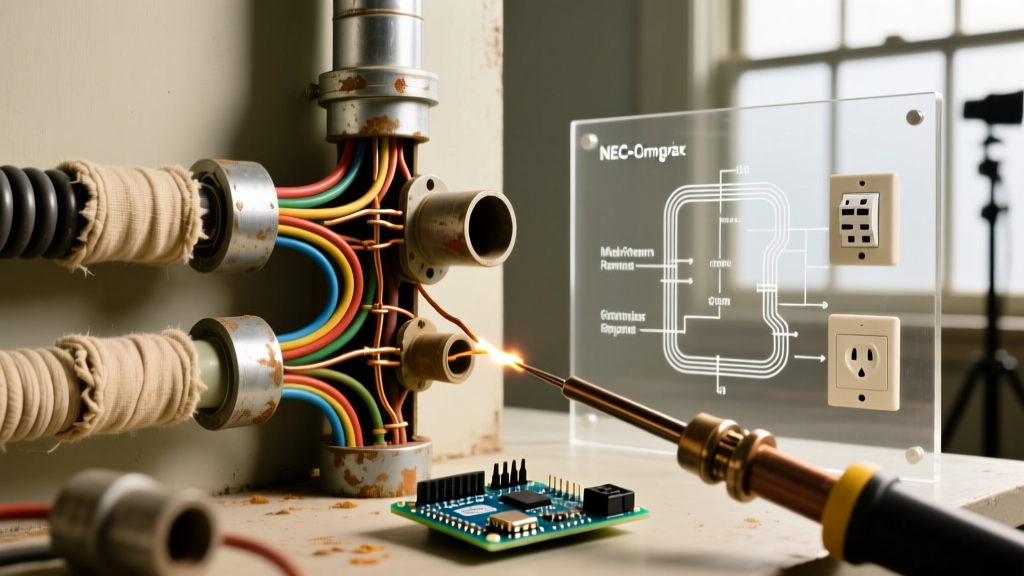
| Knob and Tube (K&T) | 1880s–1930s | Thermal entrapment when covered by modern insulation; brittle rubber insulation. | Not permitted for new installs. Must be abandoned or completely removed. No grounding path. |
| Cloth-Sheathed NM | 1930s–1950s | Asbestos content in early sheathing; cloth degrades and exposes bare copper. | Often lacks an equipment grounding conductor (EGC). Requires full replacement to meet modern AFCI codes. |
| Aluminum (AA-1350) | 1965–1973 | High thermal expansion rate causes connections to loosen, arc, and ignite. | Must be mitigated via COPALUM or AlumiConn connectors, or entirely replaced with copper. |
Pre-Demolition Safety Protocols
The most dangerous phase of updating electrical wiring occurs before a single new wire is pulled. Working in older homes means dealing with undocumented DIY modifications, shared neutrals, and mislabeled breaker panels. Implementing a rigorous Lockout/Tagout (LOTO) and verification routine is non-negotiable.
- Panel Mapping and LOTO: Never rely on the labels inside an older panel door. Use a circuit tracer (like the Klein Tools ET310) to map circuits. Once identified, shut off the main breaker, apply a physical padlock to the panel, and tag it with your contact info and the date.
- Dual-Verification Testing: Non-contact voltage testers (NCVTs) can yield false negatives on shielded or deeply buried legacy wires. Always follow up an NCVT sweep with a solenoid-based wiggy tester or a digital multimeter like the Fluke T5-600, testing phase-to-neutral and phase-to-ground to confirm zero energy.
- PPE for Unknown Materials: Homes built before 1980 likely contain lead paint and asbestos. When fishing wires through walls or removing old junction boxes, wear an N95 or P100 respirator and use HEPA-filtered vacuum attachments for drywall dust.
Expert Insight: Never assume a wire is dead just because the receptacle it feeds has no power. Older homes frequently feature 'switched loops' or daisy-chained circuits where the line voltage passes through a dead receptacle to feed a live one downstream. Always test at the wire nuts inside the box.
NEC Compliance for Modern Rewiring
When updating electrical wiring, you are not merely replacing old wire with new wire; you are bringing the circuit up to current code standards. The NFPA 70 National Electrical Code mandates several critical safety upgrades for any newly installed or extensively modified branch circuits.
Arc-Fault and Ground-Fault Protection
Under current NEC guidelines, almost all 15-amp and 20-amp, 120-volt branch circuits in living spaces (bedrooms, living rooms, hallways) require Arc-Fault Circuit Interrupter (AFCI) protection. This is typically achieved by installing Combination-Type AFCI circuit breakers in the main panel. For wet locations (kitchens, bathrooms, garages, exteriors), Ground-Fault Circuit Interrupter (GFCI) protection is mandatory. In older homes lacking a grounding path, replacing a 2-prong receptacle with a GFCI receptacle is legally permissible and provides shock protection, provided it is labeled 'No Equipment Ground'.
Upgrading the Service Panel
Most rewiring projects necessitate a panel upgrade. Upgrading from a 100-amp to a 200-amp service (such as the Square D QO 200-Amp Main Breaker Panel) requires coordinating with the local utility company. Safety best practices dictate that the utility must disconnect the overhead drop or underground lateral before the electrician removes the meter base and swaps the panel. Never attempt a 'hot swap' on a main service panel.
The Aluminum Wiring Edge Case
If your home was built between 1965 and 1973, you may encounter AA-1350 series aluminum branch wiring. The U.S. Consumer Product Safety Commission (CPSC) warns that this specific alloy expands and contracts significantly more than copper, leading to connection loosening and subsequent arcing at receptacles and switches.
If a complete copper rewire is financially unfeasible, you must use approved mitigation methods. The standard 'purple wire nut' (Ideal 65) is no longer considered a permanent, safe repair for aluminum-to-copper pigtailing due to high field-failure rates. Instead, use the King Innovation AlumiConn 3-Port lug connector. This connector uses independent setscrews to separate the aluminum and copper wires, preventing galvanic corrosion. Crucially, these setscrews must be torqued to exactly 45 inch-pounds using a calibrated torque screwdriver to ensure a gas-tight connection without snapping the screw.
2026 Cost Expectations for Rewiring Projects
Budgeting for a whole-house rewire requires understanding the variables that drive labor and material costs. Below is a breakdown of average 2026 pricing for updating electrical wiring in a typical 2,000-square-foot home.
| Project Scope | Estimated Cost Range (2026) | Key Cost Drivers |
|---|---|---|
| Full Copper Rewire (Open Walls) | $12,000 – $18,000 | Accessibility, number of circuits, panel upgrade inclusion. |
| Full Copper Rewire (Closed Walls) | $22,000 – $35,000 | Extensive drywall cutting/patching, fishing time, plaster repair. |
| 200-Amp Panel Upgrade Only | $2,200 – $3,800 | Utility coordination, grounding electrode system installation, permit fees. |
| Aluminum Mitigation (Per Device) | $65 – $95 per connection | Use of AlumiConn lugs, CO/ALR rated devices, labor time. |
Note: Prices vary heavily by regional labor rates. Always secure at least three itemized bids from licensed, bonded, and insured electrical contractors.
Frequently Asked Questions
Can I abandon old knob-and-tube wiring inside the walls?
Yes, the NEC allows you to abandon legacy wiring in place, provided it is completely disconnected from the power source. Best practice dictates that you physically remove all accessible wire from junction boxes and the panel, and push the disconnected remnants deep into the wall cavities. Leaving dead wires connected to live circuits in hidden junction boxes is a severe fire and shock hazard.
Do I need to replace the grounding rod when updating wiring?
If you are upgrading your service panel, the NEC requires a grounding electrode system that meets current standards. Older homes often relied on a single ground rod or a connection to a metallic water pipe (which may have been partially replaced with non-conductive PEX). You will likely need to install two 8-foot copper-bonded ground rods, spaced at least 6 feet apart, or verify a supplemental ground to the continuous underground metal water pipe.
Is it safe to fish new wires alongside old HVAC ductwork?
You must maintain strict separation between low-voltage/signal cables and line-voltage electrical wiring. Furthermore, NM-B (Romex) cable cannot be run inside air-handling ducts or plenums unless it is specifically rated for it (Plenum-rated CMP cable). When fishing walls, avoid running electrical cables parallel to hot flues or uninsulated HVAC ducts, as ambient heat can degrade the PVC jacket of the wire over time, lowering its ampacity rating.