
Navigating Electrical Codes for High-Load Kitchen Appliances
When it comes to kitchen remodels and new construction, wiring electric hob units (commonly referred to as cooktops) represents one of the most heavily scrutinized aspects of a residential electrical inspection. Modern induction and radiant electric hobs draw massive amounts of current, often requiring dedicated 240-volt circuits rated between 30 and 50 amps. A failed inspection doesn't just delay your project; it highlights potential fire hazards and shock risks that could compromise the entire home.
According to the National Fire Protection Association (NFPA), cooking equipment is the leading cause of home structure fires and home fire injuries. While many of these fires stem from unattended cooking, a significant percentage originates from faulty electrical connections, undersized branch circuits, and improper grounding. Electrical inspectors are trained to look past the cosmetic finish of your kitchen and focus entirely on the mechanical execution of the wiring, the accuracy of your load calculations, and strict adherence to the National Electrical Code (NEC).
This comprehensive compliance guide breaks down the exact parameters inspectors use to evaluate electric hob installations, ensuring your project passes on the first visit.
Branch Circuit Sizing and NEC Demand Factors
A common misconception among DIYers and apprentice electricians is that the branch circuit must be sized to the absolute maximum nameplate wattage of the appliance. However, the NEC recognizes that an electric hob rarely operates all burners at maximum output simultaneously. Under NEC Article 220.55, electricians are permitted to apply demand factors to residential cooking appliances.
For a single electric hob rated over 1.75 kW, the demand load is calculated based on specific tables within the code. For instance, a standard 8.5 kW cooktop does not require a 40-amp breaker based on raw wattage division. Instead, the NEC allows a demand factor that often reduces the calculated load, permitting the use of standard 40-amp or 50-amp circuits depending on the exact kilowatt rating and local amendments.
Cooktop Circuit Sizing Matrix
The following table outlines standard compliance baselines for copper conductors (THHN/THWN-2 or NM-B) at a 75°C termination rating, which is standard for most modern residential breakers and appliance terminals.
| Hob Nameplate Rating | NEC Demand Load (Approx) | Minimum Circuit Ampacity | Breaker Size | Copper Wire AWG |
|---|---|---|---|---|
| 3.0 kW - 4.5 kW | 8 Amps | 20 Amps | 20A (2-Pole) | 12 AWG |
| 5.0 kW - 7.0 kW | 11 kW (Table 220.55) | 30 Amps | 30A (2-Pole) | 10 AWG |
| 7.5 kW - 9.5 kW | 13 kW (Table 220.55) | 40 Amps | 40A (2-Pole) | 8 AWG |
| 10.0 kW - 12.5 kW | 15 kW (Table 220.55) | 50 Amps | 50A (2-Pole) | 6 AWG |
Note: Always verify the manufacturer's installation manual. If the manual specifies a minimum 50-amp circuit for a 9 kW unit, the manufacturer's instructions override general NEC demand tables per NEC 110.3(B).
Junction Box Placement and the 'Whip' Assembly
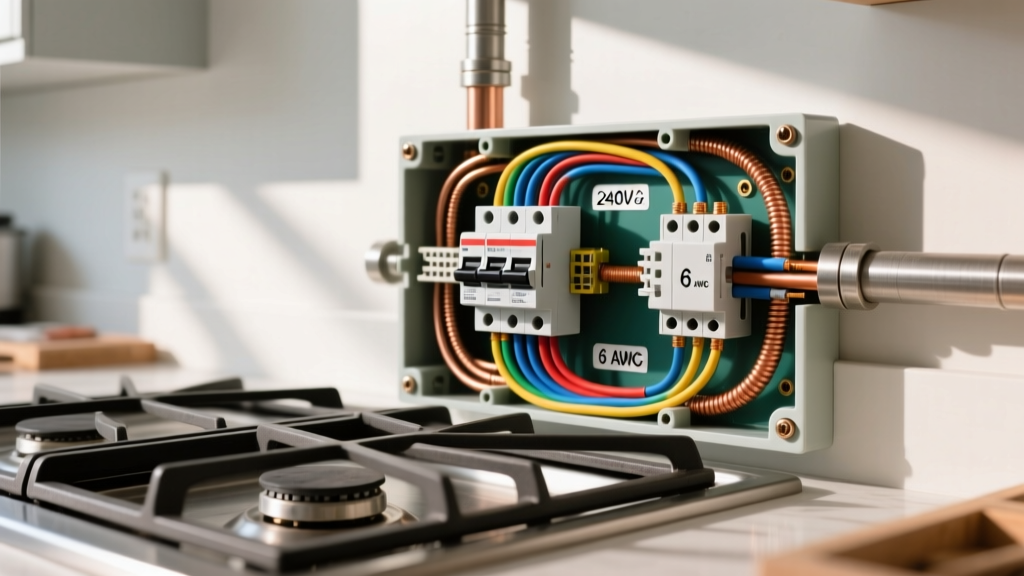
Inspectors pay close attention to how the transition is made from the home's fixed wiring to the appliance's flexible conduit (commonly called the 'whip'). You cannot simply run NM-B (Romex) cable directly into the underside of the cooktop without a proper junction box.
Junction Box Requirements
- Accessibility: Per NEC 314.29, the junction box must be accessible without removing any part of the building structure or the appliance. Inspectors will check if the box is mounted in the adjacent cabinet or lower drawer space where it can be reached by simply opening a door.
- Material and Rating: While metal boxes are standard, high-temperature-rated non-metallic boxes are acceptable if they are UL-listed for the specific ambient temperature of the space. If the box is mounted directly against the back wall behind the oven cavity below the hob, it must be rated for high heat to prevent insulation degradation.
- Strain Relief: The flexible metal conduit (FMC) or non-metallic liquid-tight whip must be secured to the junction box using a UL-listed connector. Pushing the bare whip through a knockout hole without a connector is an instant violation of NEC 300.15 and will result in a red tag.
Inspector's Insight: Flexible Metal Conduit (FMC) used for appliance whips is limited to a maximum length of 6 feet per NEC 348.12. If your hob is located on a kitchen island and the junction box is more than 6 feet away, you must run rigid conduit, EMT, or NM-B through the floor joists to a box located directly beneath the island cabinet.
The 4-Wire Grounding Mandate
One of the most frequent compliance failures in older homes undergoing kitchen renovations involves the grounding configuration. Prior to the 1996 NEC, 3-wire installations (two hots and a combined neutral/ground) were standard for ranges and cooktops. Today, NEC 250.140 strictly mandates a 4-wire setup for all new installations.
A compliant 4-wire circuit requires two ungrounded (hot) conductors, one grounded (neutral) conductor, and one separate equipment grounding conductor (EGC). The neutral carries the 120V return current for the appliance's control boards, digital displays, and ventilation interlocks, while the bare or green EGC provides a dedicated, low-impedance fault path back to the panel.
Crucial Compliance Step: When wiring electric hob units with a 4-wire supply, the bonding strap or bonding screw inside the appliance's terminal block must be removed. If the bonding strap is left in place on a 4-wire circuit, the neutral current will travel on the equipment grounding wire, creating a shock hazard and violating NEC 250.142. Inspectors will physically pull the terminal cover and verify the absence of the bonding strap.
Torque Specifications: The Modern Inspection Standard
If you are wiring a high-amperage appliance in 2026, you must be aware of NEC 110.14(D). This code section requires that all electrical connections be torqued to the manufacturer's specified values using a calibrated torque tool. This applies to both the breaker lugs in the main panel and the terminal block on the back of the electric hob.
Under-torqued connections create micro-gaps that lead to arcing, oxidation, and eventual thermal failure (the primary cause of melted terminal blocks). Over-torqued connections can strip the lug threads or shear the conductor strands, reducing the wire's ampacity. For a standard 40-amp or 50-amp 240V breaker, the required torque is typically between 35 and 50 inch-pounds (in-lbs). Inspectors increasingly carry torque screwdrivers and will spot-check lugs or look for verification marks left by the installing electrician.
The 'Red Tag' Checklist: Instant Inspection Failures
To ensure your installation passes, cross-reference your work against this list of common compliance violations that guarantee a failed inspection:
- Missing or Improper Strain Relief: The NM-B cable entering the junction box lacks a proper cable clamp, leaving the Romex jacket vulnerable to the sharp edges of the metal knockout.
- Spliced Grounds Without Pigtails: The equipment grounding conductor is daisy-chained or wrapped around the grounding screw without a proper crimp or wire nut pigtail.
- Exposed Copper at Terminals: More than 1/16th of an inch of bare copper is visible outside the terminal block lugs on the appliance, posing a short-circuit risk if the wires shift.
- Wrong Breaker Type: Using a standard thermal-magnetic breaker on a panel that requires AFCI/GFCI protection. While NEC 210.8(D) requires GFCI protection for 150V to ground receptacles, hardwired 240V cooktops generally do not require GFCI unless specified by local amendments or if the circuit also feeds a 120V receptacle. However, always verify local codes.
- Overcrowded Junction Box: Using a shallow 4x1/2 inch box for 6 AWG wires. The box fill calculations (NEC 314.16) dictate that larger gauge wires require deeper or larger volume boxes to prevent damaging the insulation during the push-in.
Commercial and Multi-Family Edge Cases
If you are wiring an electric hob in a commercial kitchen, a multi-family apartment building, or an ADU (Accessory Dwelling Unit), the compliance landscape shifts. According to guidelines referenced by the Electrical Safety Foundation International (ESFI) and commercial building codes, commercial cooking setups often require equipment disconnect switches within sight of the appliance. Furthermore, commercial hobs may be subject to National Electrical Manufacturers Association (NEMA) heavy-duty standards, requiring rigid steel conduit rather than flexible whips, and dedicated ground-fault protection for equipment (GFPE) depending on the jurisdiction's adoption of the latest NEC articles.
Frequently Asked Questions
Can I use aluminum wire for an electric hob circuit?
Yes, but you must upsize the wire and use specific terminations. For a 50-amp circuit, you would need 4 AWG aluminum instead of 6 AWG copper. Furthermore, the appliance terminal block must be explicitly rated and marked for aluminum (AL/CU), and you must apply an antioxidant compound (like Noalox) to the stripped wire ends to prevent galvanic corrosion and high-resistance faults.
Does a hardwired electric hob need a disconnect switch?
In residential applications, the circuit breaker in the main panel serves as the required disconnecting means, provided it is within sight of the appliance or can be locked in the OFF position per NEC 422.31. In commercial applications, a local, lockable disconnect switch is almost always required within sight of the cooktop.
What happens if my existing home only has 3-wire cable?
If you are simply replacing an old cooktop with a new one in the exact same location and the branch circuit is unaltered, NEC 250.140 Exception 1 allows you to continue using the existing 3-wire setup. You must bond the neutral and ground at the appliance terminal block. However, if you are remodeling the kitchen, moving the appliance, or upgrading the panel, the 'existing' exception is voided, and you must pull a new 4-wire circuit.