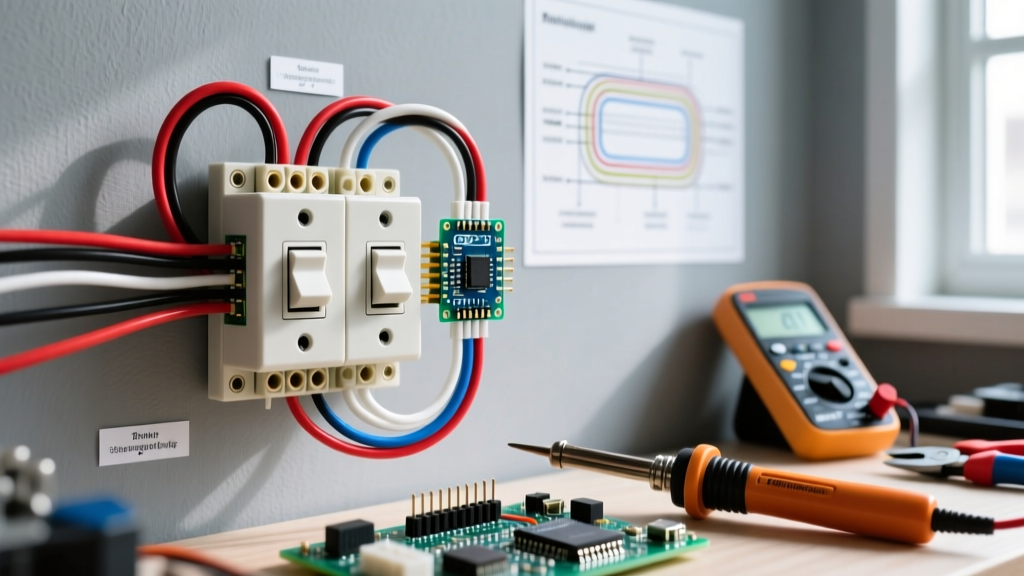

Understanding the Four-Way Switch Architecture
When a single lighting fixture or outlet needs to be controlled from three or more locations, the electrical wiring four way switch configuration becomes mandatory. Unlike standard single-pole switches that simply break a hot leg, or 3-way switches that alternate a hot feed between two traveler wires, a 4-way switch acts as an intermediate reversing valve. Internally, a 4-way switch is a Double-Pole, Double-Throw (DPDT) mechanism. It either passes the two traveler wires straight through (parallel) or crosses them over (X-pattern) depending on the toggle position.
Because a 4-way switch must always be placed between two 3-way switches, troubleshooting these circuits requires a methodical understanding of how the hot feed (line) and the switched hot (load) travel through the intermediate boxes. A single miswired traveler or misidentified common terminal will result in a circuit that only works in specific, seemingly random toggle combinations.
Essential Diagnostic Tools for Multi-Way Circuits
Before opening any junction box, ensure the circuit is de-energized at the breaker panel. However, troubleshooting requires live voltage testing to trace the fault. Relying on cheap solenoid testers or basic continuity checks is insufficient for modern 2026 diagnostics. You will need:
- True-RMS Digital Multimeter: The Fluke 117 (approx. $220) or Klein Tools MM400 (approx. $55) is required to accurately measure 120V AC across traveler and common terminals without ghost voltage interference.
- Non-Contact Voltage Tester (NCVT): The Klein NCVT-3 ($35) is essential for verifying dual-voltage presence and confirming a box is dead before removing wire nuts.
- Wire Tracer/Toner: If the traveler wires are unmarked or painted over, a tone generator helps identify which 14/3 or 12/3 Romex cables link the intermediate 4-way box to the terminal 3-way boxes.
Top 4 Failure Modes in Four-Way Circuits
1. Traveler Wire Cross-Wiring at the 4-Way Terminals
A standard 4-way switch (such as the Leviton Decora 5604-2W, approx. $12) features four brass terminals, usually grouped in pairs. While some manufacturers label them 'IN' and 'OUT', many do not. The most common wiring error occurs when an electrician or DIYer connects one traveler from the first 3-way switch and one traveler from the second 3-way switch to the same pair of terminals on the 4-way switch.
The Symptom: The light will turn on and off from the two 3-way switches, but toggling the 4-way switch will do nothing, or it will cause the light to flicker and arc internally.
The Fix: The two travelers originating from the same 3-way switch cable must land on the same pair of terminals (e.g., both on the left side, or both on the 'IN' set). The travelers from the other 3-way switch must land on the remaining pair.
2. Misidentified Common Terminals on the 3-Way Ends
The 4-way switch itself has no 'common' terminal, but the two 3-way switches bookending the circuit do. The common terminal is distinctly marked—usually with a black or dark copper screw, while the traveler screws are brass. If a traveler wire is mistakenly landed on the common screw of a 3-way switch, the circuit's logic is fundamentally broken.
The Symptom: The light will only work when Switch A is in the 'up' position. If Switch A is flipped 'down', neither the 4-way nor Switch B can turn the light on.
The Fix: Use your multimeter to identify the true line or load wire. With the breaker off, disconnect all wires from the 3-way switch. Turn the breaker on and carefully test the exposed wires. The single wire showing a constant 120V to ground is your Line (or Load, depending on the box). This wire must connect to the black common screw.
3. Backstab Terminal Thermal Failures
Builder-grade switches often feature push-in 'backstab' connections. Over years of thermal cycling (heating up under a 15A load and cooling down), the internal spring clips lose tension, leading to high-resistance connections. In a 4-way circuit, where voltage must pass through multiple mechanical junctions, a single failing backstab will cause voltage drop and intermittent light failure.
The Fix: Never use backstab terminals for multi-way circuits. Always loop the wire clockwise under the screw terminal and torque it down, or use a pigtail with a WAGO 221 lever nut (rated for 20A) to connect the wire to the switch.
4. Missing or Miswired Neutrals (NEC 404.2 Violations)
While traditional mechanical 4-way switches do not require a neutral wire, modern smart switches and illuminated locator switches do. Furthermore, recent updates to the National Electrical Code (NEC) require a neutral conductor to be present at nearly all switch boxes to accommodate future smart devices. If a white wire in a 3-way/4-way cable is being used as a traveler, it must be re-identified with black or red electrical tape or marker at both ends per NEC 200.6(E). Failing to do so creates a severe shock hazard for future technicians.
According to the National Fire Protection Association (NFPA), proper identification of ungrounded (hot) conductors is critical for safety. Misidentifying a traveler as a neutral can result in lethal conditions when servicing the lighting fixture.
Voltage Testing Matrix for 4-Way Circuits
When the circuit is energized, use your True-RMS multimeter to test the voltage at the 4-way switch terminals relative to a known ground. Reference this matrix to pinpoint the break in the circuit.
| Switch State | Pair 1 (IN) Voltage | Pair 2 (OUT) Voltage | Diagnostic Conclusion |
|---|---|---|---|
| Toggle Position A | 120V on Wire 1 / 0V on Wire 2 | 120V on Wire 3 / 0V on Wire 4 | Normal: Power passing straight through. |
| Toggle Position B | 120V on Wire 1 / 0V on Wire 2 | 0V on Wire 3 / 120V on Wire 4 | Normal: Power crossing over (X-pattern). |
| Any Position | 0V on both wires | 0V on both wires | Fault: Upstream 3-way switch is open or breaker is tripped. |
| Any Position | 120V on both wires | 120V on both wires | Fault: Both travelers are hot (short circuit or severe miswiring at 3-way). |
Modern Solutions: Bypassing the Headache with Smart Switches
If you are repeatedly troubleshooting an aging electrical wiring four way switch setup, or if the intermediate boxes lack the physical depth to accommodate bulky 14/3 traveler splices, upgrading to a wireless smart switch ecosystem is the most reliable 2026 solution.
Systems like the Lutron Caséta eliminate the need for physical traveler wires entirely. Here is the exact conversion methodology:
- Replace one 3-way switch with the Lutron Caséta Smart Switch (Model PD-5S-DV, approx. $65). This requires a line, load, and neutral connection in that specific box.
- Cap all traveler wires in the intermediate 4-way box and the second 3-way box using WAGO lever nuts. Push them safely into the back of the box.
- Install Wireless Pico Remotes (Model PJ2-3BRL, approx. $25 each) in the now-empty 4-way and second 3-way wall plates using the Lutron PICO-WBX-ADAPT bracket.
This conversion not only solves chronic traveler miswiring issues but also adds dimming capabilities, scheduling, and voice control, while remaining fully compliant with NEC requirements for switch box fill and wire management.
Frequently Asked Questions (FAQ)
Can I use a 4-way switch as a replacement for a 3-way switch?
Yes. If you are in a pinch and only have a 4-way switch (DPDT) available, you can wire it as a 3-way switch. Simply connect the line/load wire to one terminal on the left side, and the single traveler wire to the top terminal on the right side. Leave the other two terminals empty and capped. The switch will function identically to a standard 3-way, though the toggle direction may feel inverted depending on the internal mechanism.
Why does my light turn on, but turns off when I flip the hallway 4-way switch?
This specific behavior almost always indicates that the 4-way switch is wired in series with the load, rather than bridging the travelers between the two 3-way switches. Verify that the hot feed enters the first 3-way, passes through the 4-way via two separate 3-wire cables, and terminates at the final 3-way before hitting the light fixture.
Do I need to update my wiring to meet 2026 electrical codes?
The Occupational Safety and Health Administration (OSHA) and local AHJs (Authority Having Jurisdiction) generally enforce the NEC edition adopted by your state. While you are not required to rip out existing, functioning mechanical 4-way switches to add neutrals (grandfather clause), any new installation, major remodel, or panel upgrade will require a neutral at all switch boxes per NEC Article 404.2(A). Always consult the Consumer Product Safety Commission (CPSC) guidelines and your local inspector before undertaking a full rewire.