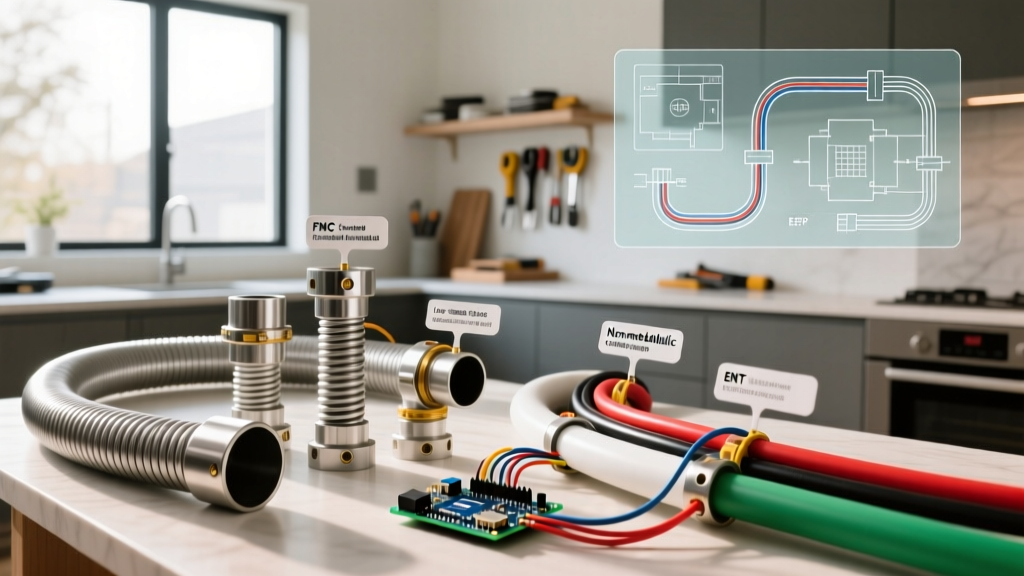

The Homeowner’s Matrix: Which Flexible Conduit to Choose?
When planning an appliance retrofit, HVAC upgrade, or attic cable run, selecting the correct flexible conduit for electrical wiring is critical for both code compliance and long-term safety. Unlike rigid EMT (Electrical Metallic Tubing), flex conduit absorbs vibration, navigates tight joist bays, and bridges the final gap between a fixed junction box and a vibrating motor or heating element. However, using the wrong type in a damp location or exceeding fill capacities are among the most common DIY code violations flagged by municipal inspectors.
Below is a technical comparison of the three primary flexible raceways used in residential construction as of 2026, including real-world material costs and specific application limits.
| Conduit Type | Abbreviation | Best Home Application | Environment | Avg. Cost (2026) |
|---|---|---|---|---|
| Flexible Metal Conduit (Interlocked steel/aluminum) | FMC / Greenfield | Attic runs, dry basement drop ceilings, accessible indoor whips | Dry, Indoor Only | $0.75 - $0.90 / ft |
| Liquid-Tight Flexible Metal Conduit (Steel core + PVC jacket) | LFMC | Water heater whips, outdoor A/C disconnects, garbage disposals | Indoor, Outdoor, Wet | $1.15 - $1.40 / ft |
| Electrical Nonmetallic Tubing (Corrugated PVC) | ENT / Smurf Tube | In-wall pre-wiring, concrete slab pours, low-voltage retrofits | Indoor, Concealed | $0.35 - $0.50 / ft |
Critical NEC Sizing and Grounding Rules
The National Fire Protection Association (NFPA) outlines strict parameters for flexible raceways in the National Electrical Code (NEC). The most misunderstood rule among home DIYers involves equipment grounding.
The 6-Foot Grounding Limitation (NEC 250.118)
Many homeowners assume the metal spiral of FMC or LFMC automatically acts as the ground wire. This is false for most scenarios. According to NEC Article 250.118(5), the metal sheath of FMC can only serve as the Equipment Grounding Conductor (EGC) if all three of the following conditions are met:
- The total length of the flexible conduit in the ground return path does not exceed 6 feet.
- The circuit conductors are protected by an overcurrent device rated at 20 amps or less.
- The fittings used are specifically listed as grounding-type (e.g., die-cast zinc compression fittings, not cheap stamped steel).
Expert Rule of Thumb: If you are running a 30-amp circuit for a water heater or a 40-amp circuit for an A/C condenser, the metal jacket cannot be your ground, regardless of length. You must pull a dedicated green or bare copper THHN ground wire inside the flex conduit alongside your hot and neutral conductors.
Conduit Fill Capacities for 1/2-Inch Flex
Overstuffing conduit causes heat buildup and makes future wire pulling impossible. For standard 1/2-inch LFMC or FMC, the maximum allowable fill for THHN/THWN-2 conductors is:
- 14 AWG: Maximum 8 conductors
- 12 AWG: Maximum 6 conductors
- 10 AWG: Maximum 4 conductors (Typical for 30A water heater whips: 2 hots + 1 ground)
- 8 AWG: Maximum 3 conductors
Step-by-Step: Installing a Liquid-Tight Whip for a Water Heater
Upgrading a water heater requires a flexible connection to absorb thermal expansion and minor vibration. Here is the professional method for installing a 1/2-inch LFMC whip using a Southwire 55182501 (or equivalent) liquid-tight kit.
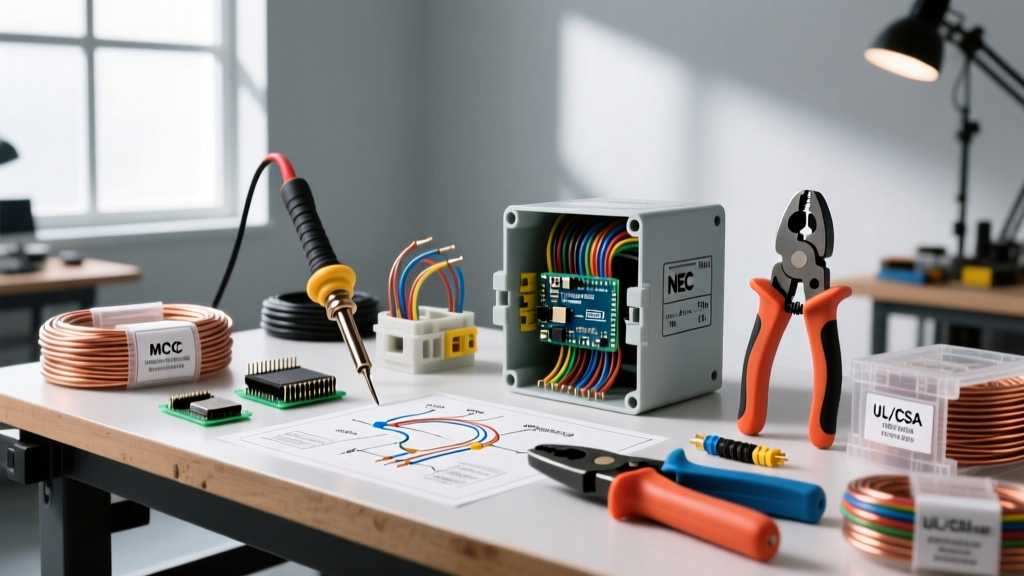
Tools and Materials Required
- 1/2-inch LFMC (cut to required length + 12 inches for slack)
- 1/2-inch Die-cast zinc liquid-tight compression fittings (e.g., Halex or Appleton)
- Hacksaw or specialized flex conduit cutter
- Klein Tools 53711 Conduit Reamer
- THHN/THWN-2 wire (10 AWG for 30A circuits)
- Yellow wire pulling lubricant
- Torque screwdriver (calibrated to manufacturer specs)
Installation Sequence
- Measure and Cut: Measure the distance from the wall junction box to the water heater access panel. Add 12 to 18 inches to create a sweeping "U" loop. This slack prevents the conduit from pulling taut and tearing the fittings loose during thermal expansion.
- Clean the Cut: Cut the LFMC with a hacksaw. The internal metal spiral will have razor-sharp burrs. Insert a conduit reamer and twist clockwise 5-6 times. Failure to ream will slice the THHN insulation during the pull, creating a dead short inside the wall.
- Prep the Fittings: Slide the compression nut and ferrule ring over the conduit end. Push the conduit firmly into the die-cast fitting until it bottoms out on the internal shoulder.
- Pull the Conductors: Tape the ends of your THHN wires together to form a smooth bullet nose. Apply a light coating of yellow wire lube. Push the wires through while gently rotating the conduit to navigate the internal corrugations.
- Secure and Torque: Mount the fitting to the junction box using a locknut. Tighten the compression nut hand-tight, then give it exactly 1.5 turns with a wrench to compress the ferrule into the PVC jacket, creating a watertight seal.
Common Failure Modes and Code Violations
According to field reports analyzed by Electrical Contractor Magazine, inspectors frequently reject flex conduit installations for the following reasons:
1. Exceeding the Minimum Bend Radius
Flex conduit cannot be kinked. NEC Article 351.24 dictates that for 1/2-inch LFMC, no bend shall have a radius of less than 4 inches (measured to the inside edge). Kinking the conduit crushes the internal metal core, reducing the cross-sectional area and creating a choke point that damages wire insulation.
2. Using FMC in Damp Locations
Standard interlocked FMC (Greenfield) is not sealed. When used outdoors, in crawlspaces with high humidity, or near water heaters where condensation occurs, moisture wicks into the metal spiral via capillary action. Within 24 to 36 months, the internal steel rusts, expands, and seizes the wires, making future removal impossible and compromising the grounding path.
3. Missing Anti-Short Bushings
When using standard FMC, NEC 348.12 requires the use of insulating bushings (often called "redheads" due to their color) at every termination. These plastic inserts snap over the jagged metal edge to protect the wires. Liquid-tight (LFMC) does not require these because the PVC jacket and compression fitting provide the necessary insulation and protection.
Advanced Troubleshooting: Retrofitting in Tight Spaces
When remodeling older homes, you may encounter joist bays packed with plumbing and HVAC ductwork, making rigid pipe bending impossible. In these scenarios, ENT (Smurf tube) is highly effective, but it requires specific support intervals.
Unlike rigid EMT which can be supported every 10 feet, ENT must be secured within 3 feet of every junction box and at intervals not exceeding 3 feet (NEC Article 362.30). Use UV-rated plastic conduit straps with stainless steel nails; standard drywall screws will rust and snap under the tension of the corrugated plastic over time.
Frequently Asked Questions
Can I bury Liquid-Tight Flexible Metal Conduit (LFMC) underground?
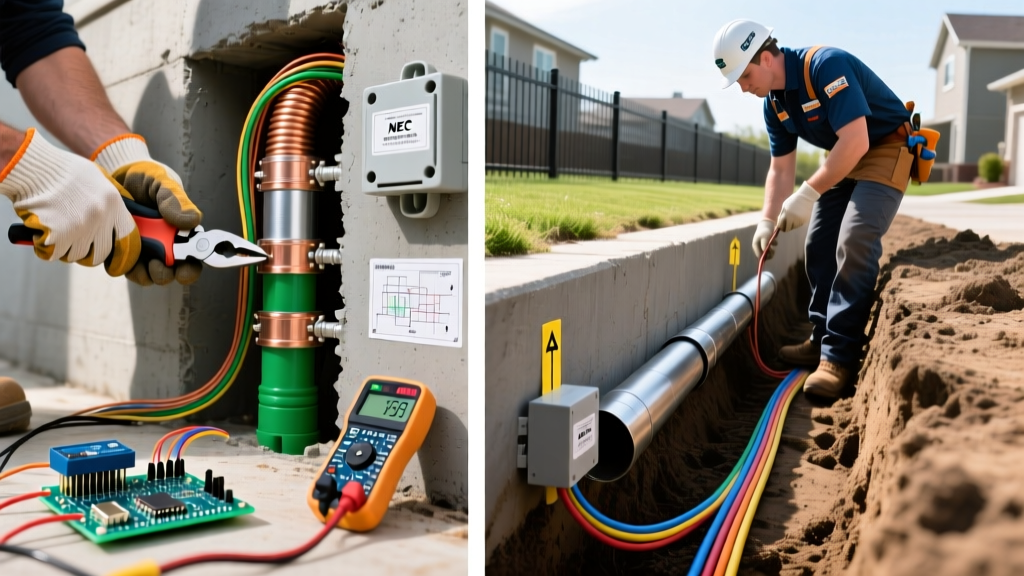
Yes, but only if the specific manufacturer's jacket is rated for direct burial. Most standard gray LFMC is only rated for encasement in concrete. For direct burial in a trench (such as running power to a detached shed or landscape lighting transformer), you must use black, UV-and-soil-rated LFMC, and it must be buried at least 18 inches deep per OSHA and NEC trenching guidelines.
Do I need to use wire lube in short flex runs?
If the run is under 3 feet with no 90-degree bends, lube is optional. However, if your water heater whip includes a 90-degree sweep to clear a pipe, the friction coefficient of THHN against the corrugated interior of LFMC increases dramatically. A single drop of polyethylene-based wire lube prevents the wire from binding and stretching the copper core.
What is the maximum length I can run flex conduit?
There is no absolute maximum length for LFMC or FMC in the NEC for general use, provided it is properly supported every 4.5 feet and within 12 inches of boxes. However, for FMC specifically, if it is being used as the equipment grounding conductor, it is strictly limited to 6 feet. For runs longer than 6 feet using FMC, you must pull a separate ground wire.