
Introduction to Parallel Circuit Architecture
In residential and commercial electrical systems, parallel electrical wiring is the foundational topology for branch circuits. Unlike series circuits—where a single broken connection kills power to all downstream devices—parallel wiring ensures that every receptacle, switch, and light fixture receives the full line voltage (typically 120V in North America) independently. If one device fails or is disconnected, the rest of the circuit remains fully operational.
However, executing a flawless parallel circuit requires more than just running cable from box to box. It demands a precise selection of materials, an understanding of National Electrical Code (NEC) box fill calculations, and the right diagnostic tools to verify continuity and polarity. This comprehensive material and tool guide details the exact components professional electricians use in 2026 to build safe, reliable, and code-compliant parallel circuits.
Core Materials: Conductors, Boxes, and Connectors
The longevity and safety of your parallel electrical wiring depend entirely on the quality of the raw materials installed behind the drywall. Below is a breakdown of the essential components required for a standard 20-ampere residential branch circuit.
1. Conductors and Cable Assemblies
For indoor, dry-location residential wiring, Non-Metallic Sheathed Cable (NM-B) is the industry standard. For a 20A parallel circuit (required for kitchen, bathroom, and garage receptacles), you must use 12 AWG copper wire.
- Top Pick: Southwire Romex SIMpull 12/2 with Ground. The SIMpull jacket reduces pulling friction by up to 50%, saving time and preventing jacket tearing when fishing wires through existing walls during remodels.
- Commercial/Conduit Applications: If you are pulling individual conductors through EMT conduit, use 12 AWG THHN/THWN-2 stranded or solid copper wire. Stranded is highly recommended for conduit runs longer than 50 feet to reduce pulling tension.
2. Junction and Device Boxes
A critical mistake in parallel wiring is overcrowding the device box. When you daisy-chain or pigtail parallel circuits, the number of conductors entering the box multiplies rapidly. According to NEC Article 314.16, you must calculate box fill volume. For 12 AWG wire, each current-carrying conductor counts as 2.25 cubic inches. A standard parallel pass-through box with two 12/2 cables entering, one device, and grounding wires requires a minimum of 20.25 cubic inches. Always use a 22-cubic-inch deep box (such as the Carlon B227R) to ensure adequate heat dissipation and physical space for splices.
3. Splicing Connectors: The Pigtailing Revolution
When wiring receptacles in parallel, you must join the incoming line, the outgoing load, and the pigtail to the device. Traditional twisted wire nuts (like the Ideal 341 Yellow) work, but they require significant hand torque and can fail if wires are cut to uneven lengths.
In 2026, the professional standard for parallel pigtailing is the Wago 221 Series Lever-Nut. Specifically, the Wago 221-413 (3-port) allows you to securely clamp the line, load, and pigtail wires independently. The lever mechanism provides a gas-tight connection that is immune to vibration loosening and allows for instant visual verification via the transparent housing.
Material Sourcing & Cost Matrix (2026 Estimates)
| Material Category | Recommended Model / Spec | Application in Parallel Wiring | Avg. Cost (2026) |
|---|---|---|---|
| NM-B Cable (250ft) | Southwire 12/2 SIMpull | 20A Branch Circuit Feed | $125.00 - $145.00 |
| Splicing Connector | Wago 221-413 (3-Port) | Pigtailing Line, Load, Device | $0.38 / unit (50-pack) |
| Device Box | Carlon B227R (22 cu in) | Accommodating Pass-Through Wires | $1.85 / unit |
| Receptacle | Leviton T5262 (TR Duplex) | Endpoint / Pass-Through Device | $3.20 / unit |
Essential Hand & Diagnostic Tools
Proper parallel electrical wiring requires precision. Stripping too much insulation exposes live copper to accidental contact; stripping too little results in insulation being clamped under the terminal screw, leading to high-resistance arcing.
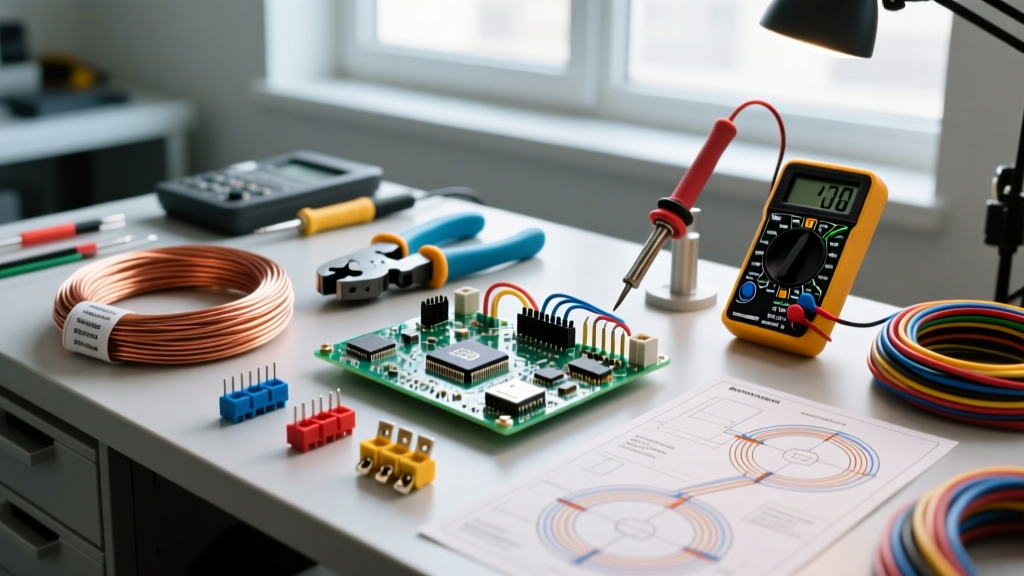
- Wire Strippers: The Klein Tools 11055 (10-18 AWG) is the undisputed workhorse. Its precision-ground holes strip 12 AWG and 14 AWG solid wire cleanly without nicking the copper, which prevents micro-fractures that can snap under terminal torque.
- Lineman’s Pliers: Knipex 09 12 240 or Klein 20001. Essential for gripping, twisting, and cutting heavy gauge copper. The Knipex features a specialized grip for pulling fish tapes and a clean-cut shear for NM-B jackets.
- Torque Screwdriver: While often associated with commercial panel work, OSHA and NEC 110.14(D) increasingly emphasize manufacturer-specified torque for terminal connections. The Klein Tools 706 torque screwdriver ensures you are applying the exact 14 in-lbs typically required for standard 15A/20A receptacle terminal screws, preventing both stripped threads and loose connections.
- Non-Contact Voltage Tester (NCVT): The Fluke 2AC-II VoltAlert is mandatory. Before touching any parallel circuit, you must verify the absence of voltage. The Fluke 2AC-II features a continuous self-test function, ensuring the internal battery and sensor are operational before you trust it with your life.
- Digital Multimeter: The Fluke 117 True-RMS Multimeter is critical for verifying parallel continuity, checking for neutral-to-ground faults, and confirming exact line voltage (ensuring it sits between 118V and 122V under load).
Execution Strategy: Pigtailing vs. Daisy-Chaining
When wiring multiple receptacles on a single parallel circuit, electricians generally choose between two methods: daisy-chaining (wiring directly through the device terminals) and pigtailing (splicing wires in the box and running a single tail to the device).
The Case Against Daisy-Chaining
Daisy-chaining involves connecting the incoming line to the top terminals of a receptacle and the outgoing load to the bottom terminals. While this saves time and wire, it introduces a critical single point of failure. If the neutral terminal on that specific receptacle loosens due to thermal expansion and contraction, all downstream devices on the parallel circuit will lose their neutral return path. This can cause severe voltage imbalances on multi-wire branch circuits (MWBCs) and lead to equipment damage.
The Professional Standard: Pigtailing
Pigtailing is the superior method for parallel electrical wiring. By using a Wago 221-413 to splice the incoming hot, outgoing hot, and a 6-inch pigtail together, the receptacle is completely isolated from the pass-through current. If the receptacle fails or is removed for replacement, the downstream parallel circuit remains fully intact and energized. The Electrical Safety Foundation International (ESFI) strongly advocates for pigtailing in all residential remodels to ensure long-term circuit reliability.
Pro-Tip for Box Fill: When using Wago lever-nuts for pigtailing, the physical footprint of the connector is larger than a traditional wire nut. Always upgrade to a deep 22-cubic-inch or 24-cubic-inch device box to maintain NEC compliance and allow the drywaller to push the device in without crushing the splices.
Common Failure Modes & Material Mistakes
Even with the right tools, poor technique can compromise a parallel circuit. Avoid these common pitfalls:
- Backstabbing (Push-In Connectors): Many budget receptacles feature push-in holes on the back. These rely on a small internal spring clip that grips the wire. Over time, thermal cycling causes the spring to relax, leading to high-resistance arcing and melted plastic. Always use the side terminal screws or the screw-clamp plates found on premium commercial-grade receptacles like the Leviton 5262.
- Mixing Wire Gauges: Never transition from 12 AWG to 14 AWG on a 20A parallel circuit. If a downstream fault occurs, the 14 AWG wire could melt before the 20A breaker trips. The entire parallel run must be uniformly sized to the breaker rating.
- Reverse Polarity: When wiring in parallel, it is easy to accidentally swap the hot (black) and neutral (white) wires at a pass-through receptacle. Always use a receptacle tester (like the Klein Tools RT210) on every single device in the parallel chain before closing the drywall.
Safety and Authoritative Resources
Electrical wiring carries inherent risks of shock, arc flash, and fire. The information provided in this guide is for educational purposes and assumes a foundational understanding of electrical theory. All parallel electrical wiring projects must comply with the latest edition of the National Electrical Code (NFPA 70) and local municipal amendments. When in doubt, consult a licensed master electrician or your local building inspector to review your material selections and rough-in work before energizing the circuit.