
The Critical Importance of Electrical Wiring Color Standards
Every year, misidentified or improperly colored wiring contributes to thousands of electrical fires and severe shock hazards in residential and commercial properties. According to the National Fire Protection Association (NFPA), electrical failures or malfunctions are consistently among the leading causes of home structure fires. When you open a junction box or electrical panel, the insulation color of the wire is your first and most vital line of defense against arc faults, short circuits, and lethal electrocution.
As a DIYer or professional electrician, relying solely on visual color cues without verification is a dangerous gamble, especially in older homes where previous owners may have ignored the National Electrical Code (NEC). This guide breaks down the exact electrical wiring color standards mandated by the NEC, outlines strict safety best practices for handling unknown wires, and provides actionable frameworks for verifying circuits before you ever make a cut or connection.
The Core Electrical Wiring Color Matrix (US/NEC Standards)
The NEC establishes strict color-coding requirements to ensure uniformity across the electrical industry. While custom colors can be used in large commercial conduit runs (provided they are permanently posted at the panel), residential and standard commercial wiring relies on a universal matrix. Below is the definitive guide to standard wire colors and their designated functions.
| Wire Color | Function | Typical Voltage | Common Applications |
|---|---|---|---|
| Black | Hot (Ungrounded) | 120V / 240V | Standard branch circuits, panel feeders, switch legs. |
| Red | Hot (Ungrounded) | 120V / 240V | 240V appliances, 3-way switch travelers, MWBC phase B. |
| Blue / Yellow | Hot (Ungrounded) | 277V / 480V | Commercial 3-phase systems, conduit runs, high-voltage lighting. |
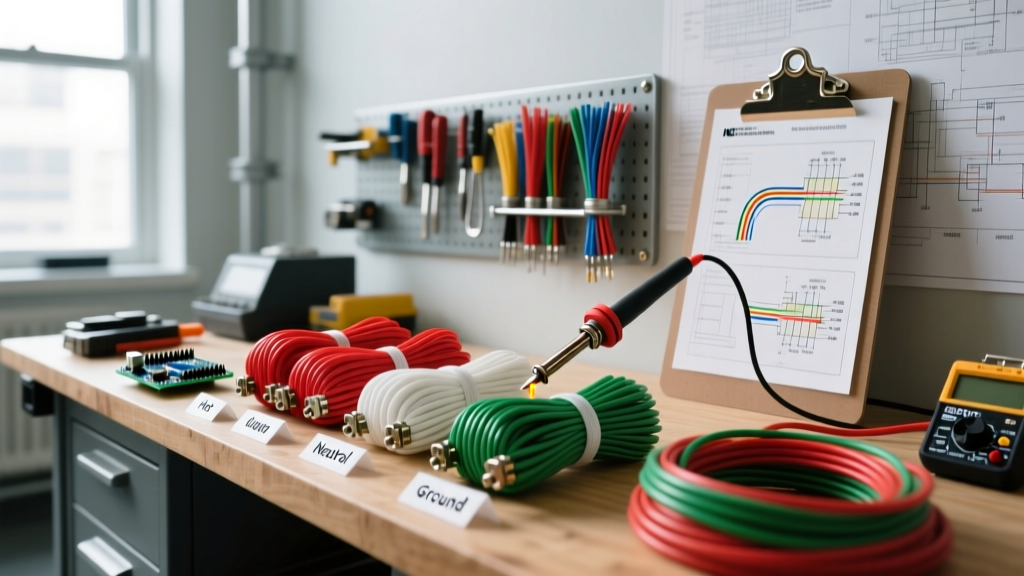
| White / Gray | Neutral (Grounded) | Return Path | Completing the 120V/277V circuit back to the panel neutral bar. |
| Bare Copper / Green | Ground (Equipment Grounding Conductor) | 0V (Fault Path) | Safety fault path to trip breakers; bonded to metal boxes and panels. |
Mandatory Safety Protocols for Unknown Wire Colors
Never assume a white wire is a neutral or a black wire is de-energized. The Occupational Safety and Health Administration (OSHA) mandates strict lockout/tagout and verification procedures for electrical work. When dealing with existing wiring where colors may be faded, painted over, or improperly installed, follow this exact verification sequence:
- Kill the Power at the Source: Turn off the corresponding breaker at the main service panel. If the breaker labeling is suspect, shut off the main breaker to guarantee a dead bus.
- Non-Contact Voltage Test: Use a dual-range non-contact voltage tester (NCVT) to scan the wires. Test the tool on a known live circuit first to verify the battery and sensor are functional.
- Multimeter Verification: Set a True-RMS multimeter to AC Voltage. Measure Hot-to-Neutral, Hot-to-Ground, and Neutral-to-Ground. A reading of 0.0V across all combinations confirms the circuit is dead.
- Continuity Testing: With power confirmed OFF, use the multimeter's continuity setting to trace which wires belong to the same cable sheath or conduit run.
NEC Re-identification Rules: When Tape is Code-Compliant
One of the most common code violations in DIY wiring is the misuse of white and green wires. The NEC has very specific rules regarding re-identification, primarily found in Articles 200.7 and 250.119.
Using White as a Hot Wire (Switch Loops)
In a standard 14/2 or 12/2 NM-B cable used for a switch loop, the white wire is often used to carry switched hot power down to a light fixture. Under NEC 200.7(C)(1), this is permissible, but you must permanently re-identify the white wire as a hot conductor. This is done by wrapping the wire with black or red phase tape at every point where the insulation is visible (both at the switch and the fixture). Failure to do this leaves the next person working on the circuit vulnerable to a lethal shock, assuming the white wire is a safe neutral.
The Ground Wire Restriction
NEC 250.119 is absolute: You can never re-identify a green or bare wire to be used as a hot or neutral conductor. Furthermore, you cannot use green tape on a white wire to turn it into a ground. Grounding conductors must be continuous, unspliced (in most standard branch circuits), and exclusively green, green with yellow stripes, or bare copper.
Pro-Tip for Phase Taping: Do not use cheap, off-brand electrical tape that dries out and unravels over time. Invest in 3M Scotch Super 33+ Vinyl Electrical Tape (approx. $6 per roll). It features a pressure-sensitive rubber adhesive that conforms to the wire and resists UV, heat, and moisture degradation inside junction boxes.
High-Risk Edge Cases in Residential Wiring
Standard color rules often break down in complex circuit topologies. Understanding these edge cases is crucial for avoiding catastrophic miswiring.
Multi-Wire Branch Circuits (MWBC)
An MWBC uses a single 14/3 or 12/3 cable (Black, Red, White, Bare) to supply two 120V circuits that share a single neutral (white) wire. The black and red wires must be connected to opposite phases (e.g., Breaker 1 and Breaker 3) in the panel. If they are accidentally placed on the same phase, the shared neutral will carry the combined amperage of both circuits, leading to an overloaded neutral, melted insulation, and a high risk of fire. Modern NEC requires these breakers to be tied together with a handle-tie or a double-pole breaker to ensure simultaneous disconnect.
3-Way and 4-Way Switch Travelers
In multi-location switching, the wires running between switches are called 'travelers'. In a 14/3 cable, these are typically the black, red, and white wires. In this specific scenario, the white wire is acting as a traveler (a hot conductor), not a neutral. It must be re-identified with colored tape. Attempting to bond a white traveler to a neutral bus or a ground pigtail will result in an immediate dead short and a violent arc flash when the breaker is energized.
Faded Cloth Wiring in Pre-1950s Homes
Homes wired with knob-and-tube or early cloth-sheathed Romex often present a massive safety hazard: the insulation colors have uniformly faded to a dirty gray or brown. In these scenarios, color coding is entirely useless. You must use an advanced tone generator and probe kit (like the Klein Tools Scout Pro 3, approx. $115) to trace individual conductors back to their origin, or hire a licensed electrician to evaluate the system for a complete rewire, as the brittle cloth insulation often flakes off, leaving bare, energized copper exposed inside the walls.
Essential Diagnostic Tools for Color Verification
To maintain strict safety best practices, your toolkit must include reliable diagnostic equipment. Relying on visual inspection alone is a violation of fundamental electrical safety principles.
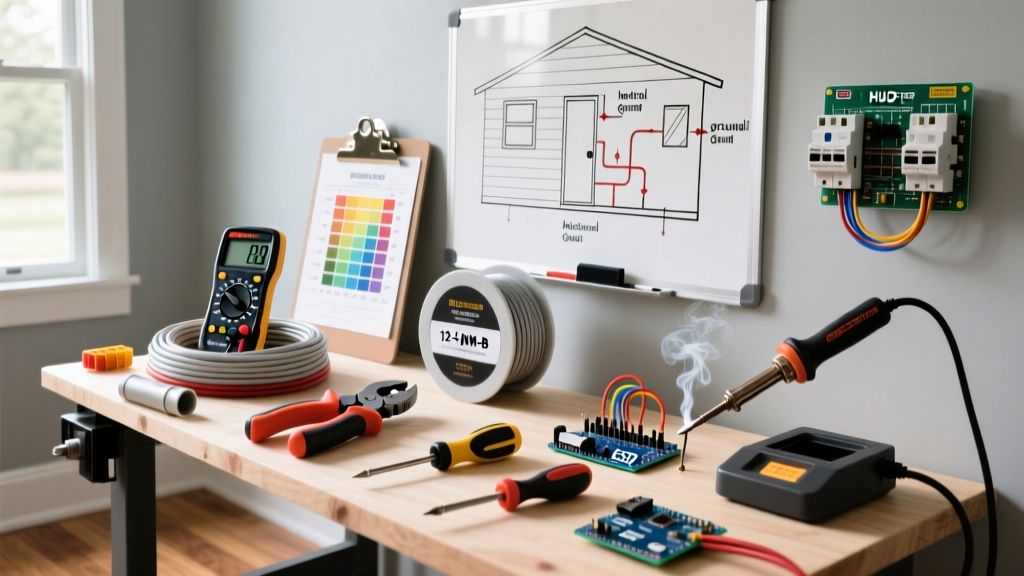
- Fluke 117 True-RMS Multimeter ($215 - $240): The industry standard for voltage and continuity testing. Its VoltAlert non-contact voltage feature provides a secondary layer of verification before you even touch the probes to the copper.
- Klein Tools NCVT-3 Non-Contact Voltage Tester ($35 - $45): Features a dual-range sensor that detects both standard 12-1000V AC and low-voltage 70-1000V AC, making it invaluable for checking thermostat and doorbell wiring alongside mains voltage.
- Southwire Circuit Breaker Finder ($45 - $60): When panel labels are missing or incorrect, this tool plugs into a receptacle and uses an RF signal to identify the exact breaker controlling the circuit, eliminating the guesswork of shutting off the wrong breaker.
Summary: The Safety-First Mindset
Understanding electrical wiring color standards is not just about passing an inspection; it is about preserving life and property. The NEC color codes provide a universal language for electricians, but that language is only safe if it is strictly followed and rigorously verified. Always test before you touch, properly re-identify repurposed conductors with high-quality phase tape, and respect the absolute boundaries of grounding and neutral conductors. For more comprehensive safety guidelines and consumer alerts regarding electrical hazards, consult the Consumer Product Safety Commission (CPSC) Electrical Safety Center. By treating every wire as potentially lethal until proven otherwise, you ensure your DIY projects remain safe, code-compliant, and built to last.