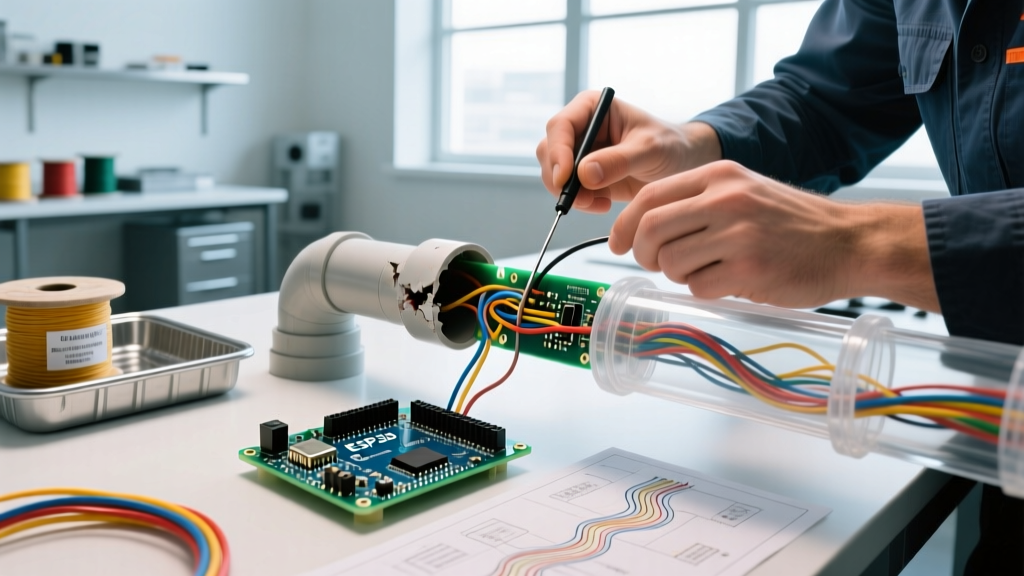

Diagnosing Common Electrical Wiring Pipe Failures
An electrical wiring pipe, universally known in the trade as conduit, is the primary physical barrier protecting conductors from mechanical damage, moisture, and chemical degradation. Whether you are working with Electrical Metallic Tubing (EMT), Schedule 40/80 PVC, or Rigid Metal Conduit (RMC), system failures generally manifest in three ways: pull jams, physical crushes, and moisture ingress. Troubleshooting these issues requires a methodical approach, moving from non-destructive diagnostics to targeted physical repairs.
Before applying excessive force to a stuck wire pull or cutting into a suspected damaged raceway, consult the diagnostic matrix below to identify the root cause.
| Symptom | Probable Cause | Diagnostic Method | Recommended Action |
|---|---|---|---|
| Fish tape refuses to advance past a bend | Conduit crush, debris, or separated coupling | Borescope inspection or compressed air blow-out | Excavate and replace crushed section or reseat coupling |
| Wire pulls smoothly then abruptly locks | Cable jamming at a sweep bend (Jam Ratio issue) | Calculate Jam Ratio (Conduit ID / Cable OD) | Apply high-performance lubricant; use a pulling compound |
| Water dripping from junction boxes or panels | Condensation or failed sealing fittings | Thermal imaging to detect temperature differentials | Install breather drains and EYS sealing fittings |
| Fish tape emerges, but wires won't follow | Exceeding maximum conduit fill capacity | Verify NEC Chapter 9, Table 1 fill percentages | Upsize conduit or reduce the number of conductors |
Step-by-Step Troubleshooting for Stuck Wire Pulls
The most frequent complaint involving an electrical wiring pipe is a conductor pull that seizes mid-run. This is rarely due to the pipe itself failing, but rather a miscalculation in pulling tension or the Jam Ratio.
1. Calculating the Jam Ratio
When pulling multiple conductors or a single large cable around a bend, the cables can wedge against the inner wall of the conduit. The Jam Ratio (JR) is calculated by dividing the inside diameter (ID) of the conduit by the outside diameter (OD) of the cable.
- JR < 2.8: Safe. Cables will lay flat against the outer wall of the bend.
- JR between 2.8 and 3.2: Danger Zone. Cables are highly likely to jam and wedge tightly in the bend.
- JR > 3.2: Safe. Cables will stack or lay side-by-side without wedging.
Example: If you are pulling a cable with a 0.35-inch OD through a 1-inch EMT pipe (which has an ID of 1.049 inches), the JR is 2.99. This falls squarely in the danger zone. To troubleshoot this, you must either upsize the electrical wiring pipe to 1.25-inch or use a specialized pulling lubricant to reduce the coefficient of friction.
2. Advanced Lubrication Dynamics
Standard wire pulling compounds often fail in extreme temperatures or long-distance pulls. For troubleshooting high-friction pulls, upgrade to specialized lubricants. According to data from Polywater Wire Pulling Lubricants, using a high-performance polymer lubricant like Polywater J can reduce pulling tension by up to 50% compared to standard soap-based compounds. For cold-weather pulls (below 40°F), standard lubricants thicken and increase drag; switch to a cold-weather variant like Polywater NN, which maintains its viscosity down to -20°F. Expect to pay between $25 and $45 per quart for professional-grade lubricants in 2026.
3. Managing Pulling Tension
Never use a vehicle or heavy machinery to pull conductors through an electrical wiring pipe. The maximum allowable pulling tension for copper conductors is calculated using the formula: T = 0.008 × cmil. For a 500 kcmil cable, the absolute maximum tension is 4,000 lbs, but industry best practice limits standard pulls to 800 lbs to prevent stretching the copper and thinning the insulation. Use a calibrated tension meter, such as the Greenlee 701 series, to monitor the pull in real-time.
Addressing Physical Pipe Damage and Crushes
Physical damage to the raceway usually occurs during the construction phase or due to environmental settling. Troubleshooting requires identifying the conduit material and applying the correct NEC-mandated repair.
EMT and IMC Crushing
Electrical Metallic Tubing (EMT) and Intermediate Metal Conduit (IMC) are susceptible to crushing when encased in concrete or subjected to heavy vehicular loads. If a fish tape hits a hard stop, use a rigid borescope (like the Klein Tools ET910) to inspect the interior. If the pipe is deformed by more than 10% of its original diameter, it violates the National Fire Protection Association (NFPA 70) code requirements for raceway integrity.
NEC Code Note: Article 300.4 requires that raceways exposed to physical damage must be protected. If EMT is crushed under a concrete slab, you cannot simply patch it. You must cut out the damaged section, install a rigid steel coupling, and pour a protective concrete envelope around the repair.
Schedule 40/80 PVC Cracking and UV Degradation
PVC electrical wiring pipe is highly resistant to corrosion but vulnerable to impact damage in cold weather and UV degradation if exposed to direct sunlight without a UV-resistant rating. If you discover longitudinal cracks in Schedule 40 PVC, the structural integrity is compromised. Repair Protocol: Cut out the damaged section using a ratcheting PVC cutter. Dry the interior completely. Prime and cement a new section using heavy-duty clear PVC cement (e.g., Oatey Heavy Duty Clear). Allow a minimum of 2 hours of cure time before attempting to pull wires, as the solvent fumes can degrade wire insulation if trapped.
Moisture Ingress and Condensation Troubleshooting
Water inside an electrical wiring pipe is a critical hazard that leads to insulation breakdown, ground faults, and catastrophic short circuits. Moisture typically enters via two routes: external infiltration and internal condensation.
External Infiltration
Underground PVC runs are prone to water ingress if the conduit joints were not properly primed and glued, or if the conduit was punctured by landscaping equipment. To troubleshoot, disconnect the power and use a shop-vac with a specialized conduit attachment to extract standing water. Once dry, install O-Z/Gedney EYS series sealing fittings at both ends of the run. These fittings ($45–$85 each) are filled with a proprietary sealing compound that hardens to block water and gas migration between different environmental zones.
Internal Condensation
When an electrical wiring pipe transitions from a cold exterior environment to a warm, humid interior (like an outdoor pole to an indoor panel), the temperature differential causes condensation to form inside the pipe. The Fix: Install breather drains at the lowest points of the exterior conduit run. These small, threaded fittings feature a porous bronze or plastic element that allows liquid water to drain out while preventing insects and debris from entering. Ensure the interior panel is equipped with a thermostatically controlled heater to keep the internal dew point above the ambient temperature.
Conduit Fill Capacity Verification
A hidden cause of "blockages" is simply overfilling the pipe. The NEC strictly governs how much cross-sectional area conductors can occupy to allow for heat dissipation and future maintenance. According to OSHA 1926.405 Wiring Methods and NEC Chapter 9, Table 1, the maximum fill capacities are:
- 1 Conductor: 53% of the conduit's interior cross-sectional area.
- 2 Conductors: 31% maximum fill.
- 3 or more Conductors: 40% maximum fill.
If you are troubleshooting a pull that feels impossibly tight, and your Jam Ratio is safe, verify your fill percentage. Using a digital caliper, measure the exact OD of the conductors (including the jacket). Use a conduit fill calculator app to ensure you haven't exceeded the 40% threshold. If you have, the only code-compliant solution is to pull a parallel run of a larger electrical wiring pipe.
Decision Matrix: Repair vs. Reroute
When an electrical wiring pipe is severely damaged or hopelessly jammed, electricians must decide whether to attempt a complex repair or abandon and reroute the circuit. Use the following 2026 cost and labor matrix to make an informed decision.
| Scenario | Estimated Material Cost | Estimated Labor Time | Recommendation |
|---|---|---|---|
| Minor EMT crush (Accessible ceiling) | $15 - $30 (Couplings, EMT) | 1 - 2 Hours | Repair. Cut and replace the 10-foot stick. |
| PVC crush under concrete slab | $150 - $400 (Concrete saw, patch, RMC) | 6 - 10 Hours | Reroute. Abandon the underground pipe and run EMT along the surface or through the attic. |
| Hopeless wire jam (Long underground run) | $50 - $100 (Lubricant, new wire) | 4 - 8 Hours | Repair/Pull. Cut the stuck wire, use a vacuum to pull a new mandrel line, and retry with Polywater J. |
| Severe moisture ingress (Direct burial) | $200 - $500 (Sealing fittings, new wire) | 8 - 12 Hours | Reroute. If the pipe is compromised underground, water will return. Trench a new Schedule 80 PVC run. |
Final Troubleshooting Best Practices
Successful troubleshooting of an electrical wiring pipe relies on patience and precise measurement. Never brute-force a fish tape or wire pull, as this can snap the tape inside the conduit, turning a simple jam into a catastrophic blockage that requires tearing open walls or excavating concrete. Always verify your Jam Ratio, utilize professional-grade lubricants, and strictly adhere to NEC conduit fill tables. By treating the raceway system as a precise mechanical environment rather than just a hollow tube, you ensure long-term reliability and code compliance for your electrical installations.