
The Shift from Recreational to Commercial RV Electrical Wiring
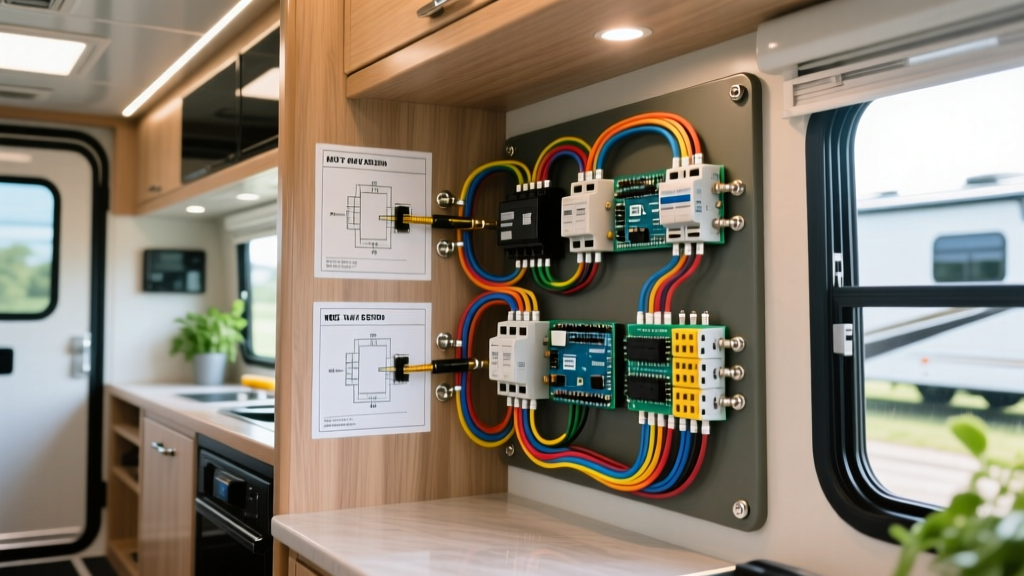
Commercial RV electrical wiring transcends the standard 12-volt lighting and 120-volt outlet paradigms of consumer motorhomes. When outfitting mobile medical clinics, broadcast command centers, or disaster response fleets in 2026, electrical contractors must bridge the gap between recreational vehicle standards and rigorous commercial/industrial codes. A mobile blood drive unit or a mobile PET scanner chassis demands absolute power reliability, heavy-duty load balancing, and strict adherence to both vehicular and healthcare electrical codes.
Unlike standard Class A motorhomes that prioritize lightweight materials and basic appliance operation, commercial RV builds must support continuous-duty HVAC systems, high-draw medical imaging equipment, and redundant server racks. This requires a fundamental rethinking of power architecture, moving away from legacy 12V DC systems toward high-density 48V DC buses and advanced automatic transfer switching.
Navigating Code: NEC Article 551 vs. NFPA 99
The foundation of any RV electrical system in the United States is governed by the National Electrical Code (NEC). Specifically, NEC Article 551 covers Recreational Vehicles and RV parks, dictating everything from cord caps to grounding electrode systems. However, when an RV is commissioned for commercial medical or clinical use, it crosses into the jurisdiction of NFPA 99 (Health Care Facilities Code).
Under NFPA 99, mobile medical units performing wet procedures or utilizing life-support equipment must integrate an Isolated Power System (IPS) and adhere to Essential Electrical System (EES) branching requirements, effectively treating the vehicle as a micro-hospital.
For commercial command centers or broadcast trucks, the NEC Article 551 framework still applies to the base vehicle wiring, but the internal build-out often defaults to standard NEC Article 300 wiring methods (using rigid or liquid-tight metallic conduit) rather than the flexible, stapled wiring methods permitted in consumer RVs by the RV Industry Association (RVIA) ANSI/RVIA LV standards.
Commercial Power Architecture: The 48V DC Standard
In 2026, the commercial fleet sector has almost entirely abandoned 12V DC architectures for high-draw applications. The physics of voltage drop over the 30-to-45-foot lengths of a commercial trailer chassis makes 12V systems dangerously inefficient. For example, a 4,000W inverter pulling from a 12V battery bank draws over 330 amps, requiring massive, heavy 4/0 AWG welding cable. By stepping up to a 48V DC architecture, the amperage drops to roughly 83 amps, allowing the use of much lighter and more manageable 2 AWG wire.
Core Components for a 48V Commercial Build
- Inverter/Charger: The Victron Energy Quattro 48/10000/140-100/100 is the industry standard for commercial fleets. It provides 10,000VA of continuous power, features dual AC inputs (shore and generator), and includes an integrated 140A MPPT charge controller.
- Energy Storage: Server-rack style 48V LiFePO4 batteries (such as the EG4 48V 100Ah server rack models) are preferred over drop-in 12V marine batteries. They offer built-in BMS communication via CAN bus, allowing the Victron system to dynamically adjust charge profiles based on real-time cell temperatures.
- Transfer Switching: An ASCO 300 Series Automatic Transfer Switch (ATS) is hardwired to manage the transition between 50A/100A shore power and the onboard diesel generator (e.g., Cummins Onan QuietDiesel 12.5HDKCA), ensuring zero-drop power for sensitive medical servers.
Wire Selection: SAE J1128 vs. THHN in Liquid-Tight
Consumer RVs typically utilize SAE J1128 (GXL or TXL) stranded automotive wire, which is thin-walled and rated for high temperatures but lacks the physical protection required in commercial environments where chassis flex and road debris are constant threats. For commercial RV electrical wiring, contractors must upgrade the physical routing methods.
| Wire Type | Standard | Temp Rating | Best Commercial Application | Est. Cost/Ft (2026) |
|---|---|---|---|---|
| SAE J1128 (GXL) | RVIA / Auto | 125°C | Low-draw 12V DC lighting circuits | $0.45 |
| Ancor Marine Tinned | UL 1426 | 105°C | 48V DC bus and battery interconnects | $1.85 |
| THHN/THWN-2 | NEC 310 | 90°C | 120/240V AC pulled in liquid-tight conduit | $0.35 |
For all 120V/240V AC commercial circuits, pull standard THHN/THWN-2 stranded copper wire through flexible non-metallic liquid-tight conduit (Carflex). This provides a 90°C temperature rating, protects against moisture ingress in the underbelly, and allows for future circuit upgrades without tearing out interior cabinetry. For the DC side, marine-grade tinned copper is mandatory to prevent galvanic corrosion caused by the harsh, high-vibration, and high-humidity environment of a mobile chassis.
Grounding, Bonding, and the Isolated Power System
Proper grounding is the most frequently failed inspection point in commercial RV builds. NEC 551.54 mandates that the RV's chassis must be bonded to the electrical system's equipment grounding conductor (EGC). However, in mobile medical clinics, standard grounding is insufficient for sensitive diagnostic equipment like mobile X-ray or ultrasound machines, which are highly susceptible to ground loops and electromagnetic interference (EMI).
Implementing Isolated Grounds (IG)
To protect sensitive commercial equipment, install Isolated Ground (IG) receptacles (identified by an orange triangle). The IG wire must be run all the way back to the main distribution panel's isolated ground bar, completely bypassing the metallic conduit and sub-panel enclosures. This prevents stray currents from the vehicle's alternator or chassis-mounted motors from introducing noise into the medical imaging circuits.
Wet Location Compliance
If the mobile unit includes a surgical suite or a wet-procedure lab, NFPA 99 requires an Isolated Power System (IPS). An IPS monitor (such as the Bender ISOMED series) continuously measures the total hazard current from the isolated power supply to ground, triggering an audible and visual alarm if the leakage current exceeds 2mA or 5mA, long before a standard GFCI or breaker would trip.
2026 Cost Analysis for Commercial Fleet Outfitting
Outfitting a commercial RV chassis with a heavy-duty, code-compliant electrical system is a significant capital expenditure. Below is a realistic 2026 cost breakdown for a complete 48V/120V electrical overhaul in a 35-foot mobile command or clinic trailer:
- Victron Quattro 48/10k Inverter/Charger: $4,200
- 48V LiFePO4 Server Rack Batteries (200Ah Total): $3,400
- ASCO 300 Series 100A ATS: $1,450
- Hubbell 4100R7W 100A Pin-and-Sleeve Shore Inlet: $380
- Wiring, Carflex Conduit, and Lugs: $1,250
- Custom Powder-Coated Distribution Panel: $850
- Specialized Labor (80 hours @ $135/hr): $10,800
- Total Estimated Electrical Build Cost: $22,330
This investment ensures the vehicle can operate completely off-grid for 12 to 18 hours while running commercial HVAC and server loads, a critical requirement for disaster response fleets and mobile blood banks.
Frequently Asked Questions
Can I use standard Romex (NM-B) wire in a commercial RV build?
No. NEC Article 334 restricts the use of NM-B cable to dry, indoor, residential locations. The constant vibration, flexing, and potential for moisture exposure in an RV chassis will quickly degrade the paper wrapping and expose the bare ground wire, leading to short circuits. You must use stranded THHN in conduit or specialized RV-rated flexible cables.
What size shore power cord is required for a commercial mobile clinic?
Most commercial mobile clinics require a 100A, 125/250V single-phase service. This necessitates a 3-pole, 4-wire pin-and-sleeve connector (such as the Hubbell 4100R7W) rather than the standard 50A NEMA 14-50 plug found on consumer RVs. Ensure the RV park or deployment site has the appropriate commercial pedestal infrastructure.
How do I handle fire-stopping where wires pass through the RV floor?
Any penetration through the RV's floor or interior fire-rated bulkheads must be sealed with an intumescent fire-stop sealant, such as 3M Fire Barrier Sealant CP 25WB+. This prevents the spread of toxic fumes and flames through the chassis cavities in the event of an undercarriage fire, a strict requirement for commercial fleet insurance compliance.